Published
Part 2
Are there everyday places, spaces, or devices which intrigue you by the way they sound? Which are these?
Stairwells, bathrooms, the threshold moments when you pass from one ordinary space to another and the sound profile totally changes (whether resonance echo/reverb/filtering, or the sounds of other beings.)
I used to work in a garden center next to a doggy day care – closing the closet door where the light switches were always made all the dogs in there bark, which was such a funny, quirk of [this door], hearing the chaos of 30 dogs barking through the wall.
Finland has an uncanny ability to make crowded places quiet—metros and buses and public squares can be so surpirsingly silent here.
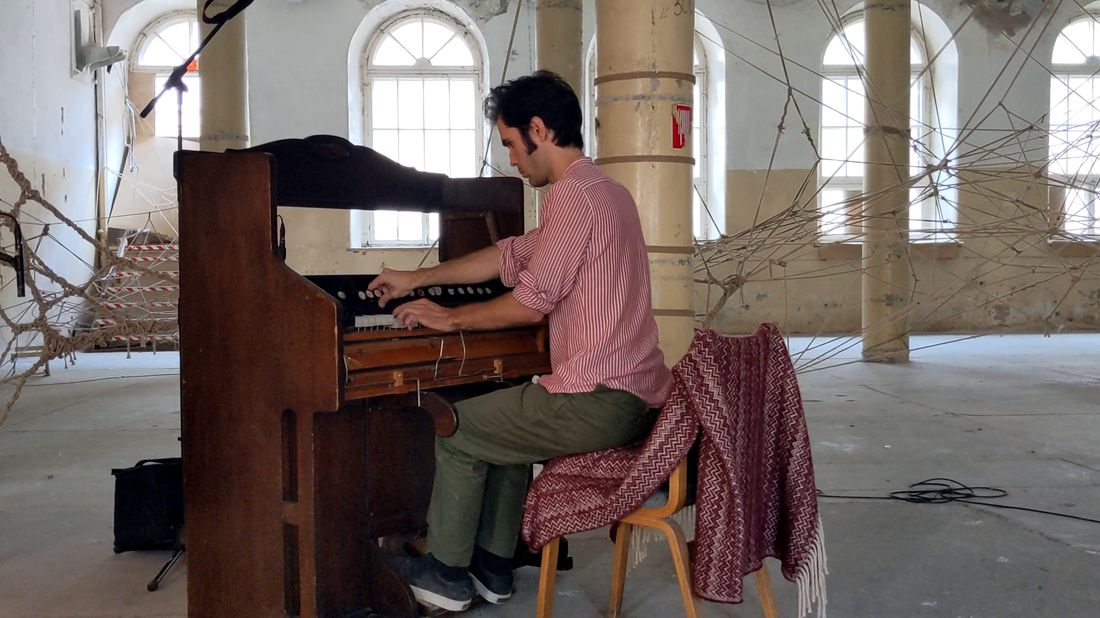
When exploring the abandoned Kreenholm Factory during my residency in Narva, it was incredible to imagine these remarkable spaces, now empty, in/as their everyday context – a normal office, a normal break room, elevator, utility closet, machine room, with personal artefacts like stickers and letters left as they were. There was a time when you needed to wear ear protection just to be in some of those spaces.
These complementary/contradictory characteristics, where now the factory floors were emptied of machines and labor – ordinary spaces made extraordinary. The sonic character was always mingling with this sense of the past uses and experiences and characters that passed through them.
A dining hall stood out for its remarkable mural; a store-room for its piles and piles of empty fabric spools, the tower which grants a view of the whole surrounding area (though mostly what you hear is the transformers powering the network infrastructure that makes use of it), and of course the massive reverberant factory floors.
Have you ever been in spaces with extreme sonic characteristics, such as anechoic chambers or caves? What was the experience like?
The spaces I made these recordings in, as well as the other collaborative performances during that residency, were all super reverberant in quite different ways. I had spent a few days walking around with my cello, with the harmonica, with found percussion objects, just sounding and playing and seeing what carries where and how – no formal acoustics training, just playing and exploring intuitively.
As much as I was drawn performatively to the biggest and longest of these spaces (where I did do one concert and live recording with Estonian folk bagpipe (torupill) player Katariin Raska), slightly smaller square ones seemed the most balanced in terms of the lower frequencies reverberating as well, which is where you hear the cello and for harmonium on this record.
This process was such a rewarding dialogue with the space – alongside the sonic aspect, learning about the history of the spaces, and knowing that in their historical use as a factory, they would have been chaotically loud with textile machines running all day, and the loss of the livelihoods and a big part of the lifeblood of Narva as the factory began laying off workers and shutting down, all added up to shape how I approached the playing.
I had the chance, once, to visit an anechoic chamber. I’d like to say it’s just like you’d imagine, but I suppose it’s hard to imagine without being there. Your attention is drawn to different things as time goes on, maybe a process of peeling away layers, as there’s such minimal input form your surroundings, and even the sounds you make seem to die right after they leave your mouth. It humbles you and quiets you down too.
What are among your favourite spaces to record and play your music?
This room in Kreenholm definitely ranks among my favorites.
Because the factory is not in use, and it’s a restricted area (it’s still technically privately owned and semi-preserved, and it’s at a sensitive border area, so I needed authorization to get into the facility—some of the few lines of Russian I managed to learn in order identify myself to the intercom at the entry gate), it gave me the unique opportunity to spend as long as I wanted in there exploring the factory, finding sounding objects and unique spaces, little histories and interventions by other visitors (human and non-human).
A few months later I had the chance to do something similar (although compressed into just one day) in an empty rail factory space near Lyon, France; the washroom there was so wonderful for the sound of the cello. Happily, it’s being reused and transformed into a concert/cultural center …
I’m also wary of this “abandoned porn“ idea that can be attached to any anonymous abandoned space. It’s definitely not something I want to promote as transferable, like “find any abandoned space and make music in it!“
These are all places attached to particular communities and livelihoods—I know I’m writing a lot about sound abstracted from everything else, but I think it’s important to keep context and ethics in mind. There are a lot of complicated stories and politics tied up in spaces like these.
Excluding sound, I’ve been hosting an improvised music series at a wonderful little bar in Helsinki, “Musta Kissa“ (black cat), since spring 2025 – the mix of great musicians, a curious and welcoming audience, and a relaxed atmosphere have made it a favorite place to play recently. Having this little home here has been such a blessing as I’m settling in to my new home city.
Elastic Arts back in my former hometown Chicago was one of those spaces as well; well, lots of these little improv spaces around that wonderful city – it’s a wonderful community there, which really is incomparable to any other I’ve come across so far.
Do music and sound feel “material” to you? Does working with sound feel like you're sculpting or shaping something?
I would say no – I do imagine “holding“ it in the sense of holding or maintaining the space, energy, or the thing that I’m/we’re building over time (these are all sounding like very material words now as I’m typing), but for me this can often feel more like carrying a thread through time, keeping it up, maintaining it in a/the moment, over the course of time.
I don’t know, it doesn’t feel like material, it’s just sound, it’s music, it’s that thing, and I can’t control it the way maybe I could a material. I feel more like I’m trying to do some things to help it happen in just the way it needs to in this moment, but I’m not the master of it, directing it from above.
I’m much more interested in … I don’t know, humbly working with it, seeing what it needs to be, listening to it and breathing with it. I guess sculpture is working with the nature of a material too, but I feel like that situates music and sound as somehow passive, and I don’t think that’s the case.
“If you take care of the music, the music will take care of you“ – I don’t remember where I first read this, but I remember Angel Bat Dawid repeating it some years ago; it seems it’s attributable to Roy Hargrove. I can’t find the video now, but I remember a clip of Jerron Paxton checking in with his banjo before starting a session, “how are we feeling today?“
I think that also sums it up nicely – collaborating with it (the music, the instrument, the space, etc.), not „making“ it happen.
How important is sound for our overall well-being and in how far do you feel the "acoustic health" of a society or environment is reflective of its overall health?
I live right next to a big highway in Helsinki; my bedroom window faces it – the low hum/rumble (when the window is closed) is persistent, and when it’s open or I’m walking to the grocery store, the noise is a real intrusion into your life.
And of course there’s plenty of research on the effects of the sound of things like airplanes and highways on humans and other beings—these are things “normal“ to our society’s operation … Policy and the world we’ve built are an expression of our values – capital and industry favors efficiency and ever-smoother exchange, so worrying about such an invisible, supposedly-immaterial thing as sound doesn’t make any sense.
I much preferred the city sounds when I lived in more of a neighborhood setting in Chicago, where the soundscape felt a little more humane, even if the relative noise level might have been the same … and yeah, it makes people stressed and agitated, and people are who make the decisions which shape our world, so I’d say we’re not in a good place in terms of acoustic ecology ...
Many animals communicate through sound. Based either on experience or intuition, do you feel as though interspecies communication is possible and important? Is there a creative element to it, would you say?
I think we have to be careful when deciding what’s interspecies communication (for us? for them?); non-anthropocentric definitions/processes ... But yes, I’d say it’s possible to have contact with other species.
Is it important? Only if we’ve got something good to say.
Is there a creative element to it? I would imagine play is the key – at least for us humans. A sense of playfulness and imagination; to start without purpose, transaction, trade in mind.
Tinnitus and developing hyperacusis are very real risks for anyone working with sound. Do you take precautions in this regard and if you're suffering from these or similar issues – how do you cope with them?
I remember becoming aware of my tinnitus in late 2022, when I was living in Tallinn.
I don’t remember why it happened or started—it didn’t feel like it came as a 1-1 result of some recent sonic experience, kind of out of nowhere after I had a flu or something—but it was definitely distressing when I would think about it early on, when my attention was drawn to the sound.
Now it generally fades into the background (fortunately it’s not so bad that I can’t “ignore“ it), and I try not to get hung up on it, but, like the gray and darkness that’s coming in as winter arrives in Finland now, not to let it keep me down.
And now I for sure put in earplugs more quickly – and have very little patience for musicians who don’t seem to be mindful of what they’re putting their audience through. I’m quicker to be that person with their fingers in their ears looking a bit annoyed during your set because you made me do this!
We can surround us with sound every second of the day. The great pianist Glenn Gould even considered this the ultimate delight. How do you see that yourself and what importance does silence hold?
I’m wary of this phrasing because of the attention economy that tries to intrude into our lives more and more – there’s so much commercial focus on ways in which our time can be filled with content; our senses, peace of mind, attention are commodities. Nowadays it can be noteworthy to just be on the bus without having something playing on headphones; not that I think that’s better than listening to music or anything.
I think my response to this is more to do with the “quality“ of the sounds you're filling your day with, or why, or who’s doing it. More sound, content, or access to it is not necessarily better.
As I write this, it’s still the cars and trucks on the highway; did Glenn Gould live in the suburbs?
Seth S. Horowitz called hearing the “universal sense” and emphasised that it was more precise and faster than any of our other senses, including vision. How would our world be different if we paid less attention to looks and listened more instead?
Likely everything from urban design to ecological sensitivity would be a lot more holistic.
And we’d maybe have more fun jingles in advertisements – I guess advertising and the attention/content economy would have a much different complexion; not better or worse, just different.