Published
Part 2
Music has become a lot more global. Do you still think there are city scenes with a distinct, unique sound?
Ingebrigt: I feel that many cities still hold on to strong musical identities. Amsterdam and Berlin remain vibrant, even as political support for the arts there, just in many other cities, has pulled back in recent years.
As a band we have always been influenced by the musical histories of areas we’re from like Houston, Dallas, Fort Worth, Chicago ... These are places where avant-garde jazz, experimental rock, psychedelia, and hip-hop have long coexisted, and that openness really speaks to me. It shapes how we approach our music and contributes to the urgency in our improvisation.
There’s also something in the Scandinavian progressive jazz scene—its sense of space and texture which I'm deeply inspired by —that I feel comes through in what we do as well.
About the Texas scene; I was once asked by Stefan to sub in his band with Ronald Shannon Jackson while I was living in Austin, but I was heading out on a European tour and couldn’t do it. I still think about that missed chance—he’s gone now, but his influence is lasting!
Stefan: Sure, but maybe it's a little difficult to say with all the mass amounts of information out there. I feel like I will be better suited to answer this question in another 5-10 years.
With the shitstorm of fascism on the rise worldwide, I think we have to wait and see what changes happen as a reaction to this state of oppression that we are surviving. Too soon to say.
But I do believe a new wave of creative and regional authenticity will come in the not so distant future.
What role do electronic tools and instruments play in your creative process?
Ingebrigt: Electronic tools are essential to my creative approach. In The Young Mothers, the addition of modular synths, samplers, and live electronic processing — especially from Jawwaad and Frank—adds a deeper dimension to the music. I think our latest album Better If You Let It reflects this well.
I see technology as a tool for expanding expression— I was introduced early to this blend of acoustic and electronic music through Bugge Wesseltoft’s New Conception of Jazz, a group I was lucky to tour with extensively. Bugge brought me all around Europe and to Australia and Japan for the first time, and that period was hugely important in my development as a young musician.
And then later, albums like Kid A by Radiohead, Massive Attack’s debut, and Donuts by J Dilla have also been lasting inspirations for how electronics can fuse with jazz sounds.
[Read our Bugge Wesseltoft interview]
[Read our Bugge Wesseltoft interview about improvisation]
Stefan: None for me, as I'm terrible with these kinds of technologies. However I do appreciate all my friends and collaborators that go this route.
The electronic work brought to this band by Jawwaad, Ingebrigt, and Frank is great and important to our sound, not selling that short. I am just not the one in control of these technological processes.
Jazz has always had an interesting relationship between honoring its roots and exploring the unknown. How does this balance manifest in your music?
Ingebrigt: I’ve always been drawn to exploring the balance between tradition and experimenting, structure and freedom across all of my projects, and The Young Mothers definitely thrive on that duality.
For me, our music channels the foundational energy of Great Black Music, but without following any fixed formula. I feel the past is always present in what we do, but we’re constantly trying hard to push it forward into something new.
One track that stands out and exemplifies this for me—though it didn’t get much attention—is “Shanghai,” the closing track on MOROSE.
Jason brought it in as a love song to his wife Ruthie. He sings, Jawwaad raps, there’s noise, and it’s also one of the few times I’ve played a straight-up “jazz bass” solo on a recording.
It’s a strange mix, but I think it's a really beautiful one.
How much potential for something “new” is there still in jazz?
Ingebrigt: We’re living in the ‘post post world’ where everything has been done but I believe there's always something new. I think our maximalist approach in The Young Mothers reflects the idea that jazz’s future remains wide open and unpredictable, haha.
At the same time, I believe it’s essential to understand the history we’re building on in order to move things forward. I see myself and our scene as part of a long lineage of creative music, going all the way back to artists like King Oliver and Scott Joplin.
But for me, jazz isn’t about preservation—it’s about possibility. One of my big heroes in that regard today is Ben LaMar Gay.
How do your live performances and recording projects influence each other?
Ingebrigt: For sure live performance and studio work are completely connected in The Young Mothers.
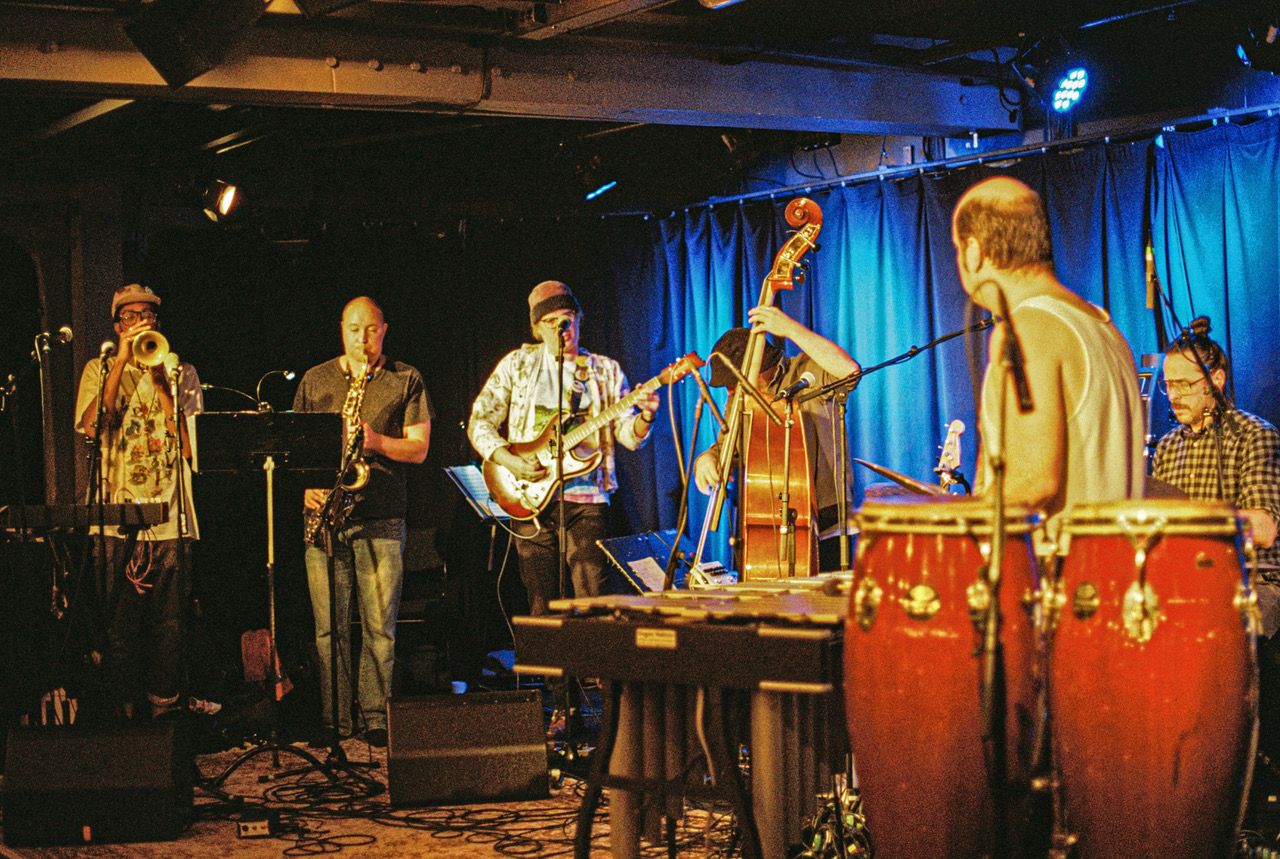
All of our albums have taken shape in the studio, and those sessions often became the starting point for how we approached the music live. We often shape forms and arrangements together, and always leave room to stretch. As improvisers, we live for those moments when the music takes on a life of its own.
For me, the relationship between live and studio feeds into the other. A good example of that is “The Wood,” the first track on our debut album.
That piece came together in the studio, it got an interesting form that changes a lot through the song, and it pushed us to really figure out how to recreate and evolve that in performance.
What are the key ideas behind your approach to improvisation?
Ingebrigt: Improvisation is about trust, dialogue, and taking risks. I try to approach each performance with a balance of structure where the music is intentional but still feels alive and open. I think it’s important to keep pushing, challenging myself and the people I play with, and staying open to the unknown every time we step into the music.
One of my biggest inspirations in free improvisation is Karyōbin by John Stevens’ Spontaneous Music Ensemble from 1968. The way Stevens, Derek Bailey, Kenny Wheeler, Evan Parker, and Dave Holland interact on that recording still feels groundbreaking to me.
You can hear them carving out something completely new—that was recorded almost 65 years ago and that sense of discovery continues to inspire me.
Do you personally feel it’s important that everything should remain available forever, or is there beauty in fleeting musical moments?
Ingebrigt: Good question! Archiving is obviously crucial for preserving history, not least for being able to revisit the history and learn from the greats, not to mention the incredible feeling of going record hunting after that ‘one’ album.
But there is also something irreplaceable about the ephemeral nature of live performance. Not every moment needs to be captured—some experiences are meant to exist in the moment.
I have countless examples of concerts really I wished were recorded, but at its core, jazz is, above all, about the present.