Published
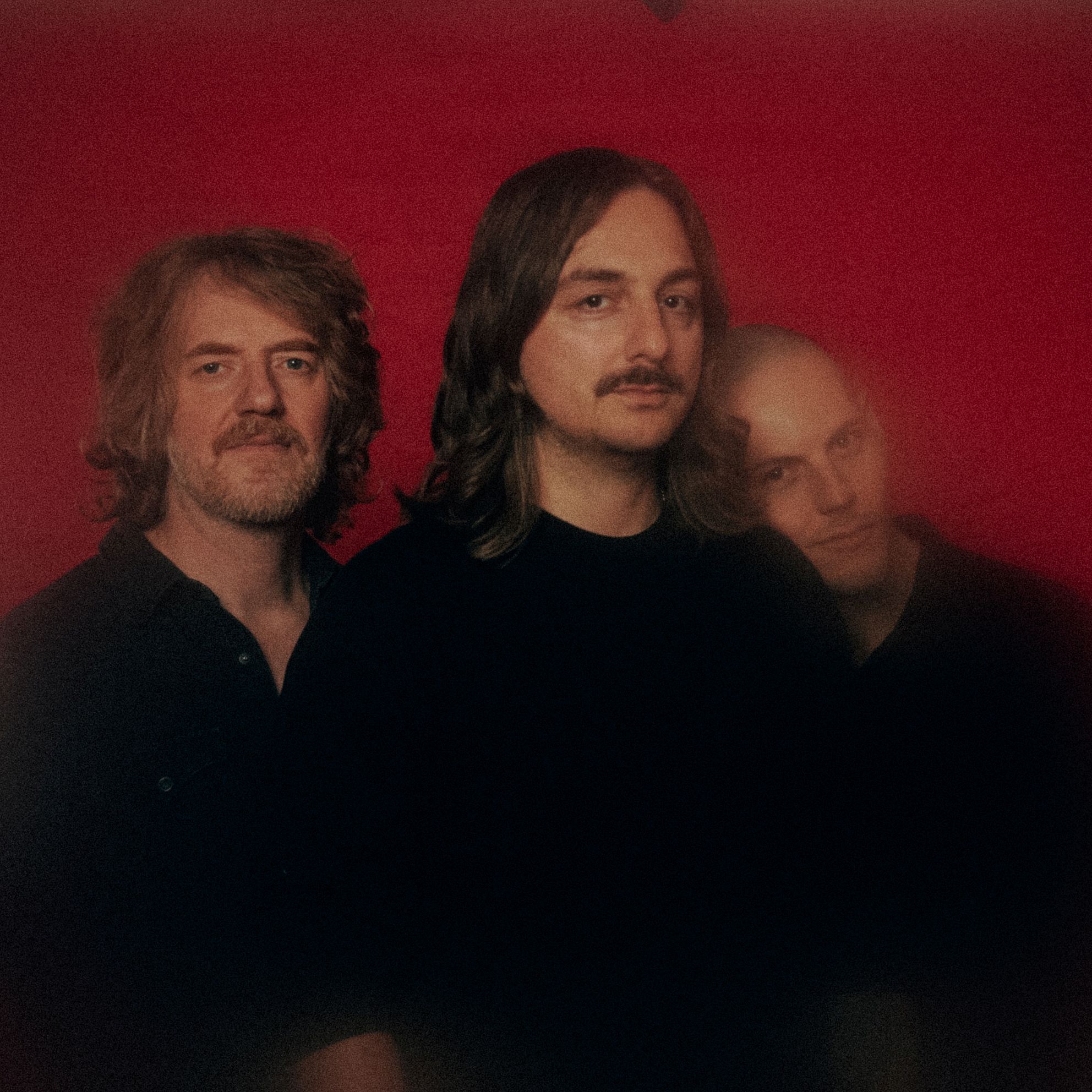
Name: ZAHN
Members: Felix Gebhard (guitar), Chris Breuer (bass), Nic Stockmann (drums)
Interviewee: Felix Gebhard
Nationality: German
Current release: ZAHN's new album Purpur is slated for release February 20th 2026. First single "Solex" is out now. Pre-order at Crazysane Records.
Recommendations for Berlin, Germany: Bis Aufs Messer Records, Marchlewskistr. 107 in Berlin-Friedrichshain. Best record store in town.
Recommendations: Zement – Passagen (Crazysane Records, 2025); Tausend Augen – Westend (This Charming Man Records, 2021)
[Read our Zement interview]
[Read our Zement interview about krautrock]
If you enjoyed these thoughts by ZAHN and would like to stay up to date with the band and their music, visit them on Instagram, Facebook, and bandcamp.
For a deeper dive, read our earlier ZAHN interview.
How would you describe your personal relationship with Krautrock? When and how did it start?
I became aware of Krautrock by taking a detour via Chicago in the mid-90s.
When I discovered Tortoise’s album Millions Now Living Will Never Die, I learned about the genre Krautrock probably by reading an article about Tortoise in a magazine.
That eventually lead me to checking out albums by Neu! and Can, and I remember being surprised that this was music written and played by Germans.
I had Kraftwerk’s Electric Café as a bootleg cassette, purchased on a school trip to Hungary in the 80’s, but I had no idea about the band’s older albums.
The term Krautrock stayed obscure to me for a long time.
Tell me about one or two of your favourite Krautrock records please.
No deep cuts here: first Neu! album and Tago Mago by Can.
[Read our Michael Rother of Neu! interview]
Krautrock always seemed like a phenomenon connected to a very specific era in German history. What about this music and its time do you connect with?
I am too young to have been aware of Krautrock when it happened. These albums didn’t exist in my parents’ record collection. So everything I know about it I learned in retrospect.
But, growing up in Germany in the 70s, I have plenty of more or less precise images and quasi-images in my head that, for me, amount to my vision of that time. So I probably place the music somewhere in that puzzle of images.
Many of the original Kraut musicians loved blues, rock, and psychedelia; they were intrigued by electronics and improvisation; they rebelled against virtuosity, classical education and the superficiality of Schlager on German radio. How much of that do you recognise in your own creative preferences and interests?
When I started making music I didn’t have any theoretical knowledge of music, I could only explain musical ideas by referring to certain bands or ways of expression or instrumentation.
When I was a kid I listened to a lot of different types of music without being able to differentiate between certain genres or styles, it was all the same to me. I discovered punk rock and hardcore in 1987, which was when I first felt that music could be some sort of rebellion at all.
It was fun to take my Black Flag Live ’84 cassette to listening day in my music class at school to annoy my fellow students by having the teacher play the entire eight minutes of “The Process Of Weeding Out.”
But really, I don’t think it’s easy to rebel through music nowadays. Everything has been done, nothing’s shocking anymore.
Both in the music and the way it was made, Krautrock was about imagining different worlds. What is the experience of listening to this music like for you and what kinds of worlds is it taking you to? What is your preferred way of listening to it?
I don’t think it’s taking me to any different worlds but I like Can and Neu! especially for their rhythmic approaches.
My preferred way of listening would be through a good stereo or set of headphones.
A lot of the Kraut spirit came to life through musicians living in communities, playing and recording together every single day. Have you ever tried working and creating in such a constellation? Is it possible to emulate this process from a home studio?
I haven’t lived in any communities like that, but I’ve worked on music in duos or groups in situations where we temporarily set up recording equipment at odd places that weren’t necessarily designed as studios – somebody’s parents’ house in the countryside, for example – and then played and recorded there.
Zahn’s music usually gets recorded at Die Mühle, a studio in the North German outback without any urban distractions around. Escaping from your day-to-day life and going to some ‘remote‘ place to do creative work can result in something good.
But then there’s usually a deadline, which a home studio doesn’t have. A combination of both things might be key, I guess.
What, to you, are the main elements that make something “Kraut?” What are the practises of the musicians from the 70s that inspire your own practise today?
I have to admit that I’m a bit skeptical about the term Krautrock, knowing that many of the protagonists of the genre back in the day despised being categorized like that despite the different bands’ vast musical diversity.
If there’s one thing I feel might have been a common approach to making music back then and there, which I hope to include in my own musical practise, it is keeping a nonchalant attitude towards commercialism and an interest in exploring music outside of established structures of how long or loud etc a piece of music should be.
Having said that (and jumping back to me playing Black Flag tapes at school) – none of this is in any way new or revolutionary today.
What instruments or equipment are you using to create your music? Are there any vintage instruments that you find essential to get your sound right?
Aside from a tape echo (which is broken most of the time) and some older amplifiers I don’t own any ‘vintage’ instruments.
I really don’t have any strict preferences, either – if something sounds good, it’s good. Even if it was manufactured only last year.
Tell me a bit about the role that improvisation and inventive arrangement techniques (like cut-up) play for your work?
In Zahn we use improvisation only to see where a certain part can lead us, how we can combine it with other parts etc, but we don’t basically go out and improvise per se – our music is usually composed.
I occasionally dabble in electronic music and do recording sessions where I let a bunch of synthesizers and other instruments run through effects chains, tweak a little here and there on the way, and then later edit these jams, cut out a fragment and make it into a sequence or a loop, to build something from that.
Implementing improvisation (or not) depends on the project and the people involved.
I got into Kraut via Tangerine Dream and early Ash Ra and to me, the motoric beat was never quite as important. Today, it seems as though it's the defining element. Are you interested in it? Are you making use if it? What makes it special to you?
While I appreciate all sorts of drone music and have listened to Ash Ra Tempel’s Amboss/Traummaschine album quite a bit, a good beat always makes me happy and keeps me interested longer.
Jaki Liebezeit’s drumming is probably what I love most about Can.
[Read our Ash Ra Tempel's Manuel Göttsching interview]
Did you ever visit one of the birthplaces of the genre – Berlin, Düsseldorf, Munich – or any spaces related to the history of Kraut? Do you own any paraphernalia from the era?
I live in Berlin and have been to Düsseldorf and Munich many times but haven’t done any genre-specific sightseeing yet.
And I don’t own any paraphernalia, no.
Are there approaches, artists, festivals, labels, spaces or anyone/-thing else out there who you feel deserve a shout out for exploring interesting directions for Krautrock?
I don’t know of any festivals specifically for Krautrock, but in Germany there are a few that seem to be driven and curated not solely by capitalist standards, but with the aim to present an eclectic and colorful programming without relying upon the sales value of a middle-of-the-road line-up.
Herzberg Festival, Orange Blossom and Haldern Pop come to mind here.
Several of the original Kraut pioneers recently passed away or withdrawn from making new music. If some of your personal favourite artists were affected as well – can you share a little what did their music meant and means to you?
Jaki Liebezeit died some time ago now, but I had the pleasure of seeing him play live with his duo with Burnt Friedman around 2010, which was quite the mind-expanding experience.
His way of playing was so effective and powerful, yet effortless and cool. I actually think back to that show quite regularly.