

Name: Adam Rudolph
Nationality: American
Occupation: Composer, percussionist
Current Release: Adam Rudolph's new album Invisible Threads, featuring Ahmet Hacı Tekbilek (ney), Jesper Egelund Pedersen (bass, electronics), Marco Cappelli (classical prepared guitar, electric guitar), Okay Temiz (tuned bells, cuica, waterphone, talking drum, thumb piano, darbuka, wood blocks, percussion), Özlem Kaya (violin), Sıla Gerbağ (bass, C flute), and Sumru Ağıryürüyen (vocals) is out September 18th via Omni Sound. It is released in memory of Hacı Ahmet Tekbilek, who passed on August 3, 2026.
Things that you are passionate about but rarely get to talk about: I practice Tai Chi Chuan every day and paint and write. What we are reaching for in music is to become music: to live in harmony with our fellow beings, to be in tune with nature (inner and outer) and in rhythm in our physical, mental and spiritual health.
If you enjoyed this Adam Rudolph interview and would like to find out more about his music, visit him on Facebook, and bandcamp.
For a deeper dive, we recommend reading the thoughts of one of his collaborators:
[Read our Wadada Leo Smith interview]
Where does the impulse to create something come from for you? What role do often-quoted sources of inspiration like dreams, other forms of art, personal relationships, politics etc play?
For me, inspiration is the spark that ignites creative ideas and action.
Although much has been written about it, its source remains a mystery. The energy of human mind/feeling activity may be transmitted and received in ways that we do not yet understand.
Whatever the source, when inspiration does come to me, I meet it with respect and gratitude.
For you to get started, do there need to be concrete ideas – or what some have called a 'visualisation' of the finished work? What does the balance between planning and chance look like for you?
I let the music guide my creative listening and relaxed resonance.
Bringing it forth is like being a midwife.
Is there a preparation phase for your process? Do you require your tools to be laid out in a particular way, for example, do you need to do 'research' or create 'early versions'?
I listen to my own consciousness - which include the unconscious.
There is no one process I use. I try many approaches. New creative processes yield prototypical art.
Do you have certain rituals to get you into the right mindset for creating? What role do certain foods or stimulants like coffee, lighting, scents, exercise or reading poetry play?
The first thing I do when I enter my studio is go direct to my hand drum set and see what the drums have to say to me that day.
Later I will move to other compositional activities. But the hand touching the drum is the aboriginal source of all of them.
Tell me a bit about the way the new material on Invisible Threads developed and gradually took its final form, please.
For me, intuition reigns supreme in the act of creating music. The gift of intuition exists only in its own moment. I always attempt to give myself the mental space and spiritual conditions under which it can flow freely.
Craft gives us freedom to say what we feel and the intellect provides process and context. But it is intuition which is the voice of inspiration and the energetic core of playfulness in creativity. Intellectual processes can be codified, repeated, taught, and explained. But we can never go back and repeat the intuitive process again.
Intuition leaves no trace of itself.
Once a piece is finished, how important is it for you to let it lie and evaluate it later on? How much improvement and refinement do you personally allow until you're satisfied with a piece? What does this process look like in practice?
No one way … Intuition, deep listening and experience are called upon.
How do you think the meaning, or effect of an individual piece is enhanced, clarified or possibly contrasted by the EPs, or albums it is part of? Does each piece, for example, need to be consistent with the larger whole?
For me it does. Most all of the recording I have done, I consider a kind of suite with several movements.
After finishing a piece or album and releasing something into the world, there can be a sense of emptiness. Can you relate to this — and how do you return to the state of creativity after experiencing it?
It is all rhythm. It is an inhalation and an exhalation.
I never worry about it. Ideas come when receptivity is a way of living.
I would love to know a little about the feedback you've received from listeners or critics about what they thought some of your songs are about or the impact it had on them — have there been “misunderstandings” or did you perhaps even gain new “insights?”
I am glad anytime someone is touched by the music I share. That I is the meaning of it.
On occasion there might be a writer who really knows how to write about what they hear.
Creativity can reach many different corners of our lives. Do you personally feel as though writing a piece of music is inherently different from something like making a great cup of coffee? What do you express through music that you couldn't or wouldn't in more 'mundane' tasks?
I will answer this question with my own quote from my “SONIC ELEMENTS” book:
“Music is a reflection of the heart’s evolution. It speaks to the inner being since it is itself of the inner being.
Listening with the heart asks for a quieting of the mind which judges, filters, and compartmentalizes. It beckons us to lift out of temporal limitations, to open up to the deep sentiment of our own being, and allow our very essence to be touched.
Communication through this invisible alchemy called music invites us to reach into ourselves, to seek to know ourselves, and to express fearlessly that which we discover. It is a way of coming to know who we are as we exist in the universe and the universe that exists within us.
Music is a profound means by which we share our most intimate and deep desire for universal consciousness.”

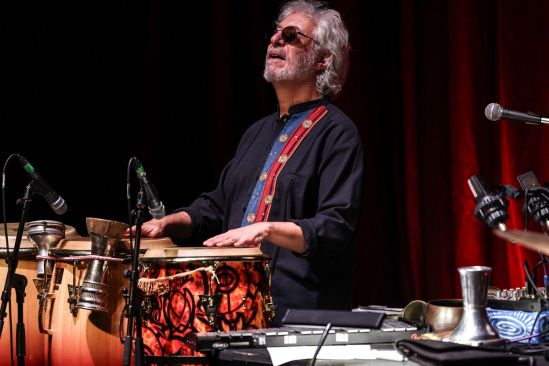 Adam Rudolph Interview Image (c) the artist
“Intellectual processes can be codified, repeated, taught, and explained. But we can never go back and repeat the intuitive process again.“
Video
