Published
Part 1
Name: Alessia Luongo
Nationality: Italian
Occupation: Sound artist, performer, vocalist, visual artist
Current release: Alessia Luongo has several new singles out, including "Medulla," "Liturgia processata," and "La Blatta."
If you enjoyed this Alessia Luongo interview and would like to know more about her music and upcoming live dates, visit her official homepage. She is also on Instagram.
You wrote that "sound is the starting point of my artistic practice." Would you say this was always the case - even when you were really young and foremost a listener?
Yes, I really think so. Looking back, sound has always held a particular fascination for me, even when my relationship with music was purely that of a listener.
I don’t think I was fully aware of it at the time, but today I recognize listening as one of the earliest ways in which I began to develop a relationship with the sonic world. I remember, for instance, being drawn to the guitar from a very early age, an instrument that has, in one way or another, accompanied me through different stages of my life. So I believe sound was already a central element of my sensibility, long before it consciously became the starting point of my artistic practice.
Over time, I came to understand that what fascinated me was not simply music as an organized language, but sound in its broader dimension: For me, sound is an invisible yet profoundly physical material, capable of moving through the body and evoking images without necessarily representing them.
Perhaps this is precisely where the continuity lies between my early experience as a listener and my current artistic research: listening has gradually become a way of questioning reality.
Today, in my artistic practice, I don’t necessarily begin with a melody or a musical structure, but often with a sonic quality, a tension, or a possibility that has yet to emerge from sound itself.
Were there albums that you loved foremost for the way they sounded or the sounds they used? If so, what were these?
Absolutely! There are several albums that have fascinated me, particularly for their sonic worlds and the extraordinary expressive possibilities of sound.
I’m thinking of Miseri Lares by Valerio Tricoli, Kevin Drumm’s self-titled album and Sheer Hellish Miasma, Hotel Paral.lel by Christian Fennesz, and Underneath the Surface by Attila Faravelli. Kevin Drumm, in particular, is an artist whose work I deeply love.
What fascinates me about these works is their ability to treat sound as an autonomous material, exploring its physical qualities, layers, imperfections, and possibilities for transformation.
Another fundamental dimension of my listening experience concerns the voice. I’m thinking of Dolmen Music by Meredith Monk and Reluctant Gypsy by Joan La Barbara, particularly the composition Klee Alee.
In these works, the voice transcends the traditional function of singing and becomes body, gesture, sonic material, and a territory for experimentation.
I believe all these listening experiences share something essential: I’m drawn to works in which sound is not simply a means of constructing a composition, but becomes the very territory of artistic exploration.
What were your first own steps into treating sound as the focal point like?
My first steps were probably much more instinctive than conscious. Throughout my musical journey, what has always fascinated me most about instruments is sound itself. I could spend hours listening to a particular timbre, vibration, or resonance, exploring its characteristics and possibilities.
Even when working within more classical and traditional musical languages, I always felt a natural inclination to push beyond their rules. I was constantly looking for a kind of escape route through creativity, a space where an instrument could express something beyond its conventional function. It was a gradual process, driven by the distance between the boundaries of traditional musical forms and the sonic possibilities I could imagine and hear in my mind. Discovering contemporary artistic practices allowed me to recognize this tension as a direction for my own research.
For me, sound is above all a physical experience. What I feel when listening to or producing sound cannot always be translated into words, but I’m constantly searching for its ability to move through the body and transform perception. This is where my desire to place sound at the center of my artistic practice emerged: not simply to explore its possibilities, but to shake the audience, provoke physical reactions, challenge conventional ways of listening, and evoke emotions ranging from unease to surprise, attraction, and disorientation.
I see these dimensions as inseparable. Sound acts simultaneously on the body, perception, and emotions, and I believe its ability to transform the experience of listening is one of the most powerful aspects of contemporary sound art.
"Traditional," harmony and melody based music is often regarded as connecting people through shared emotions, aesthetics and values. Do you think the same holds true for music which places the emphasis on sound?
Absolutely, although I don’t believe this connection necessarily has to arise from sharing the same meaning or emotion. For me, sound doesn’t need to communicate anything specific. Its power lies in its ability to generate different, even contradictory experiences. I find it particularly interesting when the audience’s interpretation conflicts with my own.
I believe the physical dimension of sound provides a profound common ground. Even unease, disorientation, or rejection can create an authentic relationship with a work. I don’t see traditional music and sound-centered music as separate worlds, but as different expressions within the same universe.
I don’t necessarily need the audience to understand what I do: I want them to feel it. Connection doesn’t require identical experiences, but rather the possibility of experiencing something authentically, even in radically different ways.
Tell me a bit about how the connection with theatre came about, please.
My relationship with theatre developed through a journey in which music and performance gradually became intertwined. Although I come from a musical background, I began my professional career as an actress and performer, never abandoning music, which eventually returned to the center of my artistic practice.
What has always fascinated me most about theatre is the possibility of transformation. The body, gesture, movement, breathing, and stage presence have become essential elements of the way I compose and produce sound.
For me, the boundary between music and theatre is extremely subtle: sound already possesses its own theatricality, even in the absence of a visible stage. It can generate actions, tensions, and dramaturgies without necessarily telling a story. I consider these two dimensions inseparable: even when I work exclusively with sound, my thinking remains deeply theatrical, and vice versa.
What were the first theatrical performances combining these thoughts and your sound work like?
I have always conceived of theatre as a multidisciplinary art form. From my earliest performances, theatrical and musical elements have coexisted, deeply intertwined.
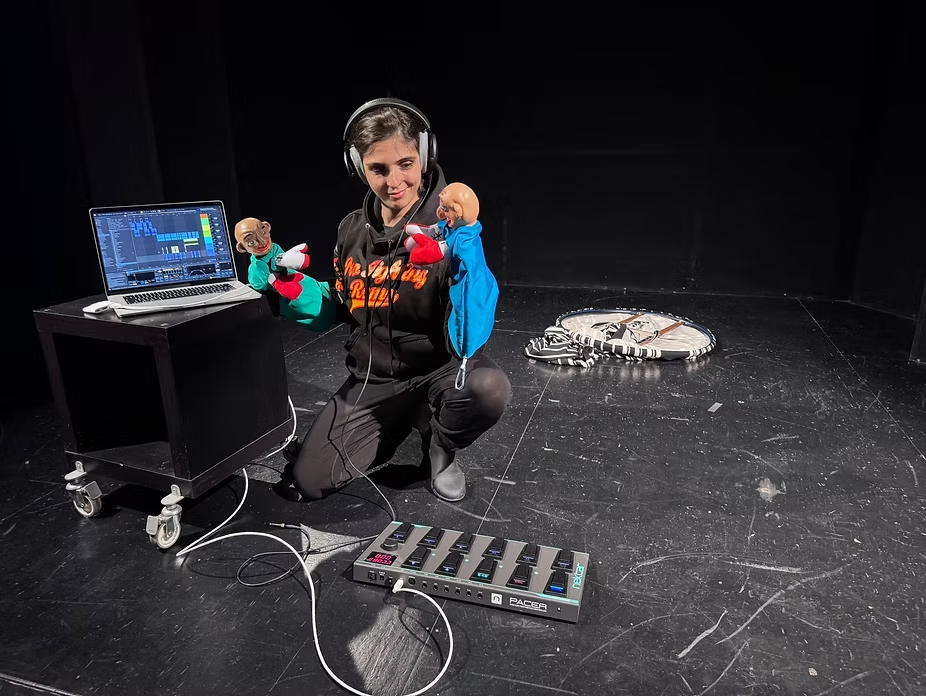
An important influence on my artistic journey has been Commedia dell’Arte, one of the great traditions of Italian theatre between the 16th and 17th centuries, where acting, dance, and music were constantly intertwined. Performers were also musicians, playing instruments on stage such as the Baroque guitar, chitarra battente, colascione, theorbo, lutes, and tambourines.
I dedicated years to studying and exploring some of these instruments. This experience helped shape my understanding of sound as an integral part of theatrical action, rather than simply an accompaniment.
Over time, I felt the need to move beyond those traditions, exploring new sonic and expressive possibilities while preserving that profound connection between music, the body, and dramaturgy.
What was concretely happening at your first "sound-theatre" performances?
In my early performances, I used musical instruments not only to accompany my singing, but also to create atmospheres and soundscapes that became an integral part of the theatrical action. I explored the timbral possibilities and resonances of the instruments, seeking to evoke environments, situations, and sensations through sound.
At the same time, working within a highly imaginative form of theatre, the physical shape of an instrument could also become a scenic element, suggesting images and taking on meanings beyond its musical function.
In this way, voice, sound, object, and gesture were constantly interacting, and the instrument became not simply something to play, but also a means of constructing a visual and sonic dramaturgy.
You mentioned that these everyday items could take on new and unexpected identities. What would be examples of that?
I think of the pans, which were just some of the objects I used in my single "La Blatta," where I explored metallic resonances, vibrations, and unexpected timbral possibilities.
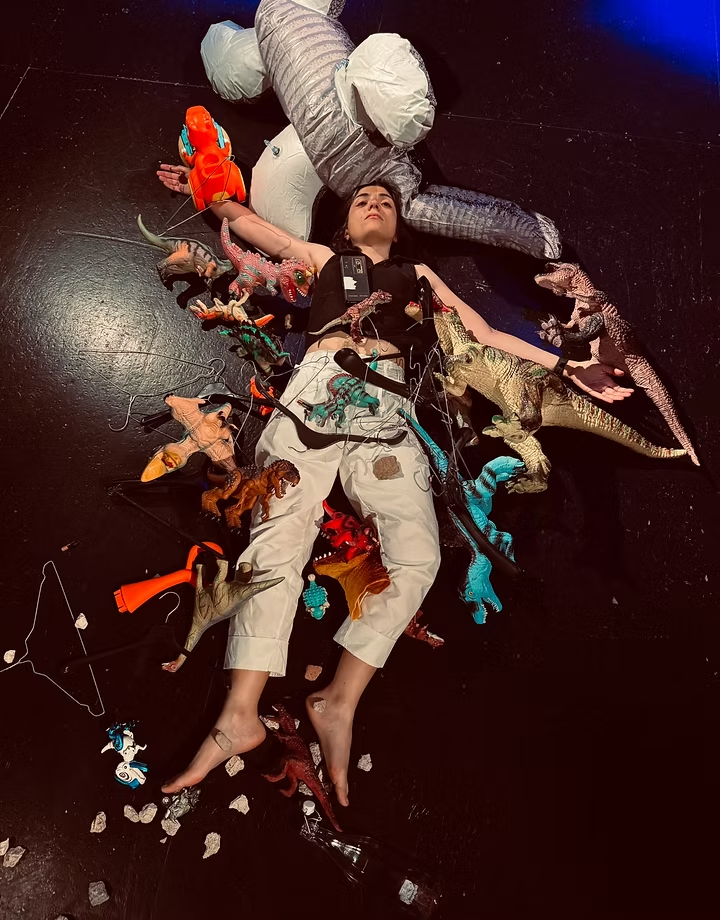
Another example are the clothes hangers, which were also just some of the materials I used in "Dyno on the Moon, both a single and a sound art and object theatre performance, where various everyday objects contribute to the creation of a lunar environment and an imaginary landscape.
What interests me is not necessarily representing something recognizable, but exploring the unexpected possibilities of objects through sound, gesture, and visual transformation.
An object can become an instrument, a stage presence, or a dramaturgical element, leaving the audience free to construct their own images and interpretations.
Would you say that the less obvious the sonic potential of an object is, the more interesting it is for you in this regard? Or do you prefer to work with materials and objects which allow for a very wide range of manipulations? (pans for example seem like a great source of many different sounds, also I love cooking, so I'd have an immediate personal connection)
I’d say both! I’m fascinated by discovering sonic possibilities in objects that seem to have little musical potential, just as much as I enjoy exploring the wide range of sounds a material can produce through different forms of manipulation. Depending on the project, I might be drawn to an object’s sonic qualities, its physical shape, or its potential for theatrical transformation.
But what I love most is the unexpected! I’m particularly interested in that moment when an object produces something I hadn’t imagined, when the material itself seems to suggest a direction different from the one I initially had in mind. I don’t want to have absolute control over everything that happens. For me, unpredictability isn’t an obstacle to composition, but one of its most fascinating possibilities.
And yes, pans are extraordinary instruments! Perhaps your love of cooking could turn into an interesting sonic exploration!