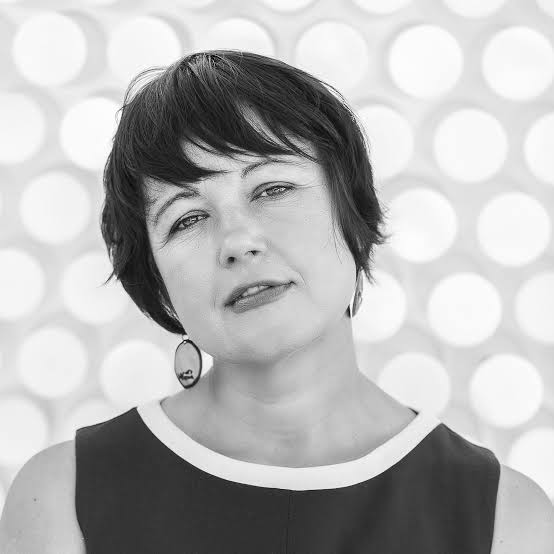
Published
Name: Alla Zagaykevych
Nationality: Ukrainian
Occupation: Composer, sound artist, producer
Current Release: Alla Zagaykevych's new album Vyshyvanyi. King of Ukraine, a recording of her opera by the same name, is out via I Shall Sing Until My Land Is Free.
Shoutouts: I know for sure that there is a media artist in Kyiv who greatly determines the level of development of electroacoustic music in Ukraine - Ujif_notfound (Georgy Potopalsky). In addition to being a self-sufficient artist in the field of generative art and algorithmic music, he works great as an assistant in the most complex set-ups. For example, I worked with him on real-time processing at the Kharkiv Opera on the production of my opera "Vyshyvanyi".
I would also like to name a Ukrainian composer who inspires me a lot - Leonid Hrabovsky (born 1935), who developed his own method of algorithmic composition and has been working on it since the 60s. His music is very intellectual and refined. I think that in the future the ability to actually be creative, to have creative imagination, will grow, but also the mastery of technology will be important.
If we talk about a broader context - for me the French school of spectral composition was important - Hugues Dufour, Gerard Grisey. In general, I believe that composers' appeal to sound material, immersion in the acoustics of sound is productive - at least it develops imagination.
Hometown Recommendation: In Kyiv, I would advise you to go to the Kyiv Pechersk Lavra at 9 am to listen to the great Lavra bell. It is the loudest of all the bells in the city. An incredible impression – a powerful low ringing, like the sound of a huge sea wave.
If you enjoyed this Alla Zagaykevych interview, and would like to stay up to date with her music and upcoming live performances, visit her on Instagram.
The borders between producers, sound artists, and even songwriters are becoming increasingly blurry. What does being a composer mean today, would you say?
For me, a composer today is – in fact, first and foremost – an artist. A person who sees (hears) some kind of their own "reality".
In addition, a "contemporary composer" today is actually very different from a "romantic or classical composer", who could quite understand the question of "what music is".
A modern composer is sometimes more like someone from a completely different "class" - an architect, a programmer, and sometimes a theater director or a performer.
Many people perceive classical music and contemporary composition as having high barriers of entrance, both for listeners and musicians. What have your own experiences been in this regard?
I was lucky. In my teens, together with my older sister, I became interested in science fiction literature, art house cinema – and according to this aesthetic, I was really looking for “new music”.
At a music college in the city of Rivne, I was very happy that during classes you could listen to the music of the “Kyiv avant-gardes” - Valentin Sylvestrov and Leonid Hrabovsky.
As of today, what kind of materials, ideas, and technologies are particularly stimulating for you?
I see the most opportunities for myself in the combination of sound materials of different natures – instrumental [acoustic] and electronic.
I like to use instrumental sounds as if they are “electronic” – to apply the technique of “instrumental synthesis”. From electronic sounds I also want to achieve maximum live quality – variability, similar to instrumental music.
Where do most of your inspirations to create come from – rather from internal impulses or external ones? Which current social / political / ecological or other developments make you feel like you need to respond as an artist?
For me, it is important to know the musicians with whom I will work. To imagine my composition as a “performance”. It seems that the composer is a participant in the process of performing music.
But besides us – musicians - there is the time we live in, its events. Life in society. In 2022, Russia attacked Ukraine. The war changed everything.
For example, now one of the key artistic themes for me is the question of “musical language in times of war”. The possibility of continuing the development of musical language, avoiding its simplification.
Tell me a bit about the sounds & creative directions, artists & communities, as well as the colleagues & creative hotspots of your current hometown, please. How do they influence your music?
I live in Kyiv. As a composer, I am attracted to the philharmonic space. All philharmonic groups are actively interested in Ukrainian contemporary music.
They are not always ready to perform radically new music in the Philharmonic, but during the festivals of contemporary music you can hear works with electronics, a noticeably new repertoire. There are active non-institutional centers in Kyiv – the Association of Electroacoustic Music, the Opera Aperta performative formation, the Ricochet, Ensemble 24 contemporary music ensembles.
The theater is developing very actively. In fact – this movement of a certain artistic resistance to war, destruction, entropy – inspires me a lot.
Composing has always had an interesting relationship between honouring its roots and exploring the unknown. What does the balance between these two poles look like in your music?
Honouring the origins is about Ukraine. We still have authentic folklore. There is a whole layer of culture of the “ethnographic direction” – a corpus of works based on folklore. And I spent a lot of time on folklore expeditions.
However, folklore for me is not “material for processing” but a self-sufficient culture. I like to use the timbre component of folk singing in electronic music. This is an extremely powerful material.
I would like folk culture in my music to remain an “exploration of the unknown”.
How much potential for something “new” is there still in composition? What could this “new” look like?
It seems that we are actively moving from “music” to “sound” - from “musical structures” to the search for new musical material itself. For me, “new” lies in this plane - a change in approaches to understanding the basics of music - “melody” - “rhythm” - “dynamics” - “timbre”.
Of course, this is a question of language … But it is quite possible - the development of music may be associated with the emergence of some completely new forms of art.
For example, we can clearly see how cinematography influences the development of music and music technologies …
It is my impression that adding a conceptual, non-musical dimension to one's work is almost a prerequisite for commissions and grants. How do you view this tendency and how “conceptual” is your own approach to writing?
I understand well the “curators”, managers of musical projects, who are looking for works for a holistic program. Actually, I myself am the curator of the electroacoustic project EM-visia, and from time to time I terrorize my colleagues with requests for a work for a certain concert, a certain concept.
This year, for example, it is writing electroacoustic works for “folk” instruments (accordion, bandura, dobmra). But, for me, the basis of music is still a musical language, a musical dimension.
Working with long forms, complex concepts or new vocabulary is potentially more challenging today because they require us to remember things that happened perhaps minutes ago – while most of us are finding it hard to focus even on what's happening right now. Both as a composer and as a listener yourself, how do you deal with this?
In fact, if we are really talking about a "new language" - when I hear something really new - it really excites me. And I will listen to it non-stop. The same with creativity. A new idea, an experiment, a new structure - they excite. Working is interesting, you never know what will happen next. First "you write music - then the music guides you".
Immersion in a work - and only in a work - is certainly a rare opportunity these days. Teaching, performing, some "organizational" projects - all this is certainly distracting.
Not to mention the constant sirens. Just now - a siren is wailing outside the window and the announcement “Drone danger in Kyiv!” sounds!
For many artists, life-changing musical experiences take place live. Few works these days, however, are performed beyond their premiere. What, do you feel, does this mean for composers, and the music they write, and how does this reality influence your own work?
A few of my works (especially symphonic) have been performed many times. I try to record works and release recordings, but still this is a separate job. Here the composer becomes a kind of “sound producer”.
Live performances for me are an opportunity to feel the audience. To listen to the musicians (what does this music mean to them, is it really interesting, what would I like to change), the audience, colleagues. As a rule, live performances are a good test - whether this work should be recorded, and how to record it, what space it requires.
I like to participate in performances of my works. I like to perform the piano and organ parts. I currently play the electronic part … or in electroacoustic works I sing with a folk voice.
The Montreux Festival intends to preserve its archive of recordings for future generations. Do you personally feels it's important that everything should remain available forever - or is there something to be said for letting beautiful moments pass and linger in the memories of those that experienced them?
"Beautiful moments" - our memories, our feelings of music - are really impossible to repeat. I have never heard a single recording of Luigi Nono's electroacoustic works made without the composer's participation - which at least somewhat resembled recordings made during his lifetime.
This is a tragedy, on the one hand - the inability to reproduce all the meanings that the composer put into his works. But another generation of listeners, performers is growing up ... And perhaps - Luigi Nono's music will inspire something completely different ...