

Name: Amalie Dahl
Nationality: Danish-born, Oslo-based
Occupations: Composer, saxophonist, improviser
Current release: Amalie Dahl's double album Live at Moldejazz is out via Sonic Transmissions. Live at Kafé Hærverk is slated for release September 25th 2026 via Trost.
Recommendations for Oslo, Norway: If you ever go to Oslo you should definitely visit some live concerts, but also places like Nasjonalmuseet and Munch Museet, and go to the forrest. The nature is so close here.
If you enjoyed this Amalie Dahl interview and would like to stay up to date with her music, visit her official homepage. She is also on Instagram, and bandcamp.
For a deeper dive, read our TREEN interview, Amalie's trio with Gintė Preisaitė (piano, objects), and Jan Philipp (drums, percussion).
The borders between producers, sound artists, and even songwriters are becoming increasingly blurry. What does being a composer mean today, would you say?
I agree, the limits are blurry, but I like that. I like that compositional choices can be many things.
Being a facilitator is also a compositional choice. Curating the band is as well, at least in the kind of music I work with. It would sound different with different people.
As of today, what kind of materials, ideas, and technologies are particularly stimulating for you?
I get inspired from reading, from other types of art, from other musicians. From textures, states, and in general people who have something to say.
Where do most of your inspirations to create come from – rather from internal impulses or external ones? Which current social / political / ecological or other developments make you feel like you need to respond as an artist?
At the moment a get a lot of drive from human encounters, the community and the togetherness.
Beautiful mistakes, and human characters.
Tell me a bit about the sounds, creative directions, artists; communities, as well as the colleagues and creative hotspots of your current hometown, please. How do they influence your music?
The music environment in Oslo is on fire in August. Last week we had both Øya festival and Oslo Jazz Festival (at the same time!?) and this week we have the impro festival: Blow Out Festival.
So I think it’s quite hot!
Composing has always had an interesting relationship between honouring its roots and exploring the unknown. What does the balance between these two poles look like in your music?
At the moment I don’t think a lot about either of them.
I’m reading the book Free Play by Stephen Nachmanovitch, and somewhere he talked about being original not as being new, but as finding your original self, which inspired me quit a lot!
What does your creative space / studio look like and what tools does it contain?
I’m very analog!
I compose mostly on the saxophone and with pen, paper, sometimes scissors and colors. I record stuff on my phone's memo app, and sometimes in the end I write down stuff on the computer, but mostly if it’s for a lot of people (like Dafnie EXTENDED).
I really love the rehearsal space that I have at the moment. All I need is a table, a couple of speakers, and a piano. The bonus here is that there are both drums and amps since I share it with other people, which allows me to try out the music with my groups.
I’ve played with electronics and samples every now and then, but it’s a lot to learn!
It is my impression that adding a conceptual, non-musical dimension to one's work is almost a prerequisite for commissions and grants. How do you view this tendency and how “conceptual” is your own approach to writing?
I think sometimes the need for funding can lead to overthinking.
I try to avoid that and to follow what I really want to do, not what I think others want me to do.
Working with long forms, complex concepts or new vocabulary is potentially more challenging today because they require us to remember things that happened perhaps minutes ago – while most of us are finding it hard to focus even on what's happening right now. Both as a composer and as a listener yourself, how do you deal with this?
I really love to be in “the zone” with focus and flow both when I play and when I write. And I think most musicians try to get there when they perform.
Sometimes the focus can be hard reach when you rehearse, but I try to encourage that we even get there when we are “just” rehearsing. I think with that focus, that’s where the magic happens.
My concepts are not that complex (I think), and I attempt for the playing and presence to be in focus. Maybe it’s a counterpoint to the lack of focus and presence you are talking about?
For many artists, life-changing musical experiences take place live. Few works these days, however, are performed beyond their premiere. What, do you feel, does this mean for composers, and the music they write, and how does this reality influence your own work?
As I mostly write music for my own groups I’m very much in charge of how many times the music gets played.
I live for live music, and my pieces are not finished when I hand them over to the musicians. We are still developing them when we play a concert. It’s part of the process, and I love when the music develops over time, when unforeseen things happen.
I think all of my pieces have been played more than once!
How, would you say are live performances of your music and your recording projects connected at the moment? How do they mutually influence and feed off each other?
Also here I’m very analog. My two latest records (including the next one coming on September 25th) are live recordings. I think they capture an energy that’s hard to get in the studio.
But I also just recorded a trio album in the studio. I think we played really nice music, but I also think it’s hard sometimes to give everything, to get the right energy, the presence, when you have a chance to do it again.
To some, the advent of AI and 'intelligent' composing tools offers potential for machines to contribute to the creative process. What are your hopes, fears, expectations and possible concrete plans in this regard?
For me, it makes no sense to involve AI in the creative process because so far it cannot be creative. And also because being creative is the fun part, the part where I connect with other people, the part where I express myself – why would I let a machine do that for me?
There are so many things I find problematic with AI/big tech, just a little part of it is where they build their reactors and how much water it takes to cool them down. But there are also so many other ethical questions!
But also I think, in art that what speaks to you is the human voice. It’s feeling someone making an effort, taking some chances, a voice, a character they built over years, having something they want to tell. I think that AI can never get this character.
To create something, being creative, is hard/a lot of work, it can be trying and trying, restarting, new attempts, hours and years of learning the skills, but this friction is also what makes the outcome interesting. And if AI is “helping” us being creative we skip those steps, and I think we will miss a lot. We will miss character, the meaning and the realness.
For me music is about the human encounter, the community, the togetherness. In this kind of music mistakes are beautiful, and they feed new ideas. (Right now) AI can only recreate, and is only making the distance between humans bigger.
I can feel that being creative is the opposite of what society wants us to be – it wants us to be effective. Even when we rest, it’s for the reason to be more effective the next day.

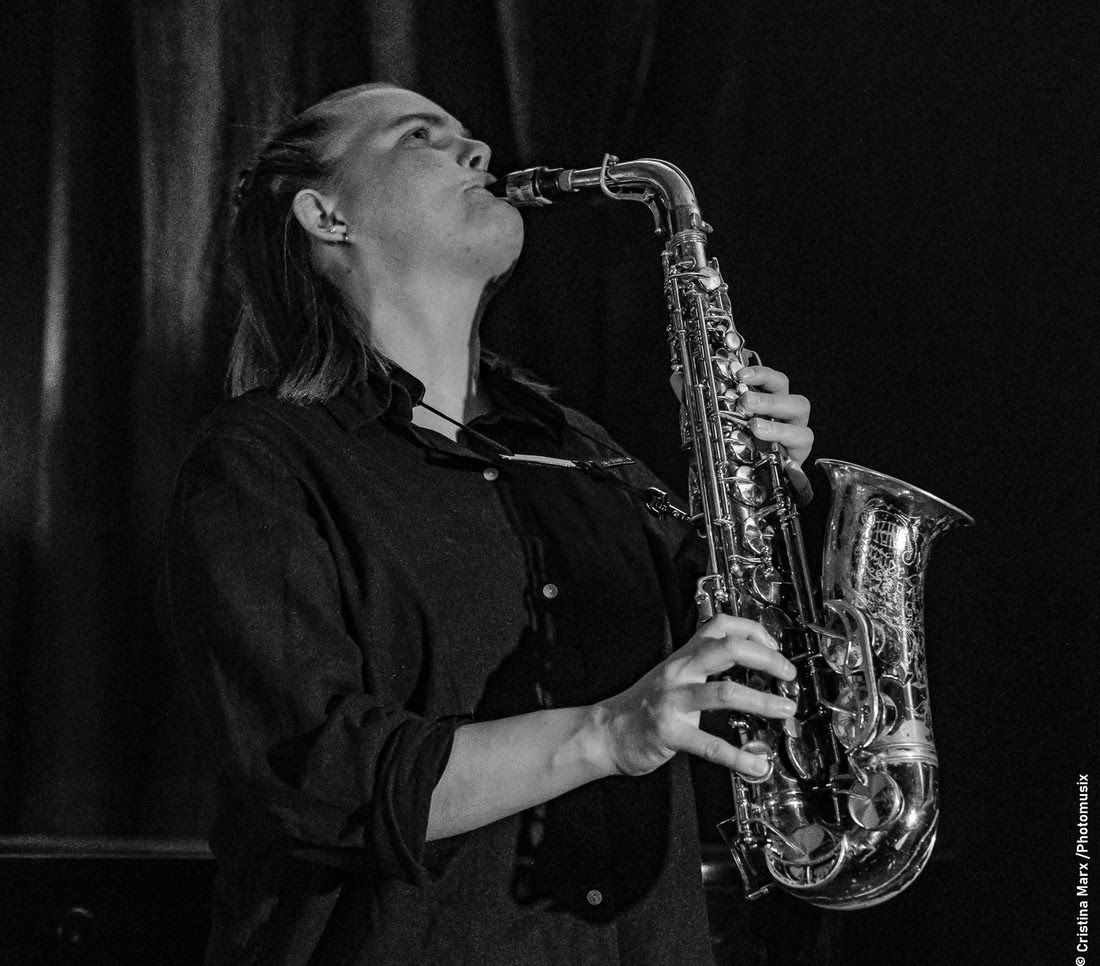 Amalie Dahl Interview Image by Cristina Marx/Photomusix
“I like that compositional choices can be many things. Being a facilitator is also a compositional choice. Curating the band is as well”
Video
