Published
Part 1
Name: Anthony Wilson
Nationality: American
Occupation: Guitarist, improviser, composer, arranger
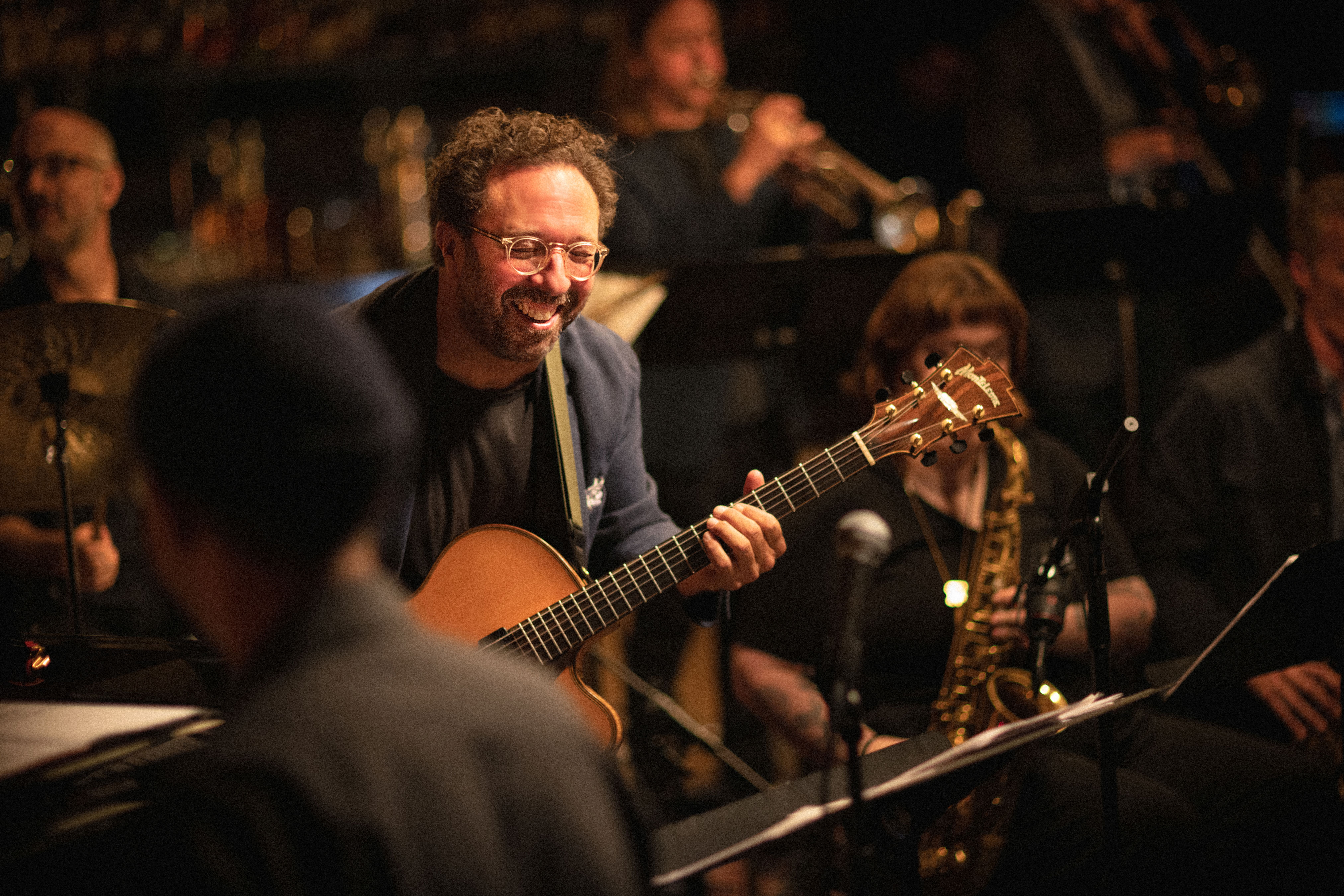
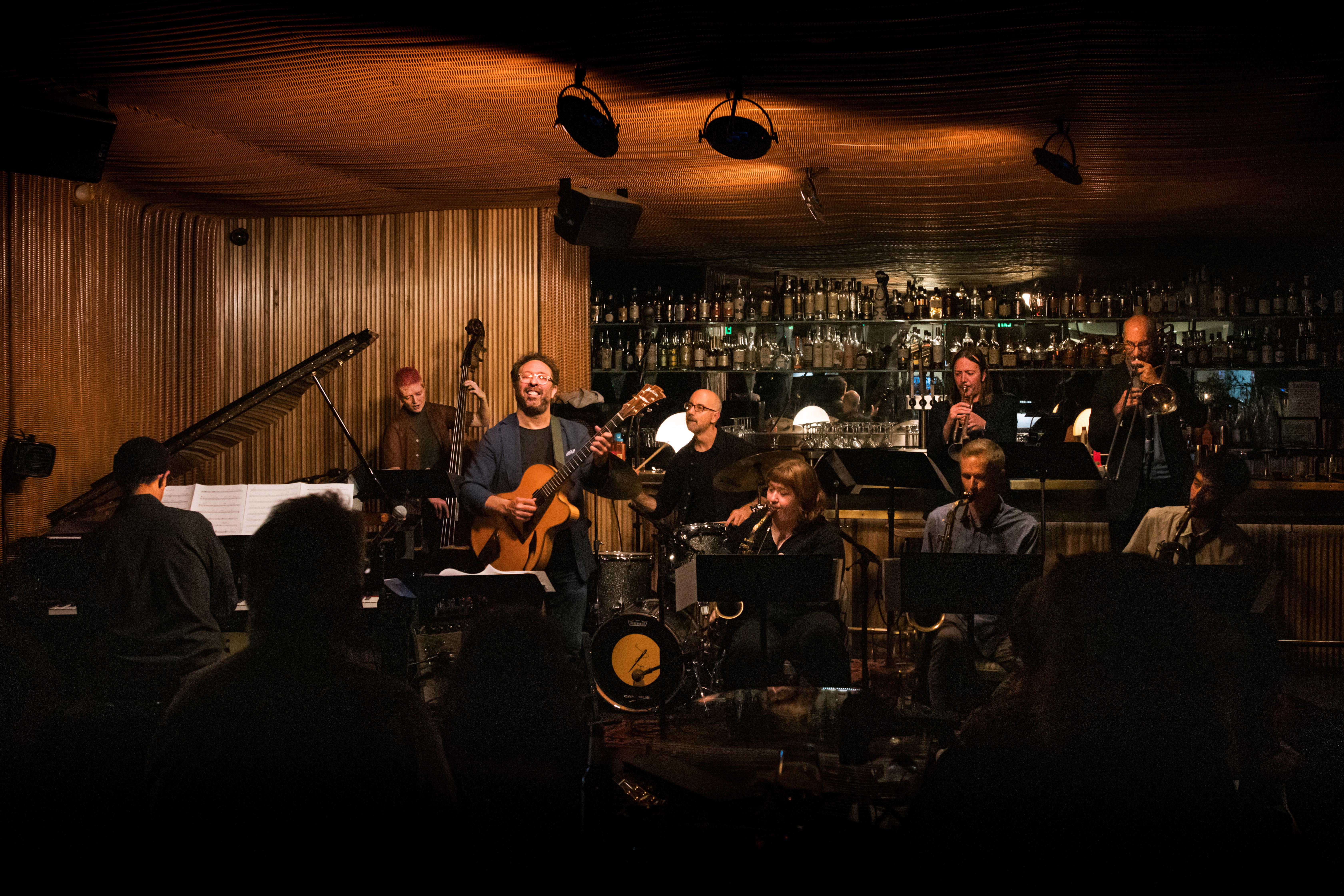
Current release: Anthony Wilson's new album with his nonet, House of the Singing Blossoms, is out Sam First.
Recommendations for Los Angeles, USA: I think that visiting Simon Rodia’s Watts Towers is a very special visit indeed. It’s just a testament to one person’s individual vision and dedication to manifesting that vision and putting it into the world. Piece by piece he made it over three decades. It’s a very moving experience to see this work.
If you enjoyed this Anthony Wilson interview and would like to stay up to date with his music and current lives dates, visit his official homepage. He is also on Instagram, Facebook, and Soundcloud.
What were some of the musical experiences which planted a seed for your interest in jazz?
My father was a jazz musician. Even as a very young boy, I was fascinated by what he did.
I knew that his life and work differed from what most of my friends’ parents did, though I did have some friends whose parents were musicians. But they played rock and popular music, and it was clear to me that there was something different, and very compelling to me, contained in the culture of jazz, in my father’s world.
Although I was a kid growing up the 1970s and loved the popular music of that time, I still had a feeling for sounds that my father made when he would practice his trumpet or when he would sit at the piano to compose. He took me along sometimes when he rehearsed with his band, and so I witnessed the fellowship that existed among the musicians. All of this was different from the popular music atmosphere of the time, and I always liked it.
Also, my mother was a true fan of all types of music, with a large record collection that spanned many kinds of music. You could find Ravi Shankar albums next to Charlie Parker albums next to Joni Mitchell albums next to collections of the compositions of Erik Satie. Langston Hughes and Jack Kerouac reading their poems.
As a very young person I was fascinated by these records and I would put them on and they enabled me to dream. This exposure to all kinds of sound was heaven for me.
All of these early experiences set me up to be open and receptive when, at the age of 13 or so, I fell in love with albums by Miles Davis, Eric Dolphy, Oliver Nelson, and Dexter Gordon.
What does the term jazz mean today, would you say?
I think that jazz has a natural way of just being what it is. It doesn't necessarily need anyone to say what it means. It just needs engaged practitioners who bring love and a sense of seriousness to what they do. Those people usually just enter the stream very naturally and the music evolves to embrace them and the sounds they are making.
I do think that there are through-lines that endure from the earliest jazz music to the music of the present day that we also call jazz. I feel that there is a certain flavor and feeling that remains at the center of the music that emerges from Black American culture and that when the music loses that sense and feeling it may be improvised music, it may be adventurous music, it may be super interesting and compelling music, but one might want to be careful about defining it as jazz or Black American music.
The essence of the blues, of a certain kind of rhythmic propulsion, a certain kind of attitude and accent in the music — I guess I’m talking most of all about the feeling of swing — if it’s absent, can easily take the music out of the realm of what I hear as jazz.
I’m not appointing myself as Jazz Police by any means, but sometimes I wonder why some folks are repelled by playing with a swing feel, or why somebody would avoid engaging with the blues in their playing. Actually, I think if one can really swing, it’s not something one would ever avoid … and there are certainly lots of ways to swing!
I wonder why rock beats and straight 8th note grooves, odd time signatures, and a certain kind of loudness and velocity are more the norm these days than a certain kind of rhythmic momentum or a tender and mature lyricism. Like Johnny Hodges playing “Day Dream” with Billy Strayhorn: where exactly is that kind of tone and resonance these days?
But these things ebb and flow. We don’t know at all what things will sound like in 15 years. And you know, there is SO much music being made. One just has to find what one gravitates to and not really worry about the other stuff.
For musicians, it helps to have an abiding confidence in what one loves, tune out the noise, and move forward. There’s room for it all, and it doesn’t really matter what we choose to call it.
As of today, what kind of materials, ideas, and technologies are particularly stimulating for you?
These days I am listening to a lot of music from the early decades of recorded jazz. Things like the 1930s recordings of Duke Ellington, Fletcher Henderson, Benny Carter, Count Basie, the work of Gil Evans with Claude Thornhill around 1940 and 41. I love the sense of complete musical narrative that these incredible musicians were able to achieve in extremely compressed durations of time (usually less than 3 minutes).
I’ve been thinking about composing in this more compressed form rather than in longer chunks of musical narrative. I haven’t gotten there yet! My most recent album House of the Singing Blossoms definitely has a few 10 to 12 minute songs with lots of extended improvisation and plenty of of loose possibilities for things to happen and develop over time.
But a project I really want to do is a large body of “miniature” compositions for jazz orchestra in which no song would be longer than four minutes, and in which the written material is so tight, the formal design so well-considered, and the thematic development so thoughtful, that a four minute piece integrating both written material and improvisation would still feel like a fully realized musical journey.
I'm inspired by the feeling I get from those early jazz recordings to try something like this.
Where do most of your inspirations to create come from – rather from internal impulses or external ones? Which current social / political / ecological or other developments make you feel like you need to respond as an artist?
Nature and uninterrupted time are big for me. Just being away from it all, out in the vastness and experiencing the landscape for me are restorative and allow my mind to wander and to find new creative pathways.
Since 2018 I have been working on a collection of songs and photographs inspired by the landscape, culture and people of the Mississippi Delta. I travel there often and spend much of my time alone in the landscape. The solitude and beauty of the place always opens up ideas for composing.
I feel and hope that contained in any beauty we’re able to put into the world, there is a response and a reply to difficulty, injustice, environmental imbalance, violence.
When I’m working in Mississippi, for example, I remain very aware of its troubling and difficult social histories, which still play out today. That stays close to the forefront of my mind, and the work I am able to do there is a response to all of it.
Tell me a bit about the sounds & creative directions, artists & communities, as well as the colleagues & creative hotspots of your current hometown, please. How do they influence your music?
I live in Los Angeles which at this moment is quite a vibrant and exciting place for musicians who play jazz and improvised music. There is a wide open vibe to a lot of the music being made here and a lot of fluidity in the community of musicians.
I think about my colleagues and friends Gerald Clayton, Nicole McCabe, Mark Ferber, Jay Bellerose, Anna Butterss, Josh Johnson, Jermaine Paul, Josh Nelson, Daniel Rotem, Julien Knowles, Jeff Parker, Larry Goldings, Kaveh Rastegar, Brendan Eder, Dory Bavarsky, Christina Galisatus, Billy Childs, Will Graefe, and so many more.
[Read our Anna Butterss interview]
[Read our Nicole McCabe interview]
[Read our Larry Goldings interview]
The community is really a paradise for musicians, composers, and songwriters. Many younger musicians are attending the various universities that exist here, many established musicians are working both in the studios and venues, and lots of folks have moved from the east coast to be here.
On any night one might hear a completely improvised set being played in one venue, a “straight ahead” group in another, a singer-songwriter bending genres in another, a composer presenting new works in another. Though the great venue called Blue Whale closed during the Covid pandemic, it will open in a new iteration in 2026; and Sam First, a really wonderful room for listening, has been a second home for so many in our community.
It’s also where I recorded House of the Singing Blossoms with my nonet, released on their own record label.
I also think about the wonderful jazz history that is so much a part of this place, and it inspires me: Central Avenue with it’s rich legacies of legendary Black musicians and entrepreneurship; the artists who recorded for Contemporary Records and Pacific Jazz, such as Art Pepper, Chet Baker, Harold Land, Curtis Counce, Buddy Collette, Chico Hamilton, Jim Hall, The Crusaders, Joe Pass, Curtis Amy, and my father, Gerald Wilson.
The legendary run of Ornette Coleman, Don Cherry, Charlie Haden, Billy Higgins, and Paul Bley at the Hillcrest Club; other groundbreaking musicians such as Bobby Hutcherson, Charles Lloyd, Charles Tolliver, John Carter, Bobby Bradford, Vinny Golia, Nels Cline ….
All of these people made their mark in the deep L.A. jazz atmosphere that is not always given its due.
[Read our Vinny Golia interview]
[Read our Nels Cline interview]
What role do electronic tools and instruments play for your creative process?
I'm primarily a guitar player and I love picking up a guitar and plugging it directly into an amplifier with no sound processing in between. I love a guitar that sounds like a guitar. I also love to play acoustic guitars. Just the instrument itself making a sound. It's extremely beautiful to me.
However I love using technology and sound processing in the creative process. I did an album in 2023 entitled Collodion in which I played almost all of the instruments and in which the process of creating the songs was completely improvised.
I worked with a producer named Pete Min in Los Angeles who has a studio called “Lucy’s Meat Market” and a label dedicated to this way of making records called Colorfield. The studio is filled with all kinds of instruments, from percussion to string instruments to almost any acoustic or electronic keyboard or guitar effect pedal that you might like to experiment with. Pete has a great collection of modular synthesizers that we used quite a bit on the album.
Encountering a new type of instrument and approaching the playing of it almost as though I were a child, with no preconceived composition in mind was a revelatory experience for me and it yielded some of the most exciting music for me personally that I've ever made. I can't wait to work on more musical projects like this in this way because it completely broke me away from my most repeated habits as a musician.