Published
Part 2
Jazz has always had an interesting relationship between honouring its roots and exploring the unknown. What does the balance between these two poles look like in your music?
I think it’s helpful to remember that the tradition in jazz is always forward-leaning and forward-looking. It's not meant to be a backward look into a nostalgic, idealized time when things were only what we want them to be, and that those things should never change.
I also like your image of roots. For a tree, roots provide a foundation and the tree grows naturally. As the roots reach deep, the tree can grow high and wide and be stable and beautiful and weather the seasons.
I think about people like Duke Ellington and Art Tatum and Ben Webster and Mary Lou Williams and Lester Young and Charlie Parker in that way. They were involved, engaged artists very serious about what they did and interested in the growth of the tree itself.
I really love how a current day artist like Jason Moran engages with tradition. It’s everywhere in what he does (both his music and his visual art), yet it is a pathway toward growth and discovery. His rebuilding of iconic jazz bandstands such as Slug’s and Minton’s, his musical work around the traditions of James Reese Europe and the Harlem Hellraisers, surround us with living tradition and point towards evolution.
My life and my music are imbued with a love and dedication to the roots of jazz. I care about what my father represents as a musician who started out in the swing era of the 1930s and continued to make vital music until 2014.
I really love classic jazz music. I love the sound of it, I love the feeling of it, I love all the culture implied by it.
It is very important to me to keep elements of that culture, feeling, and sound central to the music I make while also having the freedom to discover and add on to those things, even to veer away from them from time to time. But then, in practice, to be honest, I don't think about it much at all! It’s just there, and I make the music that sounds good to me and to my ear.
If I write a swinging theme I don't think, "oh gosh, that's an older kind of sound. Am I going to sound old fashioned?” And if I write a combination of oblique melodies meant to be exposed to variation by a group of improvisers with no meter and no chord changes (such as the introduction to the title song of my new album), I don't think, "this is current — I'm using modern techniques." I just write the things that interest me and sound good to my ear and I have the faith that my love for everything represented by the tradition as well as my love for the unknown will see me through in an interesting and compelling way and will pave the road for future development.
Something like my song "Blues for Wandering Angels” is a slow blues in E minor. With a kind of familiar-sounding, loping 4/4 swing feel. It’s a sound we know, something we’ve heard … But it's just a joy to lean in to that kind of swing feeling and that kind of vibe in a slow blues.
It brings out a great sense of energy for the soloists and the rhythm section to sink their teeth into something like that.
How much potential for something “new” is there still in jazz? What could this “new” look like?
I think we've all just only scratched the surface of what's possible! Think about it, things settle so easily into clichés, and people fall into habit, rely on styles that are repeated over and over, rather than seeking fertile ground for discovery.
I studied at Bennington College with two legendary musicians: Bill Dixon and Milford Graves, and much of what they suggested might be possible in the development of this music has not really been addressed in a significant way by current practitioners of even what's considered the most avant-garde — and certainly not by me!
There is so much that I learned from Bill and Milford that I’ve yet to incorporate into what I do. Certain textures, certain kinds of layering in the music, certain kinds of color, lyricism, and dynamics; procedures of orchestration, voicing and sound exploration, engaging with improvisation. There’s so much yet to try, so much to do.
So I think the music will continue to be new because people always come along who feel uninterested in the clichés, habits, and styles that I referred to before. And this is a welcome thing.
Also I believe that beauty is always new, real style and individualism is always new, and the sense of love and transcendence that a musician can communicate is always new. These things take different forms but their newness is always evident.
For many artists, life-changing musical experiences take place live. How do you see that yourself?
Playing live is where I discover the most about my musical process. Whether I'm playing solo or in an ensemble the immediacy of working with colleagues, listening to what they are doing and responding in the moment is truly the most meaningful part of being a musician for me.
At the most exciting of those times, one loses all focus on oneself and one simply becomes a part of a collective process of creation. When you add a truly engaged audience to this environment, the energy that's created is incredibly powerful.
I live for the kind of instant instantaneous transformation that can happen when I give myself over to that kind of powerful energy and create sound within it.
How, would you say are your live performances and your recording projects connected at the moment? How do they mutually influence and feed off each other?
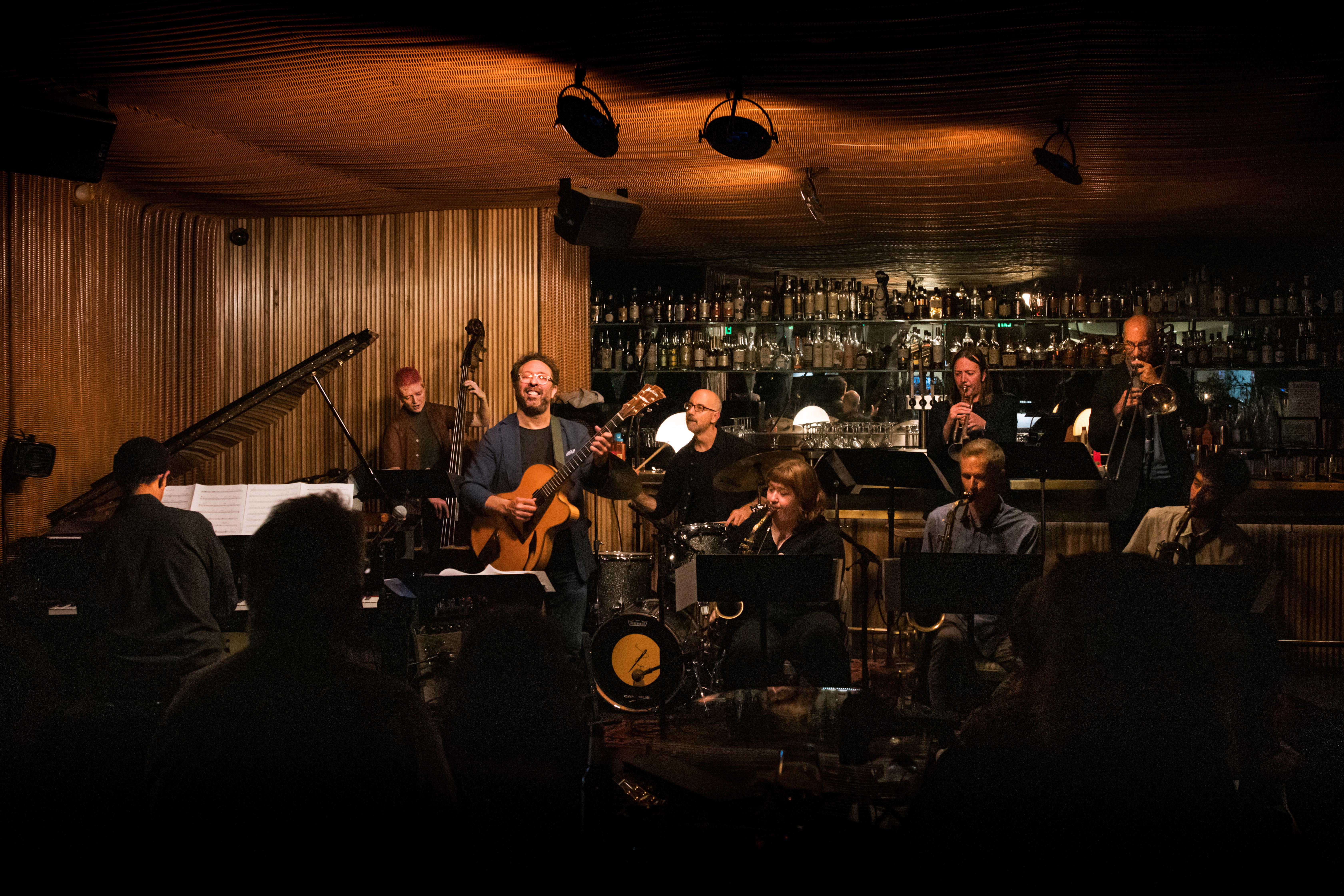
Recently I've begun performing again with a nine piece band, for which I’ve composed a great deal of music over the years. But I hadn't performed or recorded with that band for a while, and I'm really excited to be getting back to that ensemble because it contains a lot of possibilities.
I love writing arrangements and compositions for the band, knowing that there is the possibility of keeping things loose enough to invite surprising episodes of improvisation that can integrate with the written material in really interesting ways. I write with the players in mind — folks like Nicole McCabe, Alan Ferber, Gerald Clayton, Henry Solomon, and Bob Reynolds — and I like to build in enough openness so that the songs can develop over time.
Recording with the band can almost be like doing a first draft. And then, once you start doing gigs, you begin revising, adding things on, recombining material in different sequences and in different ways and the result is a discovery of what's possible in an open process of constant remaking and revision.
In all my recordings, there's been the impulse to not feel required to make a definitive version of a song but a document that contains the seed of potential development for that song. Then I live with these compositions over long periods of time so that the ability for the material to morph and change with each live performance is very exciting.
What, would you say, are the key ideas behind your approach to improvisation?
For me, everything comes down to phrasing! Phrasing, phrasing, phrasing! How things are paced and where they are placed in the bar, around the beat, the contours of a melody line, playing with rhythm so that the improvised idea can dance a bit.
I work with many students, for whom this seems to be welcomed as part of their study. Placing their more theoretical ideas (scales, motifs, arpeggios, harmonic and rhythmic concepts) in a context of the musical phrase itself, seems to help their playing open and deepen.
The Montreux Festival intends to preserve its archive of recordings for future generations. Do you personally feels it's important that everything should remain available forever - or is there something to be said for letting beautiful moments pass and linger in the memories of those that experienced them?
I must say that I’m drawn to this idea, and the way you put it, of the beautiful moment that passes and lingers in memory, rather than being preserved for all time.
Of course that’s not for everything, and we all benefit from the archival presence of recordings from a hundred years ago to the present day. We certainly would not have the same experience of jazz without the volume of recorded music that has been made, and I could never speak of being inspired by music from the 1930s and 1940s as I did earlier. So live and studio recording, the ongoing archive, historical preservation — I applaud all efforts towards that.
At the same time, I love playing music for which there is no later possibility of retrieval. Playing and then leaving the music behind is also a special and beautiful process that helps us as musicians and listeners to be in touch with the present and less inclined to try to repeat the past.