

Name: Anna Lucia Nissen aka Anyx
Nationality: German
Occupations: Vocalist, composer, songwriter
Current release: Anyx's new album Starlink, co-produced with Alexander Rathbone and Tobias Textor, is out via Larubiaproducciones.
Current event: Anyx will present the album at Galiläa-Kirche in Berlin on September 16th 2026 with harpist Andy Aquarius and lap steel guitarist Kristof Hahn. For more information and tickets, go here.
Recommendations for Berlin, Germany: As a dedicated vegan, I’ve tried pretty much all the vegan pizza places in Berlin, and the best is La Stella Nera in Neukölln. It’s not the most famous or hyped one – I don’t think they do much social media – but it’s incredible. They make their own fluffy vegan cheese. I’ve taken many friends there and everyone was thrilled.
I also love sitting by the water at Urbanhafen in Kreuzberg and watching the swans.
[Read our Andy Aquarius interview]
If you enjoyed this Anyx interview and would like to stay up to date with her music, visit her on Instagram, and bandcamp.
Are there examples of minimalism in music – and outside of music - that impressed you early on?
Around the time I transitioned from fine art into music, I attended an Orthodox church service and became fascinated by devotional vocal music. There were no instruments, only voices. I remember being struck by the idea that the human voice was considered the only instrument appropriate to the house of God – that it was enough in itself.
Around the same time, I was listening a lot to devotional music, including Hildegard von Bingen’s Canticles of Ecstasy.
I think this idea of creating something immense or transcendent from such limited means had a strong impact on me. The human voice alone can fill an entire space.
Were you ever interested in minimalism as a style – from the Philip-Glass-variety to solo instrumental work to minimal techno? If so, tell me a bit about your interest in this.
At art school I was drawn to minimalist work across music and dance – Yvonne Rainer, Anne Teresa De Keersmaeker, Philip Glass, and particularly Steve Reich’s Music for 18 Musicians, which I listened to countless times.
But my relationship to minimalism was never particularly academic. I’m not very drawn to highly conceptual sound art or music where the intellectual framework seems more important than the experience of listening to it.
I find the same qualities that interest me in minimalism in very different kinds of music: minimal electronic music like Eleh’s Radiant Intervals and Detroit techno, but also bands like Earth or early Black Sabbath. A riff can repeat and carry an entire piece, and through repetition become heavier, stranger or more hypnotic.
[Read our Earth's Dylan Carlson interview]
Maybe most important to me, though, was Hildegard von Bingen’s Canticles of Ecstasy. I can’t count how many times I listened to it. I loved the feeling of being completely surrounded and swallowed up by those voices.
I think what draws me to minimalism in all these different forms is repetition as a way of altering perception. If something repeats for long enough, it can become hypnotic, dreamlike, even cosmic.
Do you tend to find that, as many claim, “less is more?” Are the notes you don't play really as important as the ones you do play?
Yes, I do. I think it’s similar to writing a book or making a film: you don’t have to spell everything out. The listener fills in the gaps anyway, and sometimes what you leave out creates more tension than what you put in.
You can stay on one chord or root note for slightly longer than feels comfortable, and when the change finally comes, it has much more impact. I really like working with that kind of tension.
At the same time, I don’t think minimal has to mean restrained or emotionally detached. My music is structurally quite minimal, but it can also be dramatic, theatrical and cinematic. Those things don’t contradict each other at all. I’m interested in reduction when it intensifies an experience, rather than minimalism as an intellectual exercise.
Ultimately, I care less about whether a concept is interesting on paper than whether the music does something to me physically and emotionally.
Do you feel as that making music is a process of adding elements until it is done – or one where you chisel away pieces from something that is already there?
Usually I start with one particular element. It might be a few words – at the moment I have “when we grow old, when we go mad, our faces we lift from despair” – a rhythm, a sound, or even a very simple idea.
For one song, for example, I wanted to make a beat that felt like a heartbeat. I make that first element and then see what another element might do in relation to it. Is there energy between them, movement, tension, rhythm? So initially I probably build things up rather than chisel away. Ideally, I don’t really know where it is going. The best moments are often when the process takes the piece somewhere I couldn’t have anticipated.
At some point, the process reverses. Once there is enough material, I start removing things and trying to understand what the piece actually needs. I often have to add things in order to discover what I can take away. So perhaps for me it’s both: I build something in order to find its essential form.
Many artists are becoming more minimalist in their music as the years go on, focusing on the “essence.” How is that for yourself and how would you describe your development in this regard?
Looking back to 2020, when I transitioned from fine art to music as a medium, I think my work was quite minimal from the beginning.
Partly that came from what was available to me: my voice, the words I had written and a cheap microphone looper. I would layer my voice and sing over it. When I compare those early pieces to the songs I write now, I’m actually surprised by how similarly minimal they often are in terms of composition.
What has changed is my relationship to sound itself. Something can be structurally very minimal without sounding minimal at all. I love a massive wall of sound, or a deep sound that seems to draw you into it.
Over time I’ve become much more interested in processing and altering sounds, and exploring depth, texture and harmonic build-ups. So the compositions may remain quite reduced, while the sonic world around them has become much more expansive.
What were some of the starting points for Starlink?
There wasn’t really a single conceptual starting point for Starlink. Some songs and ideas were already there, including “Ladybirds Spine,” and from there the record gradually began to take shape.
Sonically, I knew I wanted to move further away from a conventional rock or band sound. Working with my former bandmates, we became increasingly interested in drones, repetitive patterns, organ sounds and atmospheric textures, and in creating movement and depth with relatively few elements.
At the same time, the themes of the songs had begun to shift. My earlier work was more concerned with gender, femininity, masculinity and religion, whereas Starlink moved increasingly towards the natural world, our relationship to it and a growing sense of environmental unease. But there is also digital overwhelm and a feeling of alienation from the world we have constructed around ourselves.
I don’t think we decided on these things beforehand and then made a record to fit them. The sound and the themes emerged alongside each other, and at some point we realised that they belonged to the same world.
Do you like to set yourself limitations? If so, which were some of those limitations for the new pieces?
Yes, definitely. I find limitations helpful because with digital production the possibilities are essentially endless. I could download another synthesizer, another plug-in or another hundred sounds every day, and at some point that freedom becomes arbitrary rather than useful.
For Starlink we worked within a relatively limited sound palette and kept returning to certain elements: voice, organ, guitar, percussion, drones and repetitive patterns. Rather than constantly introducing new instruments, I became more interested in seeing how far a sound could be pushed – through distortion, overdrive, changing bass notes, density or dynamics.
I like the idea that a limitation forces you to look more closely at what is already there. If you only have a few elements, you have to find variation and depth within them rather than constantly reaching for something new.
Thanks to sampling and digital synthesis, there are endless possibilities for sculpting the sounds and overall sound design of a piece or album. What are your considerations in this regard?
It can be overwhelming, but also incredibly fun.
There are amazing plug-ins, processors and pedals that can completely change the direction of a sound and make you hear something differently. At the same time, it can quickly become a rabbit hole. You can spend an entire day comparing pedals or plug-ins and still feel that somewhere there might be an even better sound. More options don’t necessarily make better music.
I’m still very rooted in songwriting – I love melodies, singing and lyrics – but recently I’ve become increasingly interested in treating the voice itself as material. At the moment I’m experimenting a lot with harmonizers, layering and processing my voice, so it can become a texture or harmonic element rather than only carrying a melody or words. I like that the source material is something I already carry with me – my own voice – but that it can be transformed into something almost unrecognisable. I’m increasingly interested in that point where the voice moves between meaning and sound.
What I also like about sound design is that it offers a way into music that isn’t necessarily dependent on traditional music theory or instrumental virtuosity. You don’t have to begin by thinking about complex chord structures or conventional composition; you can begin with a sound and ask what happens if you stretch it, distort it, layer it or repeat it. In that sense, I find it quite democratic.
Expensive equipment doesn’t necessarily give you a more interesting result either – sometimes a cheap instrument or a very simple recording can produce exactly the texture you need.
Would you say that you approach your creative tools with a minimalist mindset? Or do you need a wide choice of instruments and tools to make music?
No, a wide choice of instruments would probably confuse me. I tend to work with a relatively small set of tools and materials and explore what I can do within them.
“Ladybirds Spine,” for example, is largely centred around a D drone. A huge part of its identity comes from the relationship between that very limited harmonic foundation, the 3/4 percussion, my voice and the forward-driving guitar tremolo.
There actually isn’t that much material, but the interaction between those elements makes it feel much bigger.
“Window in Your Eyes” is similarly reduced harmonically. Much of the song is built around only a couple of chords, but the harp, voice, organ and the way the arrangement gradually opens up create the movement.
I’m interested in how something can feel expansive without necessarily containing a lot of musical information.
What were some of the most important pieces of gear or instruments for Starlink?
My voice is probably the most important instrument on the record, followed by the pipe organ and seven-string guitar.
With the percussion, we deliberately moved away from a conventional rock drum sound. There are very few cymbals and crashes; instead, we worked much more with toms and other percussion, so the rhythm often feels more like a pulse than a traditional drum kit.
On “Window in Your Eyes,” for example, Tobias Textor played a large floor tom in a fast, driving pulse underneath Andy Aquarius’ harp arpeggio, with occasional snare rattles and very little cymbal use.
On other songs, an arpeggiated guitar or another repeating element might carry the rhythm instead of a drum kit. I think that helped the record move away from rock and towards something more spacious and orchestral.
I also used the MicroKorg for certain synth textures and pads, and Andy’s harp became a defining instrument on “Window in Your Eyes.”
Reducing one's options and techniques often implies a different way of working with the materials. Tell me about yours, please.
I tend to work with relatively little harmonic material, so I have to create movement in other ways. I like a continuous build-up of tension, something that feels forward-driving. Often my songs use very few chords and are structured in two or three larger sections, almost like scenes in a film.
“Window in Your Eyes,” for example, works with only a few chord changes, but the harp arpeggios create a continuous pulse and the song gradually builds in density and intensity. I’m increasingly interested in creating that sense of movement through texture, sound design, repetition, arpeggios, percussion and dynamics rather than through harmonic complexity.
I just thought of a song I love, “Loud Loud Loud” by Aphrodite’s Child. It’s incredibly simple, essentially built around two chords, but it’s the way Vangelis plays them, together with that child-like spoken voice, that makes it so affecting.
I think that’s a good example of something I’m drawn to: the material itself can be very simple, but the way it is played, sung and shaped doesn’t have to be simple at all.
With so much incredible music instantly available, are you finding that you want to take it all in – or that you need to be more selective? How do you pick the music you really want to invest in?
When I become invested in music, it usually just happens. I don’t consciously pick it – I simply have the urge to listen to something again and again. I can easily listen to the same song fifteen times in a row.
At the moment that’s “Feisty" by Smerz, "Candy" by Mk.gee, a couple of songs by Martha Skye Murphy, and This Mortal Coil.
I actually notice that many of my friends who don’t make music know much more current music than I do. I do try to discover new things, often through the ecosystem around labels I like, such as AD 93, Escho and Stroom, but I don’t feel the need to constantly keep up with everything that is being released.
Of course listening to other music can be inspiring, especially in terms of production or sound, but I try not to turn everything I hear into a reference for my own work. I don’t believe you need to constantly consume other art in order to make your own. It’s equally important to leave enough space for your own ideas to emerge.
Would you say that minimalism extends into other parts of your life as well?
I do like having relatively few things around me, especially in my apartment and the space where I work. The same applies to clothes. I actually want to reduce that even further – I like the idea of having a few almost-uniforms, certain shapes or signature colours that I keep returning to rather than constantly reinventing myself.
I’m definitely not a hardcore minimalist, but we live in a world of almost absurd amounts of choice, and I often find that exhausting. Thinking about this also makes me think about consumption and class. You have to be able to afford constantly following new trends, buying new clothes every season and replacing things that are suddenly considered outdated – and then there is the question of what happens to all those things once we decide they are no longer desirable.
So in that sense, I find something appealing about a more minimalist way of living: finding the things that work for you and allowing them to remain rather than constantly replacing them with something new.

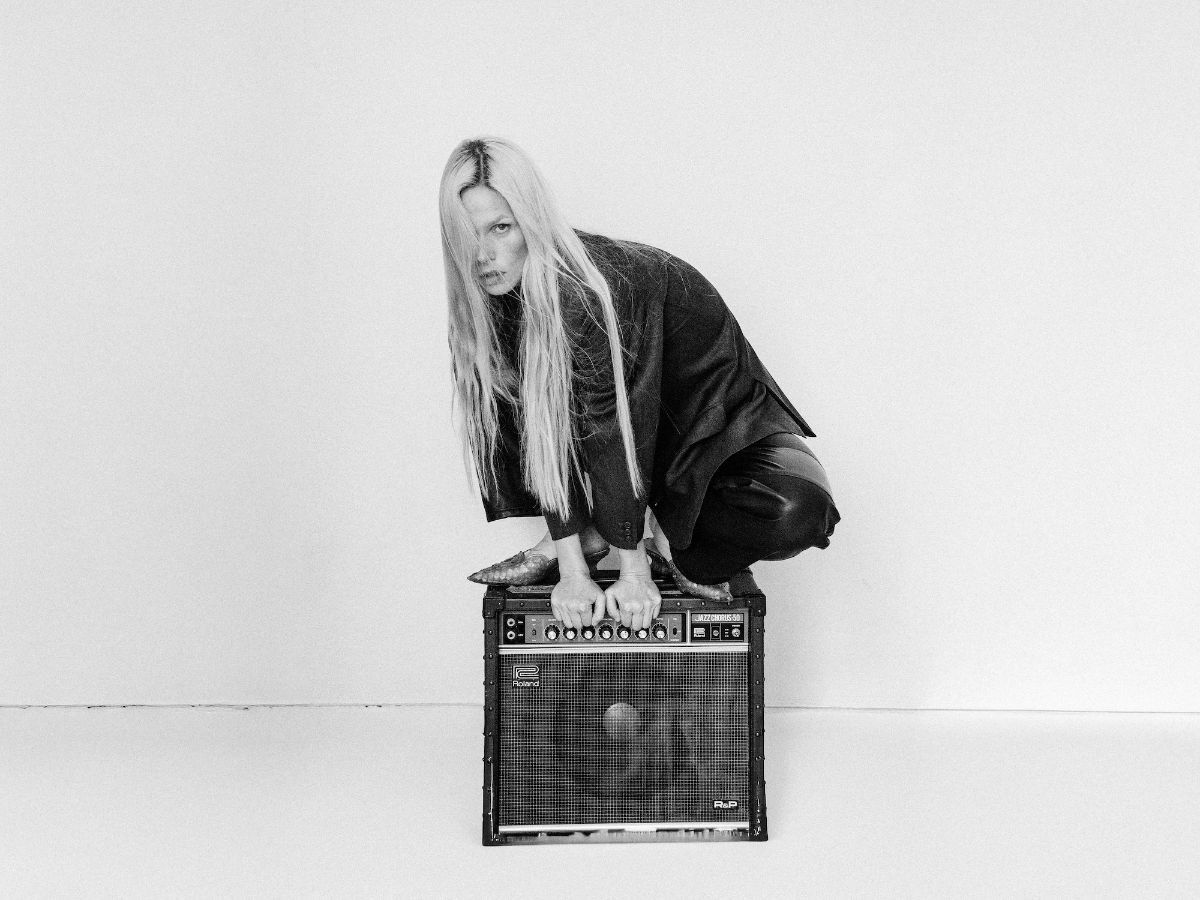 Anyx Interview Image by Michaela Knizova
“I care less about whether a concept is interesting on paper than whether the music does something to me physically and emotionally.”
Video
