

Name: Ariel Quartet
Members: Alexandra Kazovsky (violin), Amit Even–Tov (cello), Gershon Gerchikov (violin), Jan Grüning (viola)
Nationalities: German (Jan Grüning), Israeli (remaining members)
Current release: Ariel Quartet 's new album, their third volume in a trilogy of Ludwig van Beethoven's Complete String Quartets, is is out now via Orchid.
If you enjoyed this Ariel Quartet interview and would like to know more about the ensemble and their music, visit their official homepage. They are also on Instagram, and Facebook.
When did you first start getting interested in musical interpretation?
The quartet started playing together when we were middle school students. It was a school specializing in music and dance, and we became a part of a very engaged community of teenage musicians who would sight read together, explore and discuss music.
We would take interest in a musical theme, or marvel at a certain chord or a surprising key in a piece (for example, discovering for ourselves the strangeness of the last movement of Beethoven’s quartet op. 59 no.2, which starts as a C major movement while the piece is in E minor, and somehow manages to pivot back and finish in E minor) and share those exciting findings with one another.
We were just curious kids and ready to marvel at our own discoveries, not thinking much about any value in doing it or practical applications. However, this shared excitement and the desire for exploration in essence was the beginning of learning how to understand music, what to pay attention to, and most importantly the joy of communicating the fascination of those awesome findings with one another.
I now realize that these musical games and discussions were the beginning of lifelong fascination with musical analysis and has become a foundation of the interpreters we are today.
Which artists, approaches, albums or performances captured your imagination in the beginning when it comes to the art of interpretation?
While developing as a quartet and as musicians we were drawn to two types of artists.
We developed a tremendous respect for string quartets who were able to respect the score to the tiniest dot, and make a beautiful convincing and a very faithful performance of any work they play (such as the Alban Berg Quartet). On the other hand, we were absolutely taken by performers who’s sound aesthetics, artful timing and personality were absolutely at the forefront of everything they play (for example the Amadeus and the Budapest Quartet).
We felt that our role as musicians was to be able to combine those qualities in the most compelling and personal way, to be able to communicate the emotional strength of the music through our best effort to understand the intentions of the composer.
What do you personally enjoy about the act of interpretation? Are you finding that this sense of enjoyment is changing over time?
One of the biggest joys for me as an interpreter is to be able to reconstruct for myself a certain underlying logic or an overarching idea embedded piece of music and to be able to trace its thread through a myriad of small details.
Very often a seemingly minor event will have very significant consequences later (for example, the interval f-e in the cello in bar 2 of Beethoven’s op. 132 will become the main building block of the whole piece, while the note F will become the home key of the slow movement).
There is an endless joy in creating a hypothesis and having it be supported or reshaped again and again by a set of markings that at first glance may seem superficial; perhaps an articulation marking or a choice of dynamics, a surprising harmony or even an embellishment. It is similar to an experience of putting a few puzzle pieces together and having everything else magically fall into place.
Beginning with Haydn, and certainly in the music of Beethoven, every musical event or choice is based on few basic elements (i.e. motivic, rhythmic, harmonic etc.) which were embedded previously, overtly or often covertly. There is hardly a biggest joy to uncover how a certainly seemingly surprising and exciting event (such as a strange recapitulation, or a weird coda) had been conceived at the very start and just waiting to materialize.
It feels like unveiling a great secret the piece caries within it.
How much creativity is there in the act of interpretation? How much of your own personality enters the process?
The art of interpretation is one of the most creative aspects of being a musician. Every piece is like a big playground where every musician will chose to engage with the elements that are most fascinating to them, those details which feel intuitively most significant and worth highlighting.
As a string quartet, we are tremendously lucky to work as four interpreters, coming from four very different standpoints which are informed by each of our parts, our personal musical (and non musical) experiences as well as individual characters. We often argue, disagree, try various versions, and the best moments happen when we manage to combine seemingly contradictory ideas and allow something completely new to emerge.
One great example out of the Beethoven cycle would be the approach to tempo in op 95. Beethoven has given metronome markings to each of the movements, which are quite fast for the instruments (or some would say nearly impossible). At the same time these markings are very important because they illustrate the intensity and strength of the piece.
In order to resolve this conflict between what’s written and a performance that feels playable we had to endlessly experiment with faster and slower versions, approaches that were less or more metronomical to find the balance that seemed to respect Beethoven intention and at the same time give the work the instrumental and musical breathing room it deserves.
Could you describe your approach to interpretation on the basis of a piece, live performance or album that's particularly dear to you, please?
As we were recording the complete Beethoven cycle we tried to lean on two pillars, one is the emotional or more personal approach to the works, the other very disciplined, committed to being true to the score.
We have been very fortunate to play and live with the Beethoven quartets for many years, (some of the works we first learned when we were still teenagers) and have a chance to experiment with and experience those timeless works through different stages of our lives.
A musical interpretation is a living thing, ever changing with the artist. There are always more discoveries to be made, and different ways to hear those works as we change as people and musicians.
In many cases, the score will be the first and foremost resource for an interpretation. Can you explain about how “reading” a score works for you?
One of the things that is immediately evident from looking at a score is how the voices interact with one another.
For example, it’s easier to see if there is a line or a motive that will get repeated or continued in another voice. We often look at a score to see how the voices line up together in time, or what chords we create together. The visual effect of looking at a score can very quickly reveal changes in texture and length of phrasing.
However, for our quartet there is another way to “read” a score or learn a score – as we play a piece we are trying to gather information in real time by listening and observing, like we are attempting to understand and memorize the score from hearing. That allows for a deep, intuitive feel for voice leading, colours, and chord progression.
However, it is the combination of the two that allows us to get the wonderfully rich picture of the work. Needless to say, studying the score can be a nearly endless process, with always more things to discover.
One of the key phrases often used with regards to interpretation are the “composer's intentions”. What is your own perspective on this topic and its relevance for your own interpretations?
As a quartet we believe that there is an internal logic or a principle that is guiding any piece of music that is written well, and that the composer knew that all the components should work together.
Our efforts at “faithfulness” to the composer goes not only in trying to precisely execute all available markings, but to understanding the patterns and communicating the overarching idea that stands behind those markings. Not less importantly, we allow ourselves to enlist the help of our imagination to try and envision the most beautiful or spiritual way in which all these markings should come together.
The greatest mystery of interpretation and the greatest variety of possible interpretations come from the fact that likely we can never precisely know exactly what Beethoven or any other composer had in mind or what they felt when they wrote a piece. Nevertheless, with our minds and intuition we each try to get as close to it as we are able.
There is a certain way that a composer wanted their music to touch another person and perhaps convey a certain image that goes beyond words, and each one of us is in some sense is a unique reflection of those intangible ideas and images.
Using our imagination to sense those ideas is not less important than being literally faithful to the written text.
When you have the score in front of you, what's your take on taking things literally, correcting possible mistakes, taking into account historical aspects etc?
We try to assume that anything that is written has a reason behind it. Even in a case of inconsistencies, we do our best to try to find any plausible explanation. At the same time, different composers use different compositional language and style of communicating their intentions.
For example, while in Beethoven we wouldn’t allow ourselves any freedom adding (or omitting!) any dynamic markings because of how particular he was about every single detail, in some Haydn quartets we understand that the composer expected the performers to take the lead and find variety in a stylistic and tasteful way with dynamics and often articulation. Some composers perhaps allowed themselves bits of “sloppiness” with certain markings missing – assuming that the performer will treat repeated material the same way as first time.
Some composers’ lack consistency of dynamics or articulation in repeated material without a clear substantiated reason could be telling us that multiple versions are possible and beautiful.
With regards to the live situation, what role do the audience and the performance space play for your interpretation?
For our quartet the live performance has always been in the centre of what we do.
Every hall, every concert night will have its own atmosphere, a particular way people listen, and it transforms the way we feel and engage with the music on stage. We often talk about the audience as the “fifth” member of the quartet, because of the atmosphere and energy it creates.
As we were making the recordings of the Beethoven Cycle, we wanted to convey this liveness and intimacy of a concert performance through the recording. We want the music to speak to the listener in a direct and a personal way, as if they were hearing it in a concert hall.
Some works seem to attract more artists to add their interpretation to it than others; some seem to even encourage wildly different interpretations. From your experience, what is it about these works that gives them this magnetic pull?
Beethoven has written for other mediums of chamber music before he published his first set of quartets op. 18. We are incredibly fortunate to have a cycle of 16 quartets spanning through all three Beethoven’s creative periods (early, middle and late). Each of those 16 quartets is very mature and unique.
I think the Beethoven Cycle has this magnetic pull because not only that each work is so well conceived and has an incredible aesthetic and emotional depth, but together they illustrate the incredible development of Beethoven as an artist and a person. I feel that playing and listening to Beethoven’s music invites self reflection and work of imagination, which allows artists to find their own angle, their own way to connect and express the music perhaps in quite a wide range of ways.
I should also say that these 16 quartets are very demanding, instrumentally, emotionally and as an ensemble, so perhaps completing the cycle has also an element of challenge or right of passage, similar to what I can imagine would be climbing a very tall difficult mountain.
Artists can return to a work several times throughout the course of their career, with different results. Tell me about a work where this has been the case for you, please.
One such work is Beethoven’s quartet op. 59/2 in e minor. We first learned the work when we were in our teen years. At that time it was definitely the most difficult and long piece we have ever played, in fact for a long time it felt almost insurmountable. The learning was very slow and every detail took a big effort.
Looking back, I think that the challenge of learning it before we were mature enough instrumentally and musically gave us the time to explore every detail in such a deep way, that certain things have been imprinted in my mind ever since. It was also the first time for us to discover one of Beethoven's slow movements from the middle period, a time when the slow movement really became the emotional heart of the piece. Playing that e major Adagio during those impressionable years was a very deep formative experience.
Coming back to this work years later always carries with it those seedlings that were planted when we were youngsters, but being able to reexamine the work as adults has given the work a very different shape.
Part of the intrigue of interpretations is that the process is usually endless. Are there, vice versa, interpretations that feel definitive to you?
I have hard time imagining that there could be a definitive unchanging
interpretation for us. It often feels that the last note of a concert or a recording is also a point of departure.
The way we see and hear music is changing at the same rate as we change as musicians and as people. There are endless discoveries to be made and endless ways to fall in love with a work well written.
I think this fascination is what fuels us to keep performing and engaging with music.

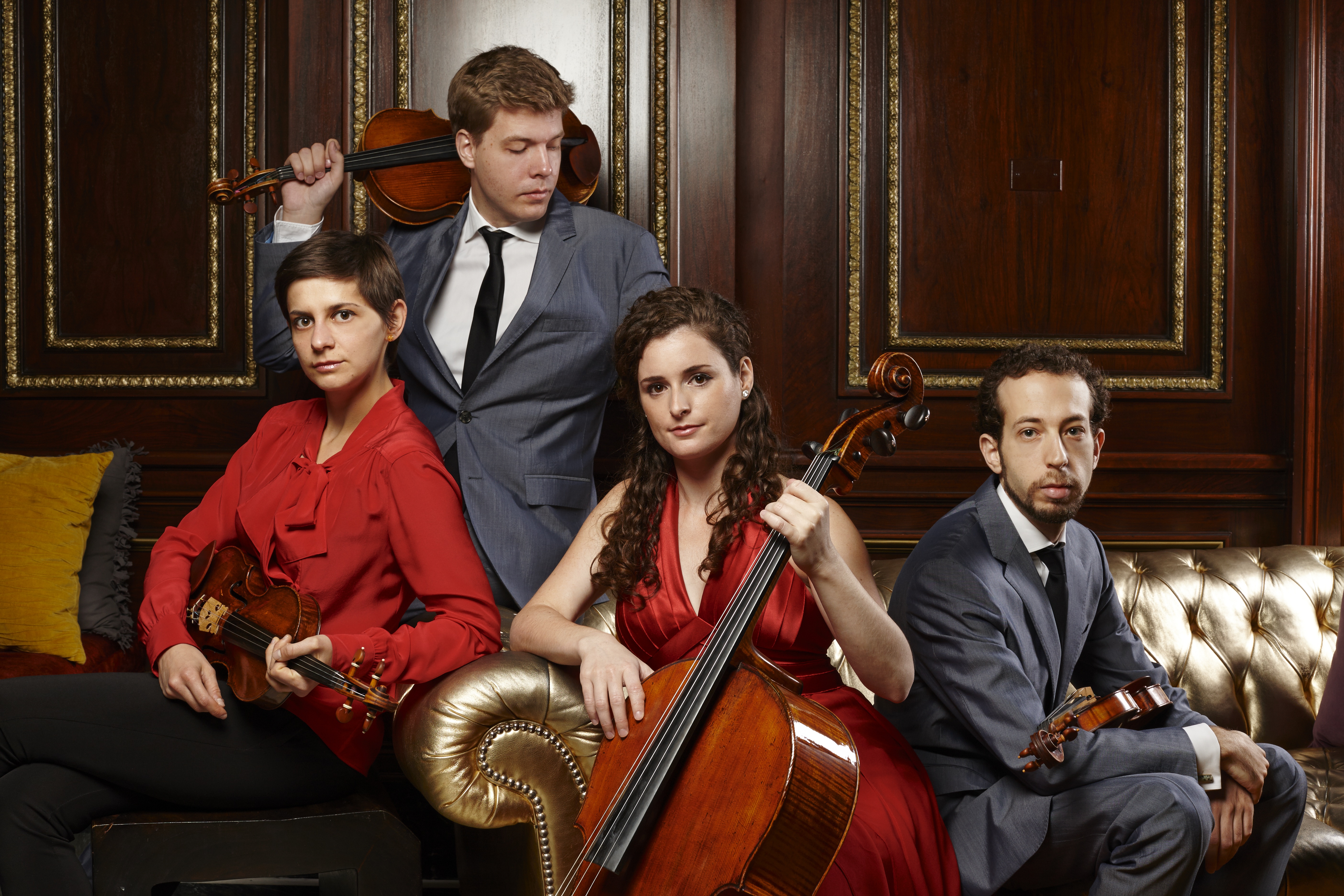 Ariel Quartet Interview Image (c) the artist
"A musical interpretation is a living thing, ever changing with the artist."
