Published
Name: BAG
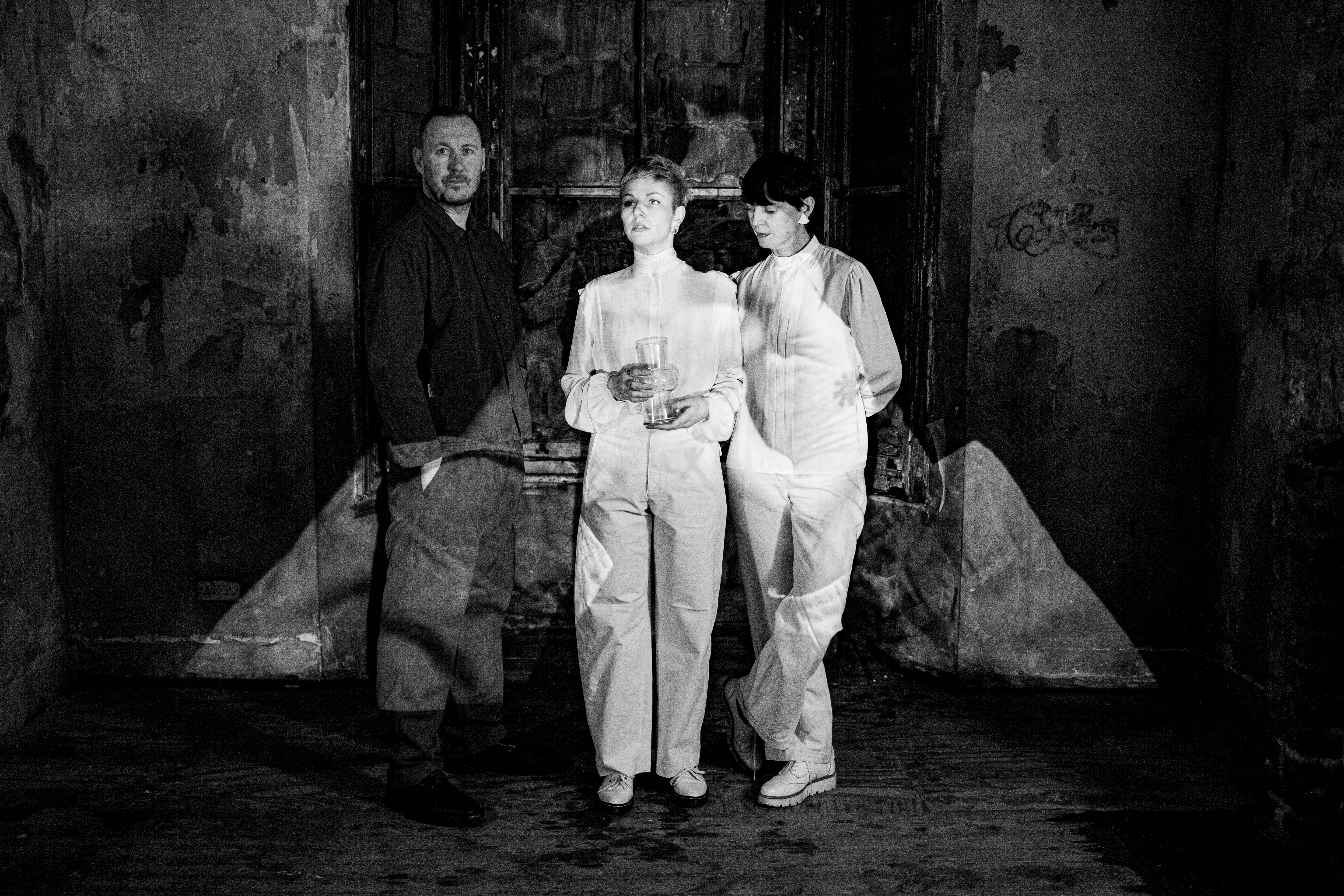
Members: Jody DeSchutter, Dan Allison, Angèle David-Guillou.
Nationalities: British (Dan), Canadian (Jody), French (Angèle)
Current Release: BAG's new album This House is a Body is out via Phantom Limb.
Recommendations on the topic of sound: I really love Trancendent Waves by Lavender Suarez. It is a beautiful book with exercises and illustrations in a digestible form.
Then of course the root of it all: Deep Listening: A Composer's Sound Practice by Pauline Oliveros.
[Read our Pauline Oliveros interview]
If you enjoyed this BAG interview and would like to know more about the band and their music, visit them on Instagram.
When I listen to music, I see shapes, objects and colours. What happens in your body when you're listening? Do you listen with your eyes open or closed?
Dan: It depends what state I’m in and the reason for listening to music at that moment.
For relaxation I’d generally have my eyes shut, I quite like to fall asleep to music. It’s not an insult to like an album because you can fall asleep to it.
How do listening with headphones and listening through a stereo system change your experience of sound and music?
Dan: Headphones when travelling, like most people.
When mixing, for me, it’s important to listen both ways. You have to understand what it sounds like in a room but also the intimacy of close up and personal listening, especially for checking how I’ve panned or placed a sound.
Tell me about some of the albums or artists that you love specifically for their sound, please.
Dan: So many … for our latest album ‘This House is a Body,’ a few of the songs were really inspired by the sound of Dr John’s Gris-Gris album.
There’s something about the production where you can feel the heat of New Orleans, the mystic smoke of voodoo in the air, it’s very sensory. That was a big inspiration, the sensory suggestiveness of the music and it’s production.
Jody: A bit left field perhaps but I remembering hearing Sylvia Plath read her poems out loud (specifically ‘Daddy’-oof) for the first time.
It was the way that they sounded – the cadence, tone, space, texture, repetition and rhythm she imbued texts with, that brought them to life and got me absolutely hooked.
There can be sounds which feel highly irritating to us and then there are others we could gladly listen to for hours. Do you have examples for either one or both of these?
Dan: Yesterday I listened to a track, can’t remember who but there was a sound that was identical to the email notifications on my phone … that was irritating.
I don’t want music to remind me of admin.
Are there everyday places, spaces, or devices which intrigue you by the way they sound? Which are these?
Dan: I make a lot of sounds via field recording, then distorting or sequencing. Our track ‘Floor Phlegm Hue’ is the sounds of a cooking pot from a house we stayed at in Italy.
I ran that through a sequencer and it produced the catchiest hook on our album.
I like to think about how many meals were cooked in that pot, cooked with love and flavour, somehow I think that metaphysically exists in the sound now.
Have you ever been in spaces with extreme sonic characteristics, such as anechoic chambers or caves? What was the experience like?
Jody: I have always wanted to experience an anechoic chamber; it seems analogous to the way we think of pure nothingness—silence is such a wonderful paradox—and always relative.
I’d love to hear my certain ‘silence’ amplified, although I’m not sure how long I could handle it to be honest … definitely on the bucket list.
What are among your favourite spaces to record and play your music?
Dan: Given the nature of what we do, we end up playing in a lot of gallery spaces, big white cold spaces where it should be hard to control the sound yet these gigs have always sounded great!
Perhaps it’s the natural reverb.
Do music and sound feel “material” to you? Does working with sound feel like you're sculpting or shaping something?
Dan: Jody and I both trained as painters, not musicians, so we approach music making as painters: layers, application, composition.
How important is sound for our overall well-being and in how far do you feel the "acoustic health" of a society or environment is reflective of its overall health?
Dan: I couldn’t live without music, it’s a constant for me, around the house, walking, working, creating. There is every type of music or creativity out there accessible via the internet now so you can find what you’re looking for, be it political or ambient.
Jody: I love the idea of having a ‘Rectifier’ fighting for the acoustic health of the city as in the movie ‘Noise’ — the connotation of the surrounding soundscape on any given day certainly alters my mood or the way I feel in a given space.
I do think it is reflective of overall health, noticing more in your body first when a space has the resources to take this into account. It doesn’t tend to be the first thing accounted for but it is noticed under the skin…
Sound, song, and rhythm are all around us, from animal noises to the waves of the ocean. What, if any, are some of the most moving experiences you've had with these non-human-made sounds?
Dan: I love the sound of crickets in a wide open space.
That’s so different from my daily existence in London that I’m sure it opens a different part of my brain.
Many animals communicate through sound. Based either on experience or intuition, do you feel as though interspecies communication is possible and important? Is there a creative element to it, would you say?
Jody: I do think we are communicating on some level across species all the time, although perhaps most examples I can think of within our current state are less positive, like modern environmental noises affecting habitats, disorienting mating calls or altering frequencies of bird song. Even if we don’t mean them to, the ultra-high pitches that prick dog ears or rumblings of boat motors carried across waves, do get a message across!
I certainly feel there is a creative element to any notion of purposeful communication; as in we need to think outside our own practiced and embodied frameworks of communication and imagine how other umwelts might operate. We should definitely do this more often.
Tinnitus and developing hyperacusis are very real risks for anyone working with sound. Do you take precautions in this regard and if you're suffering from these or similar issues – how do you cope with them?
Dan: I’m awful, I don’t take precautions despite having friends who have developed tinnitus.
Jody: I’ve started getting small intervals of tinnitus and do carry earplugs with me—I try to keep them in every bag I have but should definitely get better at remembering to put them in at every gig or soundcheck…
We can surround us with sound every second of the day. The great pianist Glenn Gould even considered this the ultimate delight. How do you see that yourself and what importance does silence hold?
Jody: I do find I need at least a small amount of silence (or relative silence) each day. Sound has such an influence on how I’m feeling, it colours the cadence of my thoughts, which I like digging in to and find useful.
But for some of those really labyrinthine thoughts or overwhelmingly beautiful views the imagined sound or amplified silence is enough!
Seth S. Horowitz called hearing the “universal sense” and emphasised that it was more precise and faster than any of our other senses, including vision. How would our world be different if we paid less attention to looks and listened more instead?
Jody: From my experience, having moved more consciously into a field of sound and listening from a solely visual one has just opened up a whole additional side of the polygon that is reality and human experience. Things feel more embodied; focussed and active.
The experience of going out field recording is truly magical; it is still one of my favourite things to do. Once the record button is pushed your attention is necessarily activated and you are almost forced to listen instead of just hear …