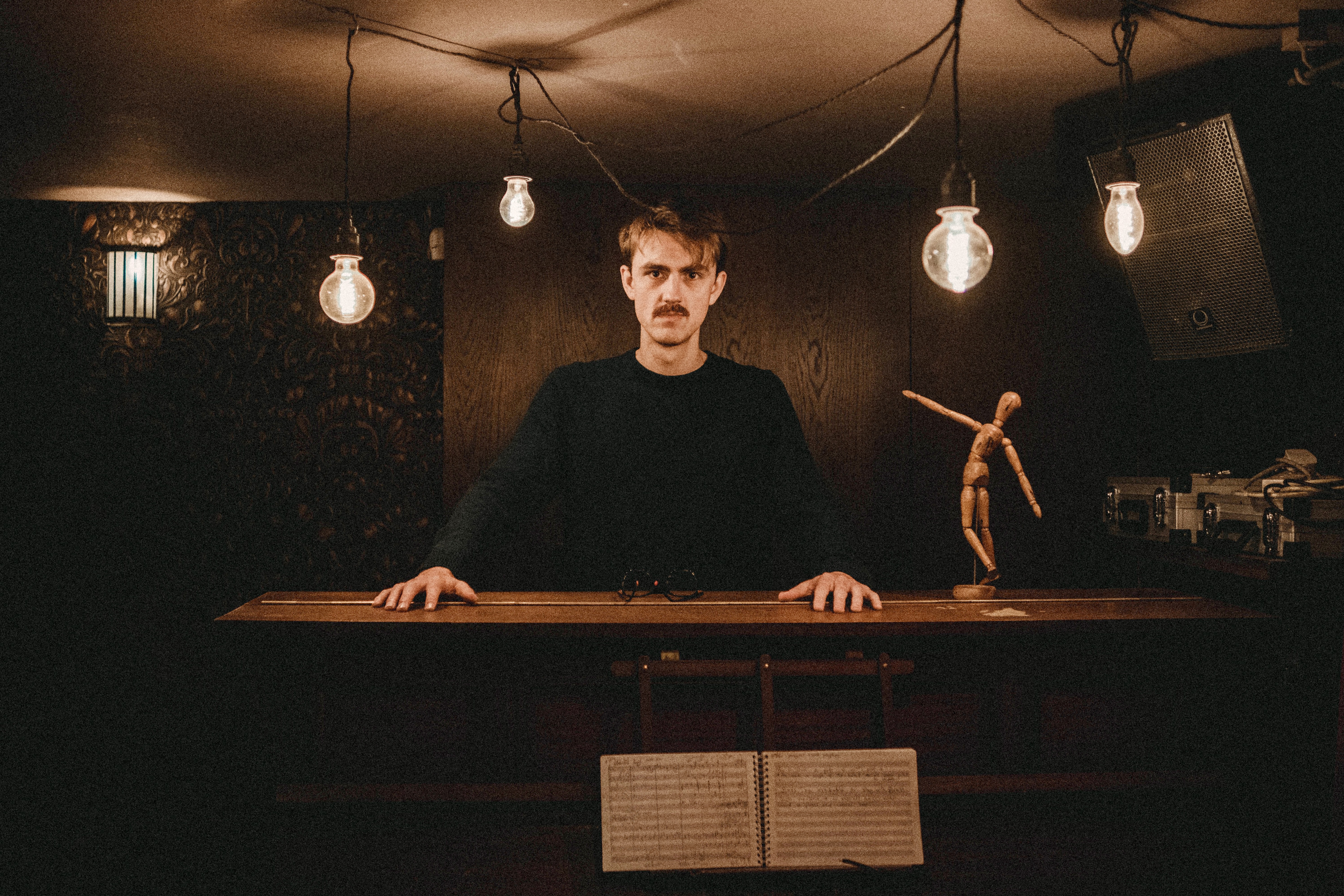


Published
Name: Billy Marrows
Nationality: British
Occupation: Guitarist, composer, arranger
Current release: Billy Marrows's new album Dancing On Bentwood Chairs (Live at Love Supreme) is out via Marrowpatch.
Hometown Recommendation: The Puppet Theatre Barge in Little Venice, near Paddington. It's a little barge with puppet shows and some music shows too: a cosy, special venue with 40 tiered seats and old puppets from around the world on the walls. I'll be playing there on 11th December with Grandinha Família, the mini version of Grande Família, for a Christmas special launching the EP we made with the wonderful Amsterdam-based singer Beth Aggett, featuring Tom Ridout, Mike Soper, Gustavo Clayton Marucci on Bass Clarinet, and Portuguese Young Musician of the Year 2025, Teresa Macedo Ferreira, on viola. Tickets: https://www.tickettailor.com/events/artofthepuppetltd/2440274
If you enjoyed this Billy Marrows interview and would like to know more about his music and upcoming concerts, visit his official homepage. He is also on Instagram, bandcamp, and Facebook.
When did you first consciously start getting interested in musical improvisation? What was your first improvisation on stage or in the studio and what was the experience like?
My first instrument was the trumpet, and I used to play along to Louis Armstrong records without any idea what I was doing. I'd copy him a bit, then just jam along. I also used to play around on the piano, playing random notes and loving the sounds they made together.
I guess that was all improvisation, but it got serious when I started playing guitar and discovered Jimi Hendrix around age 14. My first real improvising on stage was at my friend's dad's 50th birthday party at Featherstone Castle, playing Hendrix-inspired solos on "I Shot the Sheriff" and "All Along the Watchtower" with my friend and his dad. We plugged into the same amp and realised that if I alternated the tone control between 10 and 0 on my guitar it would create a wah wah effect for my friends guitar, and vice versa.
That Hendrix influence still comes through on the new album Dancing On Bentwood Chairs (Live at Love Supreme), particularly on the tracks ‘The Protagonist’ and ‘Capel Fawnog’.
Tell me about your instrument and/or tools, please. What made you seek it out, what makes it “your” instrument, and what are some of the most important aspects of playing it?
My electric is a Collings I-35 LC, which is based on a Gibson ES-335 but slightly smaller and lighter. I became frustrated with my previous Gibson ES-335 because it was a bit too dark. It was an instantly good jazz sound, but I missed having the high end sparkle.
The Collings gives me the whole frequency spectrum and is very even across the whole range. It stays open and non-muddy even on low voicings and is also incredibly stable. Once you tune it at the start of a gig you rarely have to retune, and that’s really beneficial when it comes to recording.
The new live album captures our set at Love Supreme Jazz Festival this summer from start to finish, with no editing (apart from cutting down one section of my mic chat), and I didn’t have to adjust my tuning once, which is great for the momentum and flow of a gig.
My acoustic is a Martin 000-18 Custom Shop 1937 Aged, which I got a couple of years ago. It's built like they were in the 1930s, with hot hide glue and a thin Adirondack spruce top. It's extremely resonant and dynamically responsive, and just as non-muddy.
In June I recorded an EP in collaboration Beth Aggett, a wonderful singer-songwriter based in Amsterdam. For this I used mainly this guitar, and a little bit of nylon string guitar too. It’s coming out in early December and will be my first release without any electric guitar!
How would you describe your own relationship with your instrument – is it an extension of your self/body, a partner and companion, a creative catalyst, a challenge to be overcome, something else entirely?
Mostly it's a creative catalyst.
The acoustic especially. The resonance of the sound coming from pieces of wood massively inspires me when composing, and I write very fast on it. I also love how responsive it is to loud and soft attack when I'm improvising.
The electric works the same way. You play something and it inspires the next idea. After 20 years of playing guitar they also feel like a natural extension of my body and musical mind. I try to sing through the instrument, either singing at the same time or imagining I am.
Derek Bailey defined improvising as the search for material which is endlessly transformable. What kind of materials have turned to be particularly transformable and stimulating for you?
For me, the melody of a song is infinitely transformable, in terms of phrasing, rhythm, dynamics, colour, emotion …
I love how the players in the Billy Marrows Band approach this, particularly Chris Williams, who often adds little variations to the melody. It's not just improvising the solos, it's improvising with the written material too.
You can hear this particularly in the outro to ‘Woland Blues (Live)’ from 8:10 onwards, where both me and Chris are being playful with composed lines.
The title track ‘Dancing On Bentwood Chairs (Live)’ has some inflections in the melody that Chris came up with in the moment then became part of the composition, for example 1:21 and 1:47.
Do you feel as though there are at least elements of composition and improvisation which are entirely unique to each? Based on your own work or maybe performances or recordings by other artists, do you feel that there are results which could only have happened through one of them?
I use improvisation a lot when composing: improvising on the guitar to find ideas, improvising over the top of something to find another part, or singing and recording myself.
But then taking time to put it all together, not in real time, gets me somewhere I couldn't reach by improvising alone. I do think of improvisation as real-time composition, but in my experience the results are quite different.
In a band you also get inspired by the other musicians and taken into territories you wouldn't find at home.
When you're improvising, does it actually feel like you're inventing something on the spot – or are you inventively re-arranging patterns from preparations, practise or previous performances? What balance is there between forgetting and remembering in your work?
I try to improvise purely and not rely on pre-learnt licks, but of course everything comes from somewhere: things I've practised, listened to a lot or transcribed, and some muscle memory too. It all becomes an inner bank of ideas I can draw from.
What I focus on is being creative with phrasing and rhythm, and listening to what's going on around me. That way, even if I play something similar to before, it feels fresh and relevant to that moment.
Artists from all corner of the musical spectrum, not just “free jazz” have emphasised the importance of freedom in their creativity. What defines freedom for your improvisations?
I often play over forms or chord changes, so for me freedom is not being boxed in by them.
When I was younger I noticed my lines would change direction every time the chord changed, so my ideas were being dictated by the harmony. Real freedom is being able improvise phrases that go across the form and the chord changes.
Taking your recent projects, releases, and performances as examples, what, would you say, are the key ideas behind your approach to improvisation?
It's often over forms or chord changes, sometimes completely free, and mostly melodically driven.
I try to play as compositionally as possible, developing ideas and being playful rhythmically. I also listen as much as I can and engage with the other musicians and the space, and put as much honesty and emotion into it as I can. Rhythmic interaction is also a key improvisational element for me, both between the players and between the soloist and the written material.
A couple of examples of the latter from the title track of the live album Dancing On Bentwood Chairs (Live) are: 3:00-3:42, where I’m interacting with the sax backing line, either ending my phrase just before its phrases begin, or playing over it to create a longer phrase, and 3:42-6:30, where at first Jay Davis on drums, and the Chris Williams on sax solo over the hits of the chorus.
You can really hear how Chris often ends his phrase just before the hits.
In your best improvisations, do you feel a strong sense of personal presence or do you (or your ego) “disappear”?
I'm not sure I've ever completely disappeared, but I like to think I'm experiencing the music from a bird's-eye view rather than thinking about what I'm playing.
You hear the whole music and are part of it, getting lost in it and letting your subconscious take over.
What are some of your favourite collaborators and how do they enrich your improvisations?
The guys in the Billy Marrows Band, who I've just released the live album with. They're open, endlessly creative musicians who really listen.
Playing with Jay Davis on drums feels effortless, and I play my best with him. Huw V Williams on bass has a lot of depth, in both sound and the pithiness and nuance of his playing, and gives me loads to respond to in my improvising.
We've been playing duo recently too, which has been really enjoyable.
In a live situation, decisions between creatives often work without words. From your experience and current projects, what does this process feel like and how does it work?
In the band everyone listens so much that one of us can take things in a certain direction, in intensity or dynamics for example, and everyone else will follow.
It's the same with how everything fits together rhythmically. If you leave space, someone else will momentarily come to the fore. It's a natural ebb and flow.
For form I'll cue things with a gesture or a musical cue, like playing a certain line in "Dancing On Bentwood Chairs" (eg at 1:12 in the live version) so everyone knows to go onto the next section. Eye contact matters a lot too.
Stewart Copeland said: “Listening is where the cool stuff comes from. And that listening thing, magically, turns all of your chops into gold.” What do you listen for?
I'm taking this as listening while you play, rather than listening to records, though that would be equally true.
When you're really present with the other musicians, what you play is relevant to that moment, rather than churning out stuff you know, as if you were playing along to a backing track. It turns chops from showing off into something special in the moment.
That's partly why I was so keen to release the live album. The whole day was special. Chris and Huw's little daughters, two and three years old, came along and danced like crazy, and everyone on stage was super tuned in. It's great to be able to share that.
There can be surprising moments during improvisations – from one of the performers not playing a single note to another shaking up a quiet section with an outburst of noise. Can you tell me about such situations from your own performances and how they impacted the performance?
It happens a lot in Grande Família, my 12-piece band and it’s smaller incarnations, especially with Tom Ridout on recorder and tenor/soprano sax. He'll always come out with something unexpected, especially when he's trading with trumpeter Mike Soper.
One time he played an incredibly high note on soprano, a forte-piano crescendo that got louder and louder, then stopped dead, and it was Mike's turn to play. I love that about his playing.
As a listener, do you also have a preference for improvised music? If so, what is it about this music that you appreciate as part of the audience?
I love improvised music, but I love non-improvised music too, like classical or singer-songwriter music where improvisation isn't the focus.
With improvisers, I love the free-flowing energy of hearing musicians react to each other. It's special to hear where someone's creativity takes them in the moment.
In a way, we improvise all the time. In which way is your creative work feeding back and possibly supporting other areas of your life?
Definitely positively. I teach guitar, so I'm improvising a lot while teaching, and that feeds back into my playing.
And in day-to-day life you have to improvise all the time. I think life and music feed into each other.