Published
Name: BIRDVOX
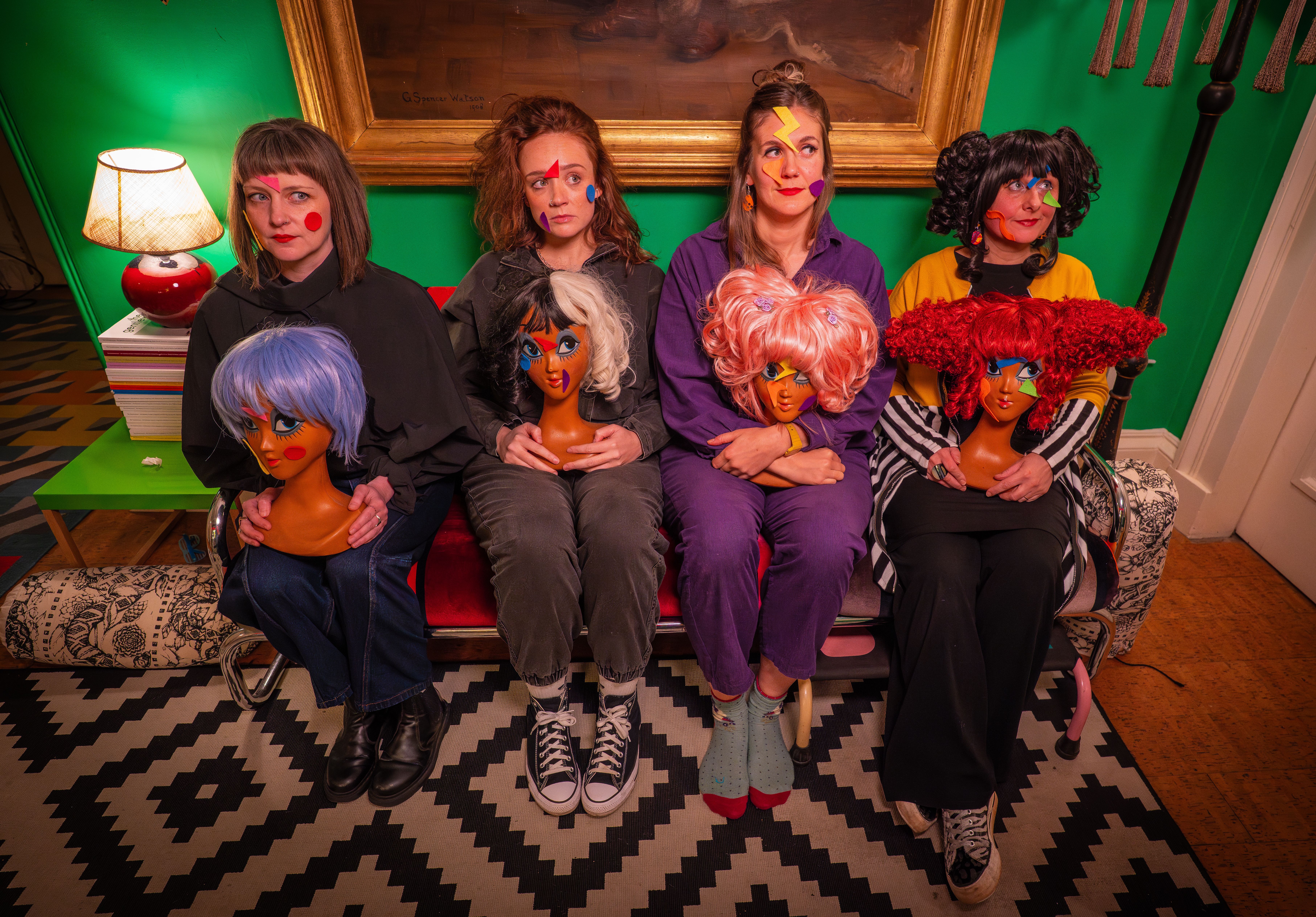
Members: Inge Thomson, Sarah Hayes, Charlotte Printer, Jenny Sturgeon
Interviewees: Inge Thomson (IT), Sarah Hayes (SH)
Nationality: Scottish
Current release: BIRDVOX's new album Shamming The Drama is out via Hudson.
If this BIRDVOX interview piqued your interest, and you would like to know more about the band and their music, visit their official homepage. They are also on Instagram, Facebook, and bandcamp.
Where does the impulse to create something come from for you? What role do often-quoted sources of inspiration like dreams, other forms of art, personal relationships, politics etc play?
IT: I love making music, I love hearing other musicians respond to what I’ve offered and I love being given the chance to respond to others’ ideas – this is the primary impetus to create.
However, spending time listening to the more human world around us inspires me to experiment and widens the possibilities in terms of lyrical content.
For you to get started, do there need to be concrete ideas – or what some have called a 'visualisation' of the finished work? What does the balance between planning and chance look like for you?
IT: I tend to start with an idea that feels concrete but soon becomes pliable and putty-like as I explore its parameters.
Chance and the 'happy accident’ usually play a big part during the development of a piece of music for me.
Is there a preparation phase for your process? Do you require your tools to be laid out in a particular way, for example, do you need to do 'research' or create 'early versions'?
IT: If I’m writing about a particular subject, I like to deep-dive into reference books and other artists’ interpretations of the subject.
I’m a serial notebook keeper; I will brainstorm ideas, make sketches, list relevant words/colours/images … anything to help build a mood.
Do you have certain rituals to get you into the right mindset for creating? What role do certain foods or stimulants like coffee, lighting, scents, exercise or reading poetry play?
IT: I like to create brain space by being outside, guddling in rockpools, swimming in lochs, turning over stones, recording birds and insects.
This is like meditation to me.
For Shamming The Drama, what did you start with? If there were conceptual considerations, what were they?
SH: This band slowly evolved out of a project called Northern Flyway – a touring audio-visual production led by Inge and Jenny in 2018.
The early concept for Birdvox as a band was for the music to be based around upbeat, mostly danceable elements, to continue to reflect our collective interest in the natural world, to be unafraid to tackle difficult subjects through upbeat music, to be open to collaging all sorts of influences and to be an outlet for other sides of ourselves we hadn’t explored in other projects.
Tell me a bit about the way the new material developed and gradually took its final form, please.
SH: Each of us brought song demos and ideas to the group. Some of these were more fully formed from the outset and we put final arrangement touches to them together (e.g. “Sparx”).
Some were in early stages of development and we wrote extra parts to flesh them out (“We Are”).
Some were just the kernel of an idea which we built from the ground up (“King Orfeo”).
Our co-producer Peter Brewis (Field Music) helped us shape and develop the songs in the studio.
We carefully considered how to make the four writing styles cohesive, particularly in the use of our voices across the whole album, the drum machine palettes we chose and the blend of acoustic and synthesized instruments.
What makes lyrics good in your opinion? What are your own ambitions and challenges in this regard?
IT: For me a good lyric is one that feels original or has a new way of saying something.
I can be emotionally receptive, sometimes a song stops me in my tracks and I feel like the lyrics resonate really deeply. When that happens I treasure the relationship I have with the song.
What are areas/themes/topics that you keep returning to in your lyrics?
SH: I first began writing lyrics around 2017 for a duo called You Tell Me (also with Peter Brewis), so it feels like I’ve come to this aspect relatively late in comparison to my other composition work, although I have always had a love for the written word.
I realised recently that several of my songs touch on my particular experience navigating life as an autistic person, either overtly or in passing – despite the fact that I didn’t know this when I wrote them! Themes of communication and confusion in relationships, a busy inner world, feeling things deeply, an underlying sense of outsider-ness.
I pushed myself to write about some new topics with Birdvox: “Sea Change” is about misogyny and abuse in the music industry (and the power of community to challenge it).
“Shape Of A Friend” celebrates the magic of friendship via the image of a blackbird.
Many writers have claimed that as soon as they enter into the process, certain aspects of the narrative are out of their hands. Do you like to keep strict control or is there a sense of following things where they lead you?
IT: I don’t feel like I’m not in control, but sometimes a whole song comes to me in one go.
There are many descriptions of the creative state. How would you describe it for you personally? Is there an element of spirituality to what you do?
SH: At its best it feels like genuine flow, uncovering each idea, becoming absorbed and refining the micro and the macro.
To be completely honest though, for me it’s becoming more difficult to find the time and headspace in amongst everything else – very much hoping I can access this again before the year is out! It’s a rare and nourishing place to be.
Once a piece is finished, how important is it for you to let it lie and evaluate it later on? How much improvement and refinement do you personally allow until you're satisfied with a piece?
IT: I think detail is really important, but I’m a firm believer in setting a deadline for tweaks.
You can tweak forever and it makes no discernable difference from the listener’s point of view – meanwhile it drives the creator mad and in the worst case scenario it can strip the human traces from a song.
In terms of what they contribute to a song, what is the balance between the composition and the arrangement (including production, mixing and mastering)?
SH: This balance can vary quite widely between projects, I think.
The production ideas, sounds and mix choices were a big part of the Birdvox record because we consciously used them as tools to help shape ostensibly disparate things e.g. four personalities, writing styles, numerous musical references.
The common sonic threads I mentioned earlier, plus trust and respect for each other, also go a long way to tying it all together while serving each song.
Music and the accompanying artwork are often closely related. Can you talk about this a little bit for your current project and the relationship that images and sounds have for you in general?
SH: Our album artwork by Caroline Dowsett reflects some of the joy and chaos found in the music.
One of the exciting things about starting this new band was having the freedom to think about visual and aesthetic elements quite early on. We had a photoshoot wearing Irregular Sleep Pattern pyjamas before we’d even written any music together! Now we wear them onstage.
I often find visual art, fashion and film really inspiring – sometimes going to an art gallery can help spark or unlock musical ideas for me more than going to a gig. There’s something about responding to an artform you don’t work in yourself.
After finishing a piece or album and releasing something into the world, there can be a sense of emptiness. Can you relate to this – and how do you return to the state of creativity after experiencing it?
IT: I have certainly felt this with previous projects especially commission work and other projects of a finite nature, however we are currently touring this work so it feels very much alive.
I would love to know a little about the feedback you've received from listeners or critics about what they thought some of your songs are about or the impact it had on them – have there been “misunderstandings” or did you perhaps even gain new “insights?”
SH: I guess we’ll know more after the album is released … but it’s been interesting hearing early responses, mainly about our bringing together of different styles and genres.
One of our core intentions was to be open to influence from anything we’re interested in – combining musical styles on an equal footing rather than them being in opposition to each other e.g. “pop vs. folk” – and we hope this is clear to the listener!
It’s been nice getting to know the original meaning behind one another’s lyrics. There have been a couple of surprises, which just reinforces how we all filter words through our own experiences and assumptions – of course these kinds of layers of meaning are what make lyrics personal and universal.
Creativity can reach many different corners of our lives. Do you personally feel as though writing a piece of music is inherently different from something like making a great cup of coffee? What do you express through music that you couldn't or wouldn't in more 'mundane' tasks?
IT: Creative artistry exists in many forms across all lines of work– as can functionality.
A musician writing a good 6/8 jig for dancing could create a great functional work of craftmanship, that same musician could create an epic work of art. Same goes for baristas!