Published
Part 1
Name: Björn Lücker
Nationality: German
Occupation: Drummer, composer, improviser
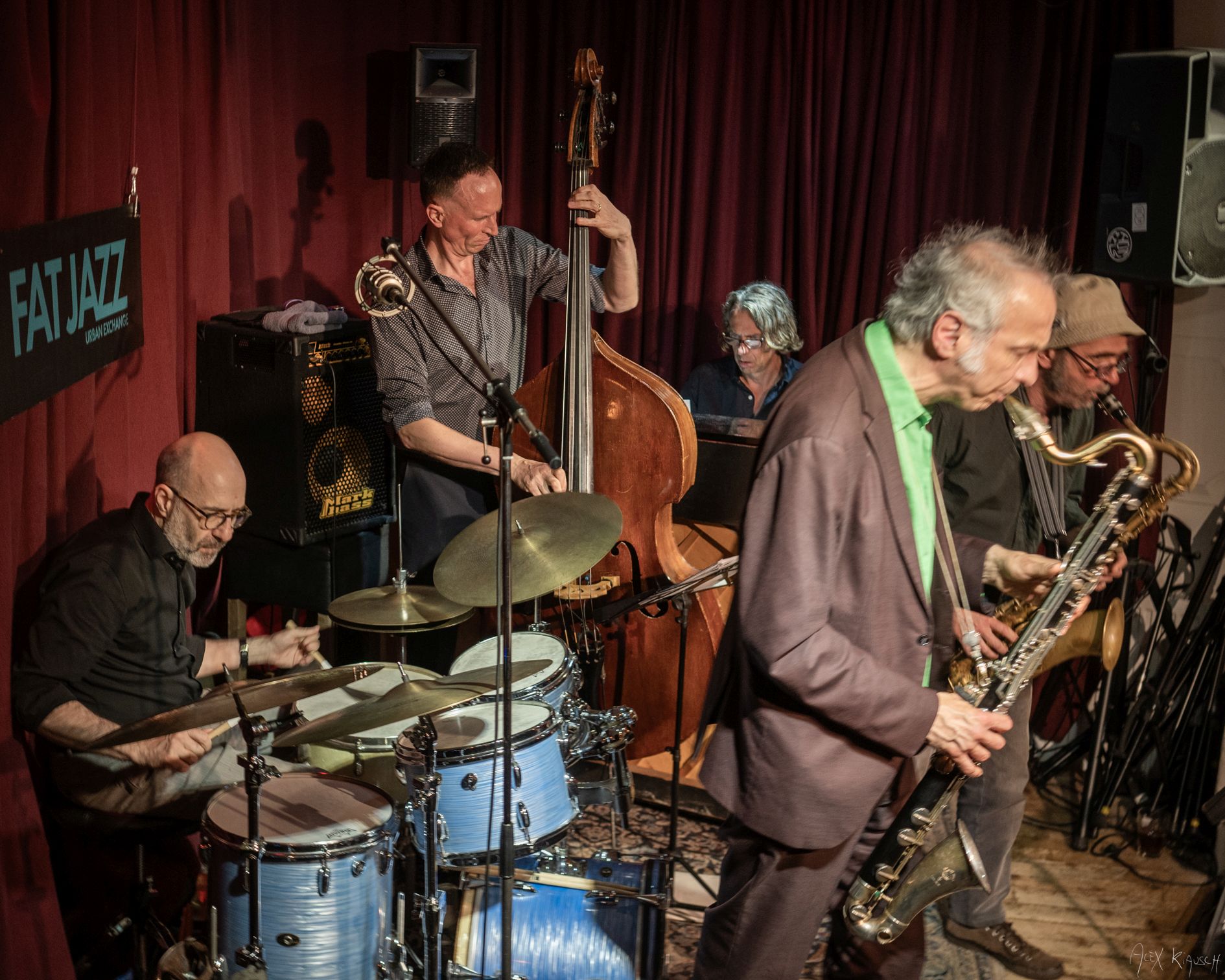
Current release: Björn Lücker Berlin Ensemble's new album Tea for Five is out via unit. Alongside Lücker on drums, it features Rudi Mahall (clarinet, bass clarinet), Henrik Walsdorff (tenor saxophone), John Schröder (piano), and Lars Gühlcke (doublebass)
Recommendation for Hamburg, Germany: Hamburg is a beautiful city with a lot of nice things to see or visit. It’s hard for me to name one. The last video is an occasional smartphone video filmed at a gig in a nice tiny club called “Hafenbahnhof“ which used to be a great place for jazz and improvised music but unfortunately stopped doing this a few weeks ago.
Recommendations for pure drum recordings: I don’t know too many of them, or at least only very few I like or find interesting. Most good solos are, for my taste, embedded in group constellations with other instruments. I think I’ve heard some good pure drum solo stuff on the net or on album or live by, for example, Andrew Cyrille, Milford Graves, Bill Stewart, Pierre Favre, Mark Nauseef, Michael Griener, Morten J. Olsen and some others.
In this interview I’ve enclosed three examples of my own pure solo recordings from the albums Aquarian Drum Song (“Ostinato 1“ and “Heart“, recorded in the studio) and Trace ("Trace Part Three," recorded live). One a capella drum solo that I like very much and which inspires me time and time again because of the sound and the conception is “Echo“ on Tony Williams’ album Spring. Lately I’ve heard that Vinnie Colaiuta thinks of it as one of the greatest drum solos ever as well.
If you enjoyed this Björn Lücker interview and would like to stay up to date with his music and live performances, visit his official homepage.
It seems as though most aspiring artists are drawn to the drums and percussion for one of two reasons: Creating sound/noise and creating rhythm. What captivated you?
I can not really say what captivated me. As a little boy I banged on pots and pans in the kitchen while my mother was cooking dishes. I think quite a few kids do so. The captivating thing at that time must have been the mixture of different sounds and physical feelings when hitting the various surfaces and then the rhythm that can easily be created and felt that way.
The first instrument I learned was the trumpet, but eventually I felt the strong wish to start playing and learning the drums.
In the school where I took my trumpet lessons, the drummer’s room was next door, and I was strongly attracted by all the drums and cymbals and sticks being stored in the corridor and as well by the people playing these instruments.
When I listen to music, I see shapes, objects and colours. Others experience emotions. Everything around drums, on the other hand, is based on touch, vibration, and movement. Does this mean that your own perception as a listener is also more connected to touch, vibration, and movement? What happens in your body when you're listening?
I think I can not separate the feelings in my body from the feelings in my mind while I’m listening to music that is played well.
I remember that while listening to the album Miles Davis In Europe for the first times (and it’s still the same sensation when I listen to it now, forty years and probably at least more than a hundred listens later) I was just overwhelmed by all the sounds, dynamic textures, harmonies and rhythms entering myself through my ears and instantly connecting and melting inside into one thing deeply touching my body and soul at the same time.
Björn Lücker Berlin Ensemble promo video, album release „Tea For Five“ (Unit Records): 19/09/25
While playing the drums I thoroughly deal with touch, vibration, movement AND emotion. While listening to or playing with a group as a whole I would like to feel all the components as one melange touching all of me in a way that even transcends verbal expressions. Of course that only happens in the best moments, and I feel that in order to create that, touch, vibration and movement are crucial on any instrument, although on the drums it might be most obvious and direct.
Over the years as a musician I learned to perceive all these components and the rhythm more and more strongly, and nowadays I might even see shapes and colours in the music, maybe especially since I started to be a painter as well.
What was your first drum set like and what are you using today? What, to you personally, are factors in terms of build and design that you appreciate in drums and percussion instruments?
My very first set of drums was a combination of big empty washing powder barrels that my mom painted silver for me to make them look like drums and a toy drum kit. I played it with chopsticks.
When I seriously started learning the drums in the late 70s I had a Pearl Export kit in the common rock sizes and a Tama metal snare drum and Avedis Zildjian and Paiste cymbals. As I got more and more interested in the music and sound of jazz I started to use drums with smaller jazz sizes and older cymbals with less weight.
After using Sonor Phonic and Gretsch I’ve been playing old vintage Slingerland drums now for many years, mostly small sizes. I love the drum sound of the 50s and 60s, and the old woods and thinner shells of the old drums give me the opportunity to get that sound and integrate it into modern music as well.
Also I was “socialised“ with the sound of the old cymbals (mostly old K and Avedis Zildjians) which bring richness and magic to the music. Actually many contemporary drum and percussion instruments sound very good as well.
Late Rush-drummer Neil Peart said: “The equipment is not an influence. It doesn't affect the way I play. It's an expression of the way I play.” What's your take on that?
Actually the equipment doesn’t really matter that much. I’ve heard so many drummers travelling without their gear and sometimes playing on very poor instruments given to them on location, sounding as good as usual.
Of course your own instruments that you select and work on express your sound and the way you feel and play. However, the more experience you have, you should be able to transform your sound through your personal touch and vibe and tuning to any instrument.
Frankly speaking it can be inspiring and freeing to play on drums that are not yours because it releases the pressure of presenting your signature sound at all times and sometimes gives you new ideas.
I’m not sure if I get Neil Peart’s statement correctly. I guess he means that he picks instruments that suit his way of expression well. Or does he mean that he takes command over any equipment to express himself without letting it influence or obscure or change his way of expression …?
Volquartz/Lücker/Hughes live at Golem
Given the fact that most people draw from the the cultures and traditions they got in touch with for some reason (I once had a student who really was an exception because he played incredibly sophisticated free improvisations on the drumset which sounded like he was deeply rooted in modern jazz traditions without ever having heard any jazz or improvised music and without knowing any traded musical form or concept), I can give a short description of my musical learning process:
At first I was simply fascinated by watching and hearing drummers play on television, no matter which style or culture at all. Then I was fascinated by all the percussion instruments I saw and heard, as I explained in the answer to the first question.
My parents always supported me and my mother arranged drum lessons for me. My teacher was a classical student who also was involved in the blues and blues rock scene. He was a very good tympani player and he introduced me to contemporary percussion ensemble music, orchestral classical music as well as to blues, rock and pop music. Later on he started to study Indian music, so I got a little glimpse of tabla playing. All these things were highly influential to me as far as music, technique and emotion was concerned.
Listening to African music and roots and dub reggae got me to hear the sound of African and Carribean percussion. By that time I was playing tympani and classical percussion in youth orchestras and drum set in blues, rock and jazz bands, mostly with my schoolmates, and in a jazz big band. A very good friend of our family was a jazz and classical music aficionado without being a musician. He taught me the feeling and the soul, just by listening to music together.
Around age fifteen I heard albums by Gerry Mulligan/Chet Baker and Clifford Brown/Max Roach at my parents' place which really turned me on to jazz. When a friend lent me the album Miles Davis In Europe which I mentioned earlier, that was the turning point for me to get totally absorbed in jazz music.
Starting to study jazz in 1989 I got in touch with European and American free improvisation concepts, free jazz and AACM, and the tradition of that added strongly to my “conventional“ jazz playing and education. Touring worldwide with a piano trio playing our own music, I experienced working with African musicians.
So in conclusion I think that in my development I was drawing more or less consciously from all these sources, the Afro- American jazz tradition combined with European influences and the touch and texture of classical music being definitely the strongest, the reasons for that being explained above.
What were some of the main challenges in your development as a drummer / percussionist? Which practices, exercises, or experiences were most helpful in reaching your goals?
I would say that the main challenge for me was to learn something that I was not gifted at at all. Learning to play the drums gave me a hard time as I did not have a good body feeling, fast reflexes or the ability for learning quickly.
Having decided to become a (jazz) drummer I knew I had to overcome all these obstacles. Listening and playing along again and again to recordings I like was the key to a self taught way of learning and improving in terms of reacting and making the music sound good.
Practising with a metronome was crucial for me, using an electronic metronome gave me the chance to hear myself and the click and to make the empty spaces to fill in bigger and bigger without loosing the tempo and time. Playing with other people as much as possible is indispensable to keep your playing rooted, playing things that work and make sense.
Books that helped me a lot where The Art Of Drumming by Robert Kaufman, using slow motion time exercises, and Accents And Rebounds by George Lawrence Stone for training both sides of your body to have the same strength and reaction.