Published
Part 2
How would you describe the physical sensation of playing the drums? [Where do you feel the resonances/pulse/groove, what are emotional sensations, is there a sense of release or tension etc …]
In the best case there is a “panoramic“ feeling.
This means that resonance / pulse / groove can move freely from the right to the left side and vice versa while playing phrases. I’ve worked a lot on creating phrases and figures that for example start on the left side between hi hat and snare drum and might move to bass drum and ride cymbal (I am right handed), allowing each limb to have equal rights in the phrase instead of using e.g. the hi hat only for playing on 2 and 4 for keeping the groove.
Nevertheless, being a jazz drummer, the ride cymbal is the main part and the power house of the groove and pulse. A jazz drummer should be able to drive the band only with his ride cymbal, creating atmosphere and time by playing it - it’s the connection to the bass and to the rest of the group. I try to listen to and feel the ride cymbal at any moment of my playing, no matter how dense my texture is. Creating a phrase or idea and building up inside it to a high tension is at some point followed by a release, like in normal life.
The same occurs when comping behind a soloist, helping him to build to a climax. By using all of the drum set’s instruments I feel the different resonances of them connected to the corresponding limbs, trying to blend them all or some of them to create an emotional statement, even if they are played one after the other.
Also I try to breathe through my phrases, changing from very spacey and sparse to very dense textures, depending on what the music calls for in different moments. I think the music always has to have a breath and a pulse that I can perceive and feel in my body, no matter if it’s time-based or non time-based / free music.
What is the relationship between harmony, rhythm and melody? How do non-percussion instruments contribute to the overall rhythmic texture of a piece?
Every player in an ensemble has the same responsibility for time and rhythm, rhythm wise the harmonies/chords and the melody have to be exactly in the right place to interlock with the drums and the bass - the right place being either on the beat, on top of the beat or laid back.
There are a lot of ways and shades to play together rhythmically, but there should be no such thing as using the drums or percussion only to rely on them rhythmically or because they are needed to help others keeping the time.
So only if every musician in the group is able to play with the same strong rhythmic sense and impact, be it with or without percussion instruments, can the music come alive with each musician ensuring the other rhythmically.
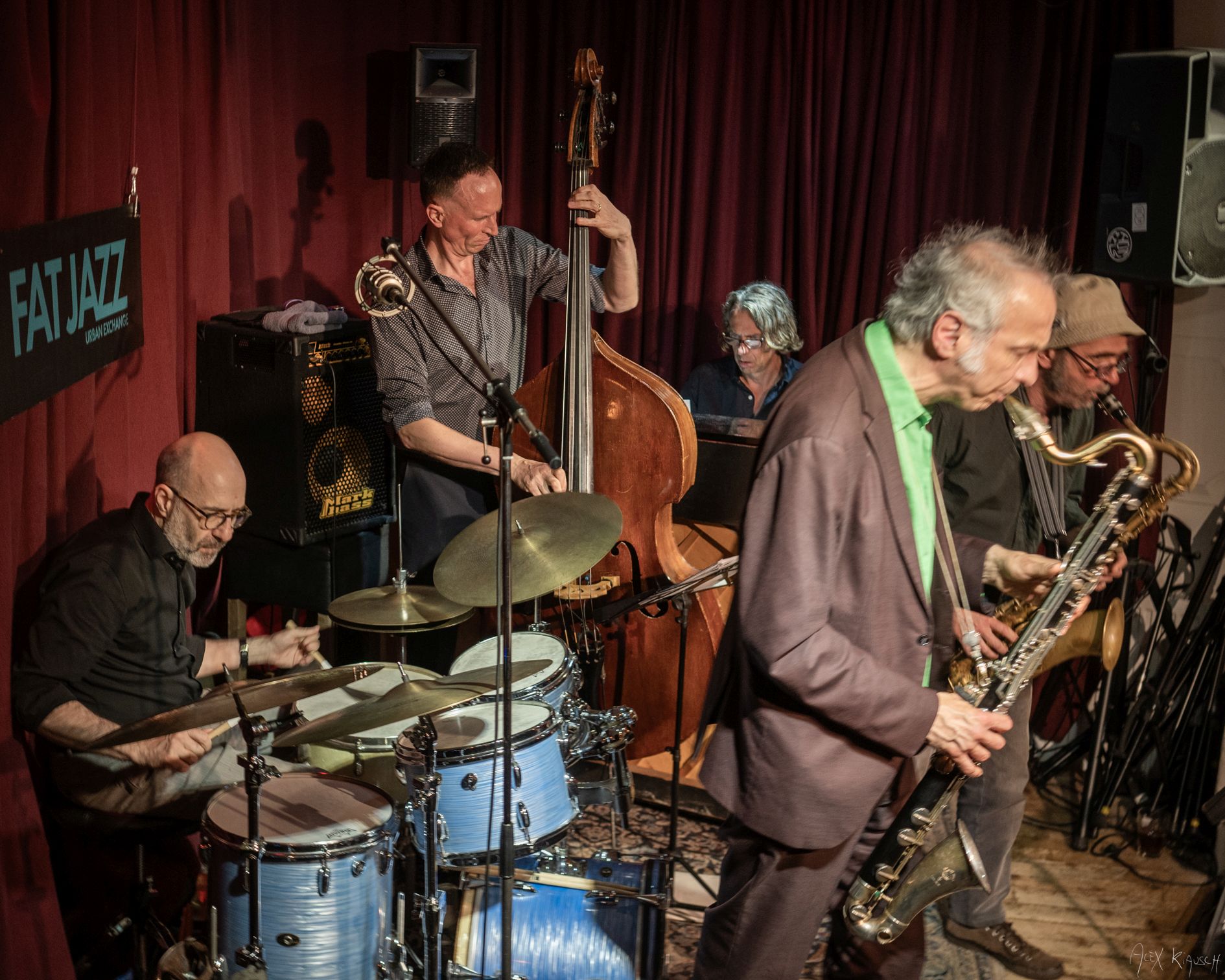
"WHL play Monk“ featuring Michael Moore
Do you feel that honing your compositional / songwriting skills has an effect on your drumming skills?
When I compose I don’t necessarily start from the drum part.
Any time when I play drums for a tune, no matter if I composed it or not, I try to make the music sound good through my contribution. As most of the time there is no written out drum chart in the music I mostly play I have to do instant composing according to the musical situation I’m in, my original music being no exception.
So I would say no, unless I compose a fully notated drum part or a tune that requires things that I’m not yet capable of playing on the drums. If that happens I definitely have to expand my drumming skills.
I've long been intrigued by bands or ensembles where the drummer is the leader and/or main composer. In as far as it is possible to generalise, what do you think changes in terms of the music or performance in these situations?
It’s mostly a psychological thing. If I’m the bandleader I might feel more responsibility for making the music and the performance come out well, although there is no real reason for that.
In this case it is normally me who calls the tunes, who arranges the set and the whole concert, making sure everything works, communicating details to the group members, the concert bookers etc ...
If it’s my original music being played / performed I might have a specific idea about how it should sound and be expressed while knowing the importance of leaving enough space for the other musicians in the band to be themselves musically. So I might compose parts tailored to the musicians who are supposed to perform the music.
It’s not that I care more for making the music / performance sound good when I’m the bandleader / composer, it’s just another way to approach it as opposed to just contribute my part as a band member.
"Gospel“ from "Free From Form For Feeling“
How are you making use of the timbral and textural potentials/possibilities of your drums and percussion instruments when making music?
I tune my drums very high because I’m aim for them to have a tone rather than just a sound or noise. By instinct I tune them to tones and intervals, not necessarily always the same intervals, but mostly harmonic relations like triads come out.
Picking and combining cymbals with the drums means to me that everything matches the way I want it to texture wise, with each instrument being still an individual voice, having an individual feel and being a musical statement on its own. In my approach even the bass drum, although still being the lowest pitch in the set, is tuned very tight in order to get a strong, short, percussive and tonal sound.
The tightly tuned drums normally don't interfere with or obscure the sound range of the other instruments in the group. When I play free improvised music I extend my sound range by adding different percussion instruments like bells, gongs, trashy metal and wood parts etc ... I call these sound percussion.
So my timbral and textural approach is inspired by the drummers I love on the one hand. On the other hand it gives me the sound possibilities for my personal way of expression after having experimented with many different tunings and sound combinations.
How has technology, such as drum machines and sequencers, impacted the way rhythm is created and perceived? Has it been a concrete influence on your own approach?
Drum machines, sequencers etc. added new sounds to the palette, which are mostly colder than acoustic sounds and can explore more extreme sound ranges like being very low, very high, very aggressive etc ... Hand made natural sounds can be imitated, contrasted, sampled or totally alienated. So the rhythm can have a whole different feeling.
Also people can make music with these devices without being able to play a “classical“ instrument.
My own approach has not been influenced much by these devices. However, I like working with musicians who use technology and electronic devices because I like the way it contrasts and completes my acoustic playing.
"Taking Off To Infinity“ by "Lücker Schickentanz,“ one of several promo videos
Physical strain is a particularly serious issue for many drummers. How does it manifest itself, how do you deal with it and in how far does it affect your creativity?
"Ostinato 1“ from "Aquarian Drum Song“
As far as I know most instrumentalists have to deal with different kinds of physical strain, depending on the particular demands of their instrument.
As a drummer I experienced hypertension in the neck, shoulders, arms, legs, feet and joints that are results of bad posture and too much tension built up because of “overconcentration,“ fear of failing and/or stressing certain parts of the body too much while executing certain strokes or figures.
I am working against that through jogging and muscular training several times a week. A very powerful method I practiced for a few years is Qi Gong. I did Chan Mi Qigong, a kind of Qi Gong for the spine, combined with Quiet Qi Gong, which is meditation with sounds. After a short period of practice the physical issues vanished and I started to be more focused and relaxed.
These days I don’t experience these issues much any more. I think reasons for that are: 1) I am more self assured and mature in my playing, which leads to more relaxed action and less hypertension. 2) I don’t consider the issues any more and if I do I don’t judge them as being bad and accept them. 3) My physical activities prevent me from having these issues.
Many recording engineers have remarked that the drums can be particularly hard to capture. What makes drums sound great on record and in a live setting?
I think what makes the drumset difficult to record are the many different and extreme frequencies and volumes of the drums and cymbals. A good and experienced sound engineer can definitely make it, though.
A special problem I’m encountering quite often are sound engineers who think of the bass drum as something that has to be deep and dry for technical and musical reasons, not being able or willing to conceive or accept the idea of a high pitched, tightly tuned jazz bass drum. Again, it depends on the person in charge.
What makes the drums sound great live and in the studio is on the one hand a sound engineer who understands and accepts the drummers sound ideas and the drum kit as a whole unit in itself, and on the other hand, most importantly, the personal touch of the player.
Drums and percussion are remarkably often used for physical therapy / healing. What, from your point of view, makes them particularly suitable tools for this?
A few times I experienced myself going on stage quite sick and with high fever, and after the gig most of the symptoms and even the fever were gone. So I think and feel that drumming somehow connects the brain and the mind to the body and centres everything, probably through rhythm, motion, resonance and sound, in a way that the (positive) energy can flow, which might result in a healing.
"Trace Part Three“ from "Trace - Lücker Solo“
To me drumming is definitely a study in motion of both body and mind.
A drummer who is well known not only for his superb musicianship but also for his thorough research and use of drumming for healing purposes was the late Milford Graves, so it must be good to check out his work.