

Published
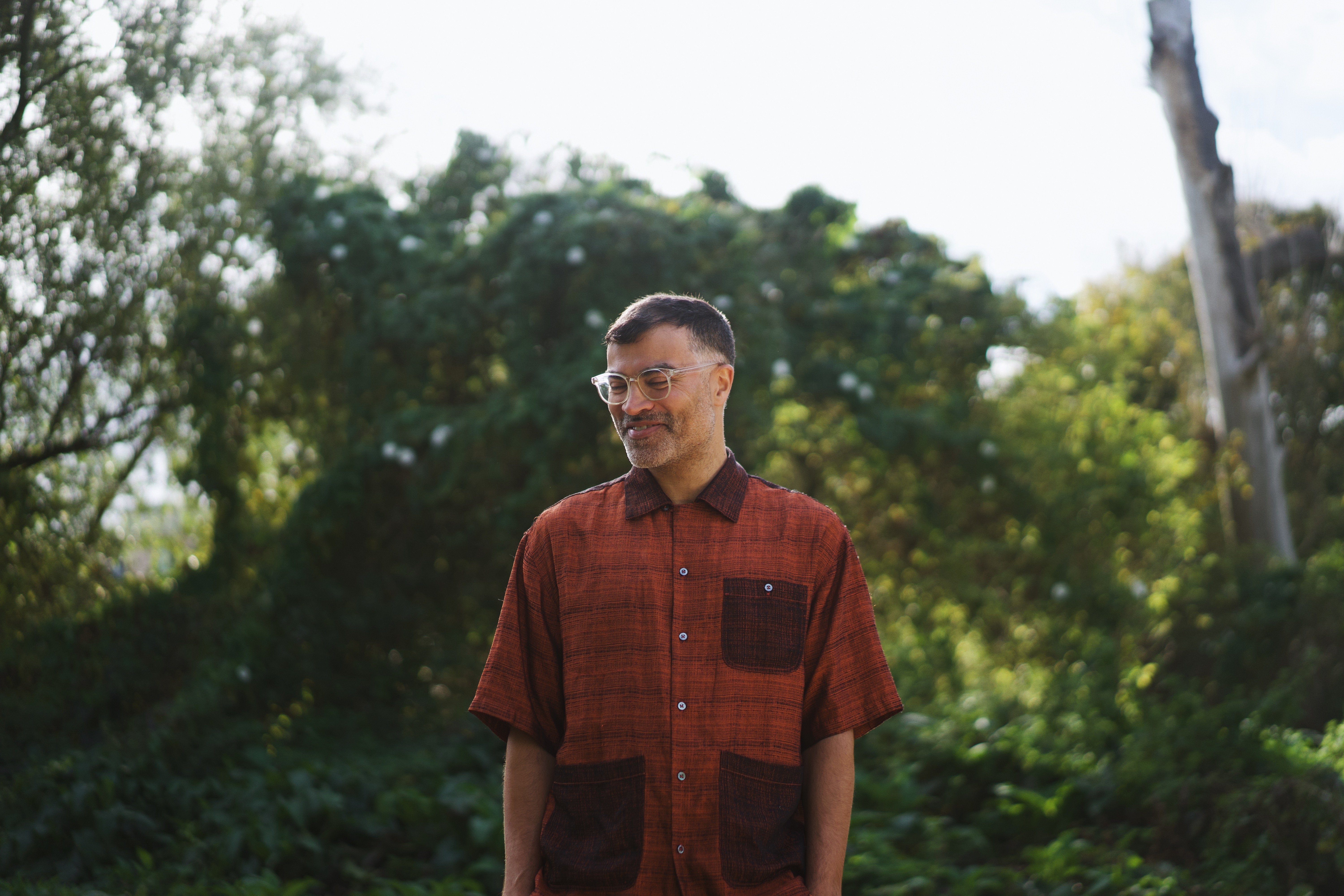
Name: Brian d’Souza aka Auntie Flo
Nationality: Scottish (British)
Occupation: Sound artist, DJ, producer, performer, curator
Current release: The Auntie Flo curated compilation Plants Can Dance is out via A State of Flo.
If you enjoyed this Brian d’Souza interview and would like to know more about his music and projects, visit his official homepage. He is also on Instagram, Soundcloud, and bandcamp.
There exists, as has been pointed out, a fascinating “attraction of humans to plants, and other non-human organisms.” What causes this attraction, do you think? And what caused it for you personally?
I hear this quote a lot: “we are nature, we come from nature” – and there is a truth to it.
Our evolutionary history humans have had a much closer relationship to the natural world than we have in the post-industrial era. There is a very deeply rooted, biological need to reconnect with it.
When we're talking to plants – aren't we actually just talking to ourselves, similar to a prayer? Why do you feel it might be different?
It may or may not be different, I am none the wiser. I do get asked this question a lot, and people mainly reference Prince (now King) Charles as the person who popularised this notion, or at least ensured it has become rooted in public consciousness for several decades.
Apparently it is the vibrations that are emitted when we talk – and that lower frequencies and higher volumes are potentially more effective as a means of connecting to the plants.
The press release mentions “a growing appetite for work that reconnects music with the natural world.” I can sense this as well. What are some of the reasons for this, and how does this manifest itself in the audience response?
A combination of different factors, one I mentioned already in question 1 where we ‘come from nature ourselves’.
Building on this – it is important to consider that 80% of the world’s population now live in cities, mostly surrounded by concrete. In tandem, we have the looming (or very current to be more accurate) climate crisis – with the news cycle now increasingly dominated by climate disasters.
On a more cosmic sense, the overwhelming beauty and immense strength and power found in nature is inspiring, plus the fact that are yet to fully understand its connective power (i.e, through the myceial network) and deeper workings (i.e. through the ecosystems that continuously adapt to environmental factors).
All these serve as points of inspiration to musicians and artists, and are in my experience welcomed by the audiences I play to. I’ve heard many report that my music under the Plants Can Dance banner has helped them see (or hear) the natural world in a novel way.
At best I hope this will lead to them respecting it more as we all need to face up to the challenges that are caused by the climate crisis.
Tell me about how the Plants Can Dance events got started, please.
I started to experiment with biosonification as a means of creating music inspired by plants and fungi around 6 years ago.
I had a few artistic commissions around that time that were all nature based – making music for these ‘Cubes of Vertical Light’ for Dandelion’s project across Scotland, which aimed to inspire people to grow herbs at home; then I was tasked with ‘sonifying’ a show garden at the Chelsea Flower show for urban gardener Wild City Studio; and finally a commission at Glastonbury to make a piece for their Mycelium Pavilion stage, which ended up being the first release on A State Of Flo.
From there, things kind of snowballed – I appeared on 6Music, The Discvery Channel with Vinnie Jones, recorded a show for The BBC World Service, and did further commissions for the likes of V&A, Design Museum, Tate and more.
A result of this continuing interest and also with a fortuitous meeting with Lamine from Repot Plant Shop led me to create Plants Can Dance (and Mushrooms Sing) as a banner that all this work could sit under.
Many animals, more obviously than plants, communicate through sound. Based either on experience or intuition, do you feel as though interspecies communication is possible and important?
The natural world is alive with sound, and sound has always been a crucial way for animals to make sense of the world. Birdsong is heard throughout the forest and crucially operates as an early warning signal for many species in the face of a predator or adverse weather change.
I’m fascinated to read about interspecies communication in plants – mainly through chemical and electrical signalling. The way that some trees warm their neighbours about a harmful insect attack through the release of chemicals or how across species help can be offered through the exchange of nutrients.
Is there a creative element to it, would you say?
As Zoe Shlanger says in the Light Eaters – ‘plants are the very definition of creative becoming’
Why did you focus on plants for your events, rather than, say, animals?
This is something I’ve never considered!
I guess I didn’t want to run a zoo ... animals run around and poop too much!
What were these events like and how did they evolve over time?
The Plants Can Dance events started off much more performance centred. I would connect my modular synth to a plant and create a composition based on the data it would pick up.
They have evolved to be much more workshop oriented, where during the performance I regularly stop and explain what is happening, and offer the audience the chance to come on stage and join the performance, either by creating a circuit with their own body, or by watering the plants and hearing how the activity changes. So it’s become much more interactive and hopefully educational - we usually end with a Q&A which can run for longer than the performance itself!
I am totally up for demystifying this whole alure around ‘plant music’ – there can be an overreach by some of the people operating in this space, and also a common misunderstanding by the audiences that we are really tapping deep into a layer of plant communication or even consciousness.
Through the discussion we hopefully present a bit of a reality check: this is ‘bio-philic’ music, made inspired the plants and definitely falls into the ‘art’ category not ‘science’.
How has listening to animals changed your views on various topics?
I got really obsessed in lock down with using a range of bird call identification apps: Warbler, Chirp-O-Matic, Merlin all come to mind.
It was like learning a new language – and although I lost my streak a long time ago, it did open me up to the many layers of communication that is happening that I am completely oblivious to.
Some have argued that recording animals or plants is a form of appropriation and that they should be compensated in some form.
Yes I’ve read a lot on the debate around this, the field recording community has struggled somewhat to reconcile with this notion of rights and it can sometimes fall into the covert surveillance category, which starts to sound slightly sinister.
Chris Watson was the first to successfully argue that a field recording is a piece of art as the listening experience is still fundamental due to the ‘artistic’ choices the recordist had to make – where to point the mic, when to start recording etc. I think it is important to acknowledge arguments against but not get too bogged down in them.
I like what EarthPercent are doing with their SoundRight campaign – where ‘Nature’ can be recognised as an artist. I made the pledge when I started A State Of Flo that 10% of all revenue we make will be donated to them, which as most of the music we put out has a nature-based component, helps me rest slightly easier.
I do think that intent is important too – that’s the crux of the appropriation versus appreciation debate, and one that only an artist themselves, after a long look in the mirror, can ever reconcile.
The press release states: “At the core of Plants Can Dance is a question about how we define music, and how we choose to listen.” What's your take on terms like energy, vibration, sound, and music?
I think music is something that is fundamental to what makes us human, and that it needs to be defined on a much more macro level than its current formulation, which seems to fit it into an ‘entertainment’ category. It goes music deeper than that, and at its essence is sounds, which are vibrational energy.
The thing I’m trying to get at with the statement in the press release is the way this means of composing with plants is defined by the normal musical structures we find in contemporary music – there is no tempo, there isn’t a repeating pattern, there isn’t even a real start or end point.
The ‘Dance’ of plants can dance is a provocation to think about time perception – plants do ‘dance’, just very slowly – imperceptible to the human eye. Using a time lapse camera allows us to see the plant dance as it turns to the light, or responds to environmental factors.
So by adjusting our normal ways of listening onto this ‘plant time’ is perhaps a good way of helping us tune of listening skills.
How would you describe the different modes of shaping “acoustic ecologies” on the compilation?
Much like I’ve described above – the music is an interpretation of data gained in real time from the plant.
I can set up rules around what notes can or cannot play and layer as many or few instruments as I see fit that are played by this data. The electrical spikes are averaged out and normally placed on a western scale, but it is interesting to experiment with different tuning or just simply tuning by ear to find an ‘ecology’ of notes that subjectively work together.
I try to limit my interactions once I’ve settled on a patch on the modular I am happy with, and let the plant do the talking!
Tell me about your own contributions to the compilation, please.
Hector’s Sunflower is a track I made with the sunflower seeds that my son Hector brought back from school. We planted them together and watched the sunflower grow over several months. The track on the compilation is an edit of a track that was part of my ‘Sunflowers’ album on Music To Watch Seeds Grow By label, from earlier this year.
My other contribution was a collaboration with my co-resident at Plants Can Dance Lamine. Lamine runs the Repot plant shop and in parallel to my work was developing his own modular plant music – mainly to play in his shop as background music. I wanted to collaborate with him in the same way as we do during the Plants Can Dance events – where he brings a load of plants and terrariums from his shop for us to make music with.
After listening to a lot of “compositions” created for this project, how has this affected your creative process in terms of composition, approach, aesthetics, listening etc?
I wanted to have a spread of artists that I’ve met over the past 6 years who’s work has inspired me. I liked the way they all approach the music in different ways, often with completely different technology and philosophy.
Crucially, I wanted the music to work as a standalone listening experience, so the tracks all flow nicely together.
Without even using a word like communication, do you think that a deeper relationship between plants and humans is imaginable?
Yes!
For sure, and that is what is exciting – we are only just beginning to understand what is possible.
If I would like to engage in it, what could be the first steps for me to take in that direction?
The first steps would be to get out into nature and start listening, using your ears as microphones is a good start! It is not so often we grant ourselves the chance to stop and listen, closed eyes, for any length of time. Try doing this for 10 mins and hear the layers of the soundscape become more evident.
From there you could start to experiment with different technologies- microphones to supersize your hearing or biosonification devices such as the Pocket Scion or PlantWave to listen to the electrical signalling.
Sound, song, and rhythm are all around us, from animal noises to the waves of the ocean. What, if any, are some of the most moving experiences you've had with these non-human-made sounds?
I’m developing an app called Soniferous at the moment – it’s about ‘Planetary Listening’ – and mainly contains field recordings I’ve done from around the world turned into soundscape compositions.
Many sounds on there are deeply moving – sounds I captured through moments of deep connection to a place, or with some personal story such as the recordings I did in Kenya and Goa where my mother’s side of the family is from.
In another piece I worked with Martyn Stewart OBE of The Listening Planet, he’s a renowned field recordist with decades of recordings to his name. He shared some of his most treasured recordings – many contain the sounds of extinct animals and ecosystems that no longer exist. It was a truly heart breaking and emotional experience.