Part 1
Name: Brian House
Nationality: American
Occupation: Sound artist, new media artist, field recorder
Current release: Brian House's new album Everyday Infrasound in an Uncertain World is out via Gruenrekorder. For the release, Brian first made recordings of frequencies lower than 20 Hz in Amherst, Massachusetts. He then sped these up by a factor of 60, raising the pitch by almost six octaves and making formerly inaudible infrasound audible. As he puts it, “although we might think we hear something familiar when listening to this album, only its very highest sounds could have been detected with an unaided ear.”
If you enjoyed this Brian House interview and would like to find out more about his work and releases, visit his official homepage. He is also on Instagram, Soundcloud, and bandcamp.
Originally, I sent you questions about very high frequencies … in a way, infrasound fits that category, but in other respects, it falls entirely out of it. To a layperson, how would you define what infrasound actually is, what creates- and what influences it?
Ultrasound (sound above 20 kHz) and infrasound (sound below 20 Hz) are both anthropocentric and ableist terms. The human range of hearing is often understood to be between 20 Hz and 20 kHz, but of course every person has a different relationship to sound, and certainly nonhumans have all sorts of ways of relating to sound.
To answer the question, I would just say that infrasound is sound that is too low-frequency for any human to hear. It is created by anything that disturbs the atmosphere, whether that’s geophysical forces like storms or wildfires, or by human interventions like HVAC systems and atomic bombs.
What are the properties of infrasound that you find most fascinating?
Well, first, infrasound is low-frequency. That’s interesting to me, not so much because it’s low, but because it’s hidden. There’s sound around us all the time that no one can hear; if we could, the world would be a very different-sounding place.
Secondly, because low-frequency sound is not dampened by air as readily as higher frequencies are, infrasound can travel much further through the atmosphere. So a very big sound might traverse all the way around the planet. This is really fascinating to me, because it’s a way of perceiving at a distance. We’re used to seeing at a distance; satellite imagery, for example, has taken that to an extreme. But hearing at a distance, and what that does to our sense of space, is novel.
And then there are the sounds. Once I coaxed the audio out of the data and sped it up 60x so that I could hear it, this incredibly weird sound world emerged. Some of the time, I have an idea of the source, but more often, I do not. And I hear it, and I go, what is that. Without knowing where it’s coming from, it acts on me in this primal way.
When did you first hear about infrasound and start getting interested in the topic?
I feel that my projects always have multiple origin points. When there is a confluence of inspirations, the work just kind of becomes inevitable. In this case, there are quite a few, so this will be a long answer.
First, I had just done a project on urban rats (Urban Intonation, 2017), recording their ultrasonic communication, so afterwards I was naturally interested in the lower end of the spectrum. Then there was a conversation I had with the theorist Shannon Mattern about listening to infrastructure, and the work I was doing with Laura Kurgan at Columbia’s Center for Spatial Research, that had me thinking about scale, space, and how the built environment resonates.
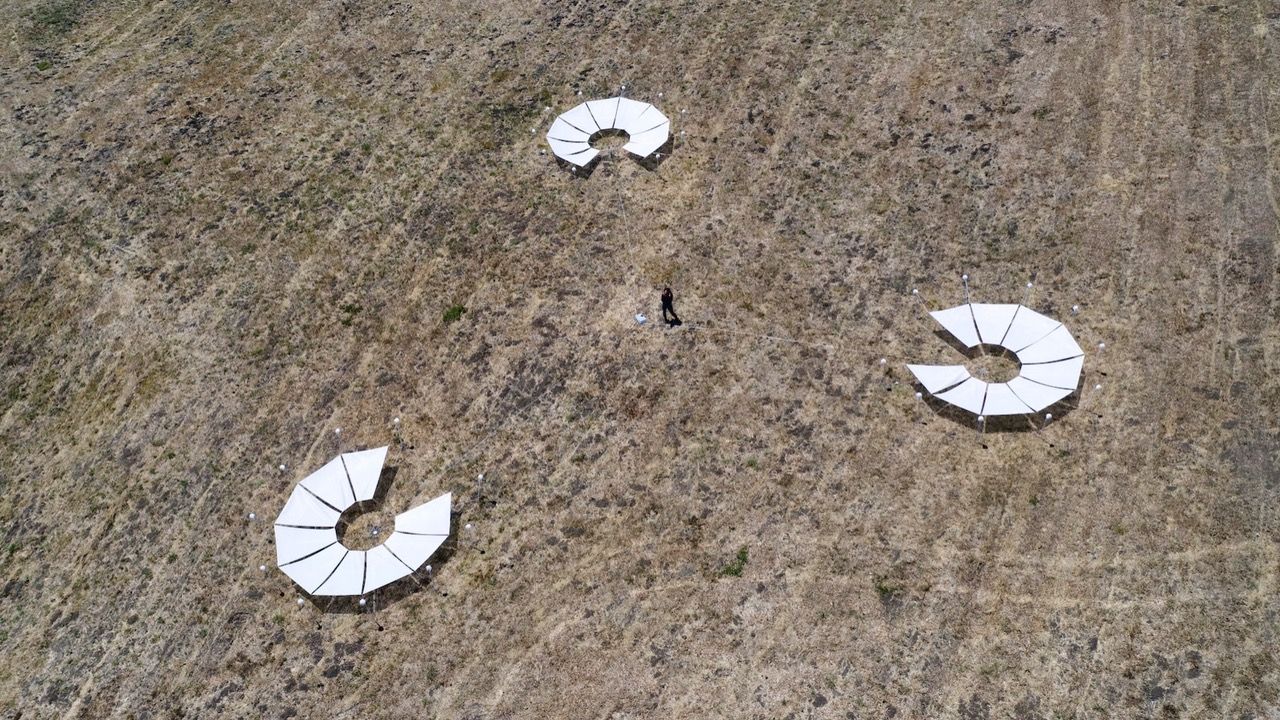
Around the same time, probably 2019, I think just by Googling “infrasound,” I saw an image of an infrasound array, likely one of the CTBTO ones, and the instrument just looks like a fantastic piece of land art. While I’m critical of the land art movement in many ways, it is inspirational in terms of situating art in the world and in its treatment of scale, and it’s provocative to think of that in relation to sound.
All of these threads were brewing when I met Ben Holtzman, a geologist who was also at Columbia at that time (and who initiated the Seismic Sound Lab), who answered all my questions about infrasound and took me down the rabbit hole of how geologists work with low-frequency data. Geologists are mostly interested in vibrations through rock, but the atmosphere can also come into play.
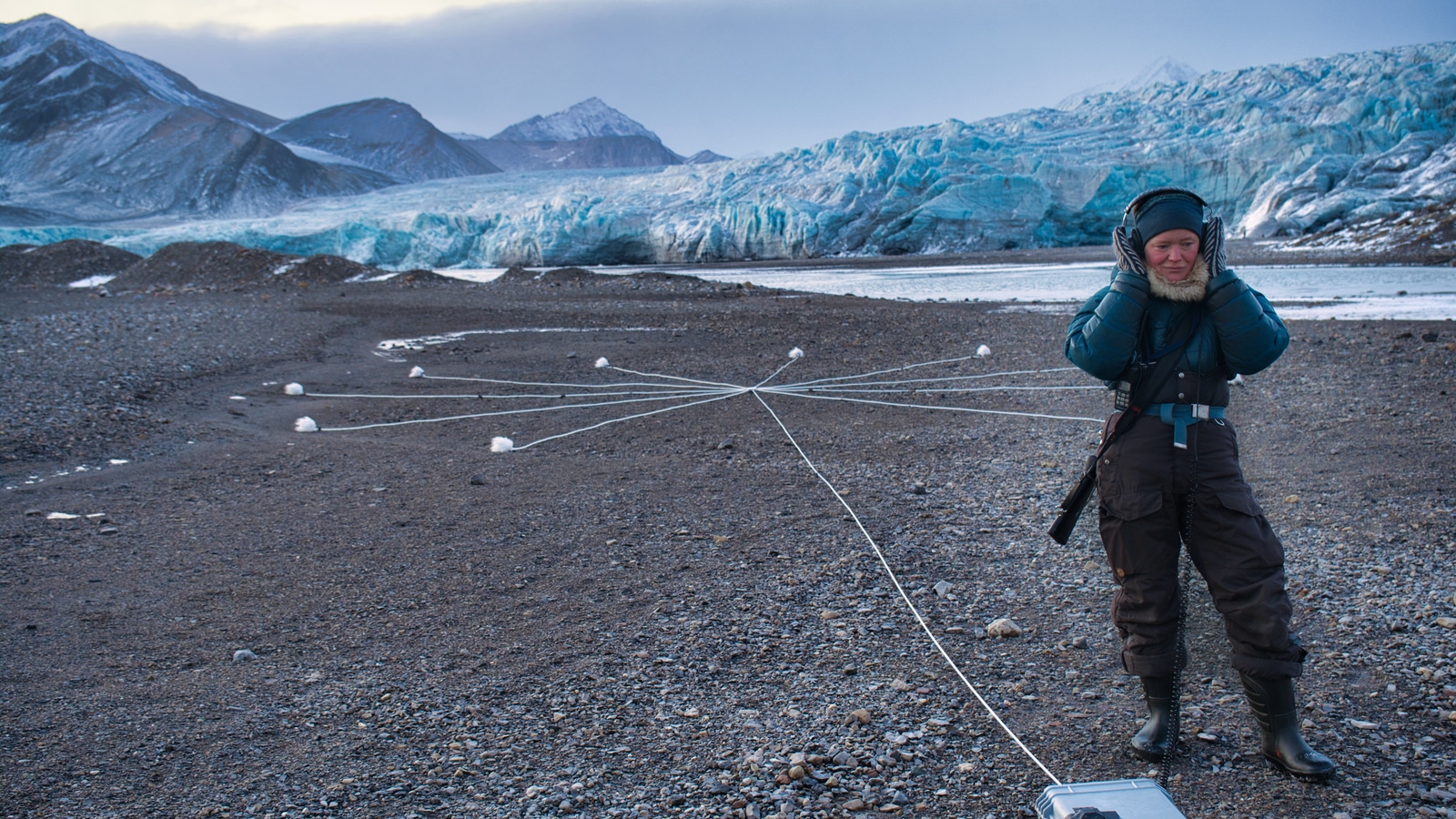
And then I moved to Oregon, the pandemic started, and I was totally isolated, doing everything on Zoom. That became exhausting very quickly, and it brought to the fore this idea of how we relate to each other at a distance. The property of infrasound that it can travel vast distances meant it was in some way an alternative to the internet, or at least evocative of an alternate reality where sound is the medium of long-distance connection instead of electricity. It presented a way to critique our digital condition, and I think that is when it became an art project. And it’s when I decided that I needed to make my own version of an infrasound array, which I call a macrophone.
Finally, in the middle of all that, Oregon caught fire, and we had the heat dome. So, unprecedented climatic upheaval, which has an infrasound signature. If I was thinking about infrasound as a communication medium, then it became clear how it was the planet itself that had something to say.
You mentioned that the sources of infrasound “are entangled with climate change.” In which way?
The sources of low-frequency sound in the atmosphere are all these things that have to do with climate change: wildfires, icebergs calving, super storms, avalanches, ocean currents.
On the one hand, they are geophysical phenomena. But on the other, these are all influenced by the carbon emissions of capitalist industry. Alongside those sounds, you also get stuff like gas flares, the massive cooling systems in data centers, wind turbines, and whatever else that is directly produced by human machines in the act of interacting with the atmosphere.
So even though climate change is a gradual trend, not any one given event, infrasonic frequencies are where the process of that change makes noise.
I find the ecological aspect of your project and album very interesting because it is both powerful and subtle. What kind of music/art do you feel the world needs right now - does it need “healing,” “shaking up,” “an escape from reality,” “consolation,” “a sense of community,” “holding up a mirror,” something else?
I think about this question a lot.
Obviously, this project of mine is very technical, and I tend to nerd out when talking about it. But ultimately, it’s about the aesthetics and how we make sense of the world. I hope that comes through, because in general, I see too much art that addresses us only on a conceptual or representational level, and to some extent, I feel doing that is just capitalizing on our condition.
On the other end, I also see/hear a lot of really anodyne stuff getting a lot of traction, and that’s also disappointing. I think there’s a difference between something that is healing and something that is numbing; the former is necessarily a little challenging. But that’s what I’d say is necessary.
I’m not sure this project achieves that, but it is a form of witness, a diagnostic, and maybe that’s a first step.
How would you describe your ecological and creative motivations for the project?
My work is experimental. I wasn’t sure how hard it would be to capture infrasound myself, but I wanted to try. But it was not only the technical process of doing that, but also a process of learning how to listen and coming to terms with the implications of what I was doing. The work has taught me what it is about. And ultimately, it’s about how we relate to the planet.
There’s sadness in it, mostly with how capitalism is so ensconced in everyday life that we can’t help but engage with it even as its consequences are already causing such suffering.
There’s anger in it, which for me is largely directed at social media and the tech industry, something that I used to be a part of, and which I feel has reneged on all of its political promise to pursue this very destructive attention economy that alienates so many of us from a more direct ecological awareness.
And there is awe in it, that the forces of the planet are vast, agential, and beyond what we understand.
Were there any examples of infrasound you'd heard prior to starting your own explorations? Who, outside of sound artists, is currently interested in them?
There are plenty of artists working with low-frequencies, but it’s mainly about producing infrasound. Retribution Body, from Providence, is one example, or Stefanie Egedy in Berlin. Even the largest sound systems produce infrasound, to some extent, and there’s a discourse around dub that talks about the effects of low-frequencies on the body.
But even though that is technically infrasound, it’s at a much higher frequency, close to 20 Hz, than what I’m most interested in, which goes down to a fraction of one hertz. And I don’t make the sounds I record; I’m interested in the soundscape that is already there.
The only other artist I know of that has explored something similar is the late Felix Hess, whose work is wonderful, and who I discovered while making this work. But Hess’s process and aesthetics are very different than my own.
Outside of sound artists, the people who deal with infrasound are scientists, such as vulcanologists like Jeff Johnson, who has developed instruments and techniques for tracking volcanic events through infrasound, as well as Leif Karlstrom and Ben Holtzman, who work with geologic sonification. Leif is also a musician and has a great album that has musicians play along with volcanoes (The Volcano Listening Project, 2024).
There’s also the hauntologists who connect infrasound to paranormal activity. I need to look into that aspect further; there is some resonance between dub and hauntology, via Lee “Scratch” Perry and others, that goes deep. This is not where I’m coming from, but it’s not irrelevant to how I’m thinking about the planet.
Finally, of course, there is the Preparatory Commission for the CTBTO, which monitors for nuclear testing. They are the ones with the coolest infrasound arrays. It’s pretty depressing how relevant they’ve become again.
Speaking about the CTBTO, you even based the design of your microphones on what the Comprehensive Nuclear Test Ban Treaty Organization uses to detect distant warhead tests. Just out of curiosity - why did you know this pretty specific fact?
The nuclear resonance of this project has gradually become more central.
The history is that during the Cold War, the US military was trying to figure out a way to monitor what the Soviets were up to on the other side of the globe. Remote sensing from satellites in space is the way that went. But before Sputnik, there was a lot of research into infrasound as a way of listening at a distance. Lewis Strauss, if you remember the villain in the Oppenheimer film, promoted the idea. The CTBTO inherits it, on the peacemaking side, as infrasound remains an effective way of monitoring for nuclear tests.
What’s crazy is that when the Anthropocene was proposed to the International Commission on Stratigraphy—a new epoch defined by human detritus in the geologic record—fallout from those early H-bomb tests that the US and USSR were conducting was cited as a marker of its onset. So infrasound haunts our epoch.
The CTBTO has some white papers on their designs, so I used that as a model. That said, they are interested in detecting one specific thing. My version is much more audio-oriented (listening, not detecting), it’s not nearly as sensitive, and it’s more broadband. And it’s way more DIY.