Part 2
The microphones obviously look amazing once set up ...
Thanks!
… but I can imagine that getting them to this point wasn't easy. Tell me about the development process for the microphones, please.
Yeah, I call them “macrophones,” because if microphones make small sounds bigger, these make big sounds smaller (the Dutch artist Theun Karelse came up with that for me).
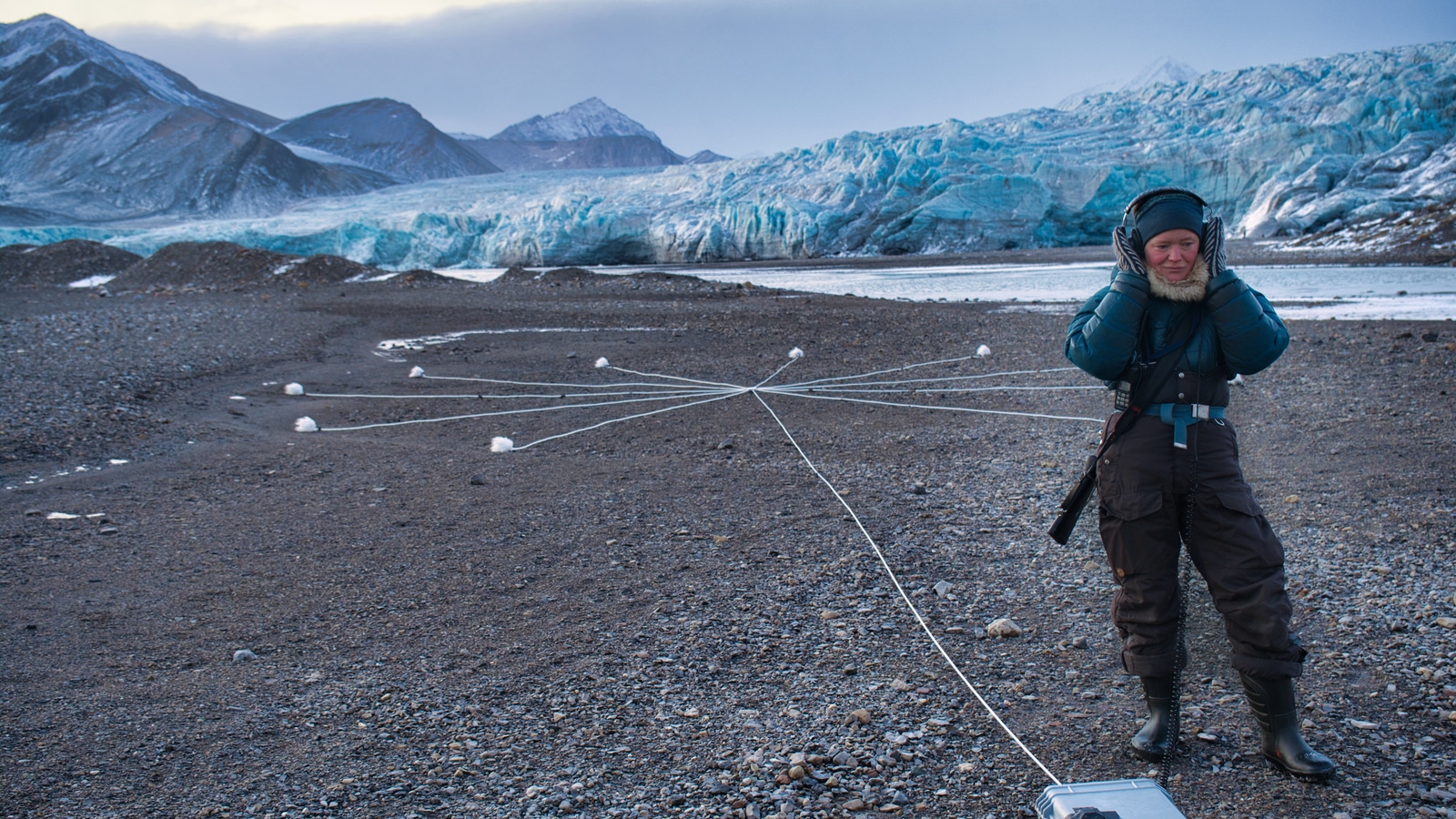
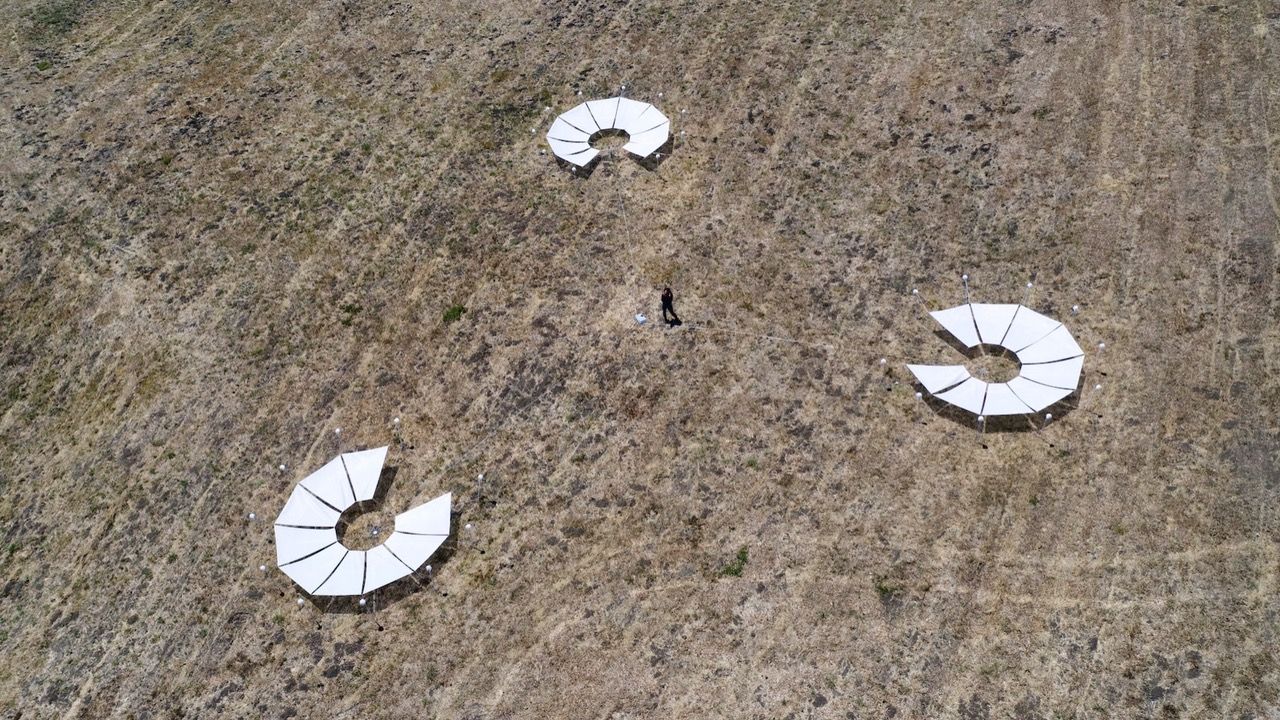
The technical purpose of the structural elements is to mitigate wind, which is the main source of interference when it comes to infrasound. It’s not a diaphragm, as infrasound is too low/slow for a conventional microphone design to work. After the wave has been distilled a bit, it flows to the center, where there is a microbarometer that’s measuring the air pressure; ultimately, that’s what sound is, at least from a physics perspective. Once it’s data, I’ve written a set of DSP routines that turn it into reasonable audio that you can listen to on site or transfer to a DAW for mixing.
For the first year or two of working on this, it really didn’t work. The materials I was using for the tubing, for example, were leaky, and then there was the jitter coming from the insufficient speed of the SD card I was writing the data to. It was just a ton of trial and error.
And once I was getting infrasound, the trial and error continued as I tuned the instrument until it sounded right—changing the diameter, spreading out multiple macrophones at different distances and geometries (for stereo and spatial sound), swapping the microbarometers for ones that the inimitable engineer Dave Saum made for me with a different frequency response. The experimentation hasn’t really stopped.
There are several versions of macrophones—the installation prototype you see in the video, the portable version I’ve used to record in more remote places, and then the somewhat ugly but higher-fidelity version that I used to record the album. A more solid installation version is in the works.
If you’re a scientist, you can buy equipment that does pretty much the same thing (although with an emphasis on measuring instead of listening). But I need to wrestle with things a bit. The fact that this has taken so long has changed my approach to the material in a way that I think is really essential, though I can’t really explain it.
I am always somewhat sceptical about processes where something is transposed or slowed down to the realm of human perception, such as in recordings from space etc. Would you say that, after the transposition, we are actually still listening to infrasounds? To something new that still carries the DNA of the original sounds? Something different altogether?
I’m really disappointed that NASA, among others, posts stuff online like “sounds of the sun” or “listen to the universe” or other bullshit like that. There is no sound in space! Those things are data sonification—translations of data into sound according to some essentially arbitrary mapping.
Data sonification is a completely legit thing, and something that I’ve used artistically (Quotidian Record, 2012).
But to call it “the sound of…” is really misleading. It does a disservice to rigorous sonification practices (like Ben’s and Leif’s) and also to the fact that there is infrasound and ultrasound on this planet outside of our perceptual range that is worth listening to if we can figure out how.
I think the make-music-with-plants people are often guilty of this as well when they say the plants are singing or whatever. Plants actually do make interesting sound. But slapping an electrode on a plant and translating that data into MIDI notes is not it, not to mention how the plant might feel about it.
Putting sonification aside, your question is actually about this issue of transposing the actual signal, and whether that still retains some indexical relationship to reality. And I think that it does.
We wouldn’t say that a photograph is any less representational if it’s printed smaller or larger, right? That said, we will respond differently to a postage stamp versus a billboard. So obviously, there is technical mediation involved, and I call the larger project “Macrophones” specifically to call that out.
But I don’t think scale is the issue; it’s about being truthful in our narratives.
How did you go from the recordings to the finished LP? What was the balance between a personal element and the purity of the field recordings?
In addition to all of the engineering with the macrophones themselves, the post-processing was really a matter of bringing out the signal, which as recorded is really very faint and quite shitty, frankly. And that meant tons of noise reduction and compression tailored to each event. So it’s interesting to talk about “purity,” as I don’t think the starting point is necessarily “pure”; it’s the process that purifies it.
In that sense, it’s not personal, I’m not going for any kind of individual expression, I’m trying to clarify what is there. But of course, I’m also doing things that amount to compositional decisions at some level, including the decision to speed it up by a factor of 60 and not some other rate (I wanted to make the sound audible, but also keep it as low as possible within that so that the effect remains visceral).
As a result, I’d say the personal comes in with the intimacy with which I’ve been involved at every stage of the recording, shepherding it into being. I’m very attached to it.
I also want to mention how key the mastering process was, with Jon Cohrs. His work ended up having such a big effect on the result that we ended up iterating back and forth between the mix and the master until we had it dialed in. Having his involvement was really key.
How did you select the places where to record these sounds? Had you been personally affected by the wildfires? And, just out of curiosity: How different would recordings from different places sound?
Yes, when we lived in Portland, we had to evacuate from our home. It wasn’t in danger of burning down, but the air was bad enough that it was hazy inside the house, and unbreathable. My partner was also 9 months pregnant. So the climate change thing was not abstract.
But these tracks represent 24 hours recorded in Amherst, where we live now. I think it’s perfect because it’s not a particularly charismatic location; it’s just a small town, semi-rural, suburban-feeling environment. And yet right here there is all of this insane infrasound passing through.
I’ve recorded in Svalbard next to the glaciers, in old-growth forests, in the middle of big cities, close to the wildfires, and all that stuff sounds awesome. But when I considered what I think these sounds mean, it’s really the everyday-ness that is the key thing. It’s not about heroically going to some exotic place and capturing sounds to bring back to listeners, and I dislike the colonial overtones of that kind of practice, it’s just so prevalent. This stuff is here, wherever here is to you, and to me, it’s in Amherst.
All places are going to share some of the same kinds of sounds because of how far infrasound travels. But they will also have their specificities. And that’s really all I can say, it’s hard to generalize about differences.
In the video, we can see people who dropped by to listen to the recordings as they were taking place. Tell me about some of the feedback you've received from listeners about how the experience impacted them. What was your own response to the recordings once you'd transposed them?
The video is from the installation prototype at the Djerassi residency in the Santa Cruz mountains, in California.
I’ve always intended the work to be an installation; the record was secondary, until it wasn’t, but I’m still planning on showing this as an in-person experience. What’s great about the installation is that the sounds aren’t separated from the recording site, which means the listener is so much more conscious of how they are situated within them.
Responses to that prototype and to the record have been really varied. Of course, there is the natural reaction to try to attach sounds to sources, which is more or less futile with this album, but people hear sci-fi spacescapes, and huge animals, and voices, and whatever. Some people have said they find it calming, others terrifying—which I think are kind of two sides to the same coin, which is awe.
Maybe that makes too much of it, but ultimately that’s what I’m hoping for, and that’s what I feel, just this idea that there are things happening that are beyond us that should be received with a sense of humility.
How do you see the benefits (and potential downsides) of combining science and art?
I think they’re more or less the same thing. Science has a formalized process of collaboration, which is really helpful, while artists are always scrambling to make it work through grassroots community in an individualistic economy.
On the other hand, artists are obviously more comfortable with the fact that aesthetics are their own form of knowledge. But the basic empirical process is alike.
I think it’s to our detriment that many of us are so acculturated to thinking of them as oppositional.
Music is often referred to as a universal language. Staying with that image for a moment - what, then is infrasound?
There’s a lot packed into that question!
Is music a language? I think it’s more than that, it’s a more direct form of relating to each other than any semiotic system can provide. And then, music is sound that’s structured in a way that’s intended for human participants. So what about the nonhuman, even the geophysical?
I’ve resisted calling this album “music” because I think that implies that I composed it, which I did not. But if we’re calling it music because of what the atmosphere is expressing to us, because we are in relation to it in a way that makes us newly sensitive to it, then I’m all for it.