Published
Name: Chris Cheek
Nationality: American
Occupation: Saxophonist, composer, improviser
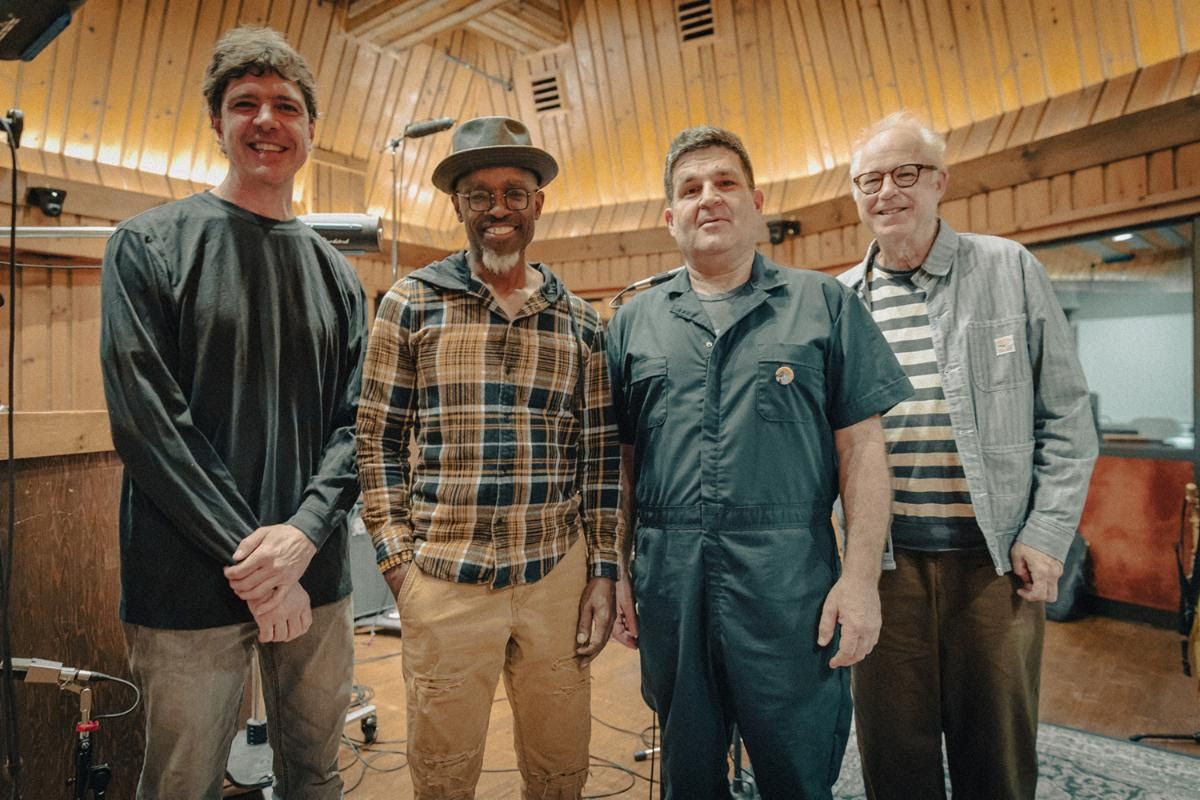
Current release: Chris Cheek 's new album Keepers of the Eastern Door, featuring Bill Frisell, Tony Scherr and Rudy Royston, is out via Analog Tone Factory.
Recommendations for Northampton, MA, USA: It’s a beautiful area full of water and rich farmland. Just to the south of here is Mount Holyoke State Park and at the top is the Summit House. It was originally a hotel built in the 1850s. After being closed for some time, it was renovated in the 1980s and is currently open to the public and maintained by the state conservation dept. The view outside from the decks around the upper floors is absolutely magnificent.
There’s a famous painting known as “The Oxbow” by Thomas Cole which is the view looking west (100 years ago!) from the summit. To the North, and East you can see mountains in distant Vermont and New Hampshire. The Connecticut river sparkles and winds through the valley and it’s not uncommon to see hawks and eagles soaring close-by. I think it’s one of the most spectacular and awe-inspiring places I’ve ever seen!
For a deeper dive into the Analog Tone Factory philosophy, read our series of interviews with Jerome Sabbagh about Analog vs Digital, Analogue Philosophy, and Audiophile Records, Great Sound, and the Double-Edged Digital Sword.
What were some of the musical experiences which planted a seed for your interest in jazz?
When we were growing up, my parents had an 8 track tape of the soundtrack to The Sting. (1973) Piano rags and the music of Scott Joplin played by Marvin Hamlisch.
When they would go out for the night, my brother and I would play that tape and crank up the stereo!
I remember my dad also had a ragtime record by the Southland Stingers and some different brass band music, he was a public school band director in St. Louis. A friend of his was a fellow trumpet player and composer and directed his own big band.
I remember going to some outdoor concerts in the summer and seeing his big band up there on stage, sweating under the lights, with all the mosquitoes, and I thought, “…this is the life for me..”
What does the term jazz mean today, would you say?
Duke Ellington preferred the term “beyond category.”
I think it really depends who you ask! To me, Jazz is still Louis Armstrong, the king and fountainhead of the music. Everything is already in there, the rhythm, the sound, the spontaneity, the joy, humor and charm, and all those high Cs!
Jazz is an ongoing evolution like everything else. There are so many more influences and people all across the globe who are playing and listening to Jazz. I think it can also be a refuge for musicians who like to play but don’t resonate with the confines and demands of “classical” music, and don’t necessarily fit into the “rock & roll” world either.
Jazz audiences are usually those kinds of people that like to go out to club before or after dinner and maybe have a drink; somewhere that is culturally stimulating and where it’s not too loud so they can talk during the bass solos.
As of today, what kind of materials, ideas, and technologies are particularly stimulating for you?
On the material plane, there have been some great improvements in certain products repairmen use to fix saxophones that need maintenance. Hybrid cork materials and teflon tubing among other things can help keep a horn in good playing condition for longer because of their strength and resilience.
Just recently, a student of mine found a very good telescopic saxophone stand that clips onto the horn and takes the weight of it off your body. I might have to get one!
Where do most of your inspirations to create come from – rather from internal impulses or external ones? Which current social / political / ecological or other developments make you feel like you need to respond as an artist?
I don’t think I knowingly try to “use” music to promote an ulterior agenda.
Sometimes I’ll have an amorphous feeling about something that manifests itself as music, but mostly I’m fascinated by intervals, harmonies, rhythms and the tonal system. I do wind up finding some ideas coming out of exercises I like to write and when I’m practicing I like to improvise; if I find a little idea I like, I try to notate or record it before I forget.
On a practical side, having projects and/or gigs where I have to contribute material means I have to get down to the hard work of the task at hand. I prefer to think of music as a craft. This takes some of the poshness out of it and helps me accept the daily and long term nature of it.
What role do electronic tools and instruments play for your creative process?
I still get a lot out of working with a tuner and a metronome. I have a Yamaha TD-100 tuner and a strobe app that I use when I’m practicing to help hone in on the pitch and an old Franz bakelite metronome that helps keep me in time!
I also use the notation software program “Finale” to make play-a-longs and write out charts. And while I used to use it more often, I still find Logic to be an amazingly helpful tool for working on and hearing ideas that I can’t play on a piano keyboard.
Thanks to technological advances, collaboration has become a lot easier. What have been some of the most fruitful collaborations for you recently and what approaches to and modes of collaboration currently seem best to you?
Most of my work and interactions with colleagues and students is done face to face. I’ve had only limited experience with online lessons and remote recording. I enjoy and am open to virtual collaboration, but I mostly wind up in situations where I have to be there “in person.” I do, however, appreciate the ease of being able send and receive audio files and charts to anyone in the world, instantly.
Practically speaking, I have been amazed and benefited by working in proper recording studios where the engineers have a knowledge and command of some very sophisticated editing software. I’ve witnessed how audio files and waveforms can be manipulated and adjusted to produce refined and pleasing results.
Having that back-and-forth personal dialogue, of listening and trying different things and processes in a recording studio with capable and musical technicians can be a remarkable and productive experience.
Jazz has always had an interesting relationship between honouring its roots and exploring the unknown. What does the balance between these two poles look like in your music?
Yes, there’s so much to gain by listening to and researching Jazz’s inception and ongoing evolution. I still get a lot out of transcribing solos and tunes, for me it’s the most direct way to learn and discover.
And, although I don’t think of it as a “fixed” thing, my idea of what’s possible in a saxophone sound has certainly been shaped by all the brilliant and diverse horn players I’ve heard on record and live, on the bandstand.
So, while it may be mostly unconscious and difficult to articulate, in both my playing and writing I feel like an ongoing amalgamation and reflection of all the music I’ve listened to and continue to study.
How much potential for something “new” is there still in jazz? What could this “new” look like?
I think part of the reason people are drawn to jazz both as players and listeners, is the possibility to participate in the process of discovery.
It’s normal and common to want to find consistency and certainty in music, but music can also inspire a sense of mystery and wonder. While it may never be commercially or widely “popular,” some curious audiences are drawn to the pregnant potential that Jazz offers. Because improvisation is such a big part of the music, even with familiar tunes there will always an aspect to it that is fresh and “un-rehearsed”.
One of the pillars of Jazz’s foundation is that it’s an “inclusive” rather than an “exclusive” music. Jazz invites collaboration and cooperation, and as long as human musicians keep interacting, listening to and leaving space for each other, Jazz will continue to expand and evolve in ways we can only imagine.
For many artists, life-changing musical experiences take place live. How do you see that yourself?
I think especially now, people are hungry for human interaction and connection. I’m always amazed and reassured to see audiences who are willing to close their phones and open their eyes and ears for an hour or two.
Live performances are temporal, it really is about a sharing fleeting moments in time. Music is transcendental and reflects universal and eternal archetypes. What you take away from a performance can be very real, albeit un-quantifiable and hard to explain.
I’m hopeful that some of the socially divisive effects brought about by technology and social media will continue to be countered by a growing realization of the value and precious nature of human interaction and the sense of “togetherness” that occurs during a shared-experience, live-music event!
How, would you say are your live performances and your recording projects connected at the moment? How do they mutually influence and feed off each other?
For me, a recording is kind of a place marker for a particular time in space. It’s different from a gig in the sense that it’s more contained and not influenced by any type of audience reaction. For that reason, I like to try to think of presenting something that, hopefully, stands up on its own after repeated listenings and remains interesting to the ears.
For a gig, that feels like the time to stretch out and maybe be a little more experimental and just “roll” with the feeling and emotion in the band and in the room. In that situation, the solos are more about trying to create interest and energy and fulfill the role that an entertainer provides.
Ultimately, things can happen both ways … playing the music before recording it can help familiarize the players with the material and in doing so, help find shape and direction. But sometimes, recording a tune that’s relatively new and “unrehearsed” helps capture a freshness and interpretation that’s immediate and not hampered by expectations.
After recording and documenting a tune, in a way, you’re allowed to set it free and “let go” of whatever variation winds up being recorded and assembled. The beauty and magic of Jazz is that it’s not so much about cranking out a “correct” version of a particular song but rather, in using familiar forms and structures as tried and true vehicles to go on adventures and occasionally find new places!
Ímprovisation is obviously an essential element of jazz, but I would assume that just like composition, it is transforming. How do you feel has the role of improvisation changed in jazz?
Jazz has branched out in so many different directions, nowadays it can become highly sophisticated and complex. Improvisers are often required to navigate modulating rhythms and non-“functional” harmonies.
But, I guess as long as you have a “tune,” the role of improv is basically the same; to provide opportunities for moments of spontaneity and “play” in between iterations of the melody.
Other branchings have led to more of an art music, some musicians prefer to have very little or nothing written or pre-conceived ahead of time, choosing to commit fully to playing and interacting in the moment. In this case the improvisation is everything, creating a completely unique and unreplicable momentary happening.
Amazingly, there is an audience for this type of approach. Some people genuinely like to listen and be a part of something that is unexpected, has energy and is full of surprises!
What, would you say, are the key ideas behind your approach to improvisation?
A few years ago, I took a Jazz history class taught by Ricky Riccardi at Queens College which focused on the life and music of Louis Armstrong. It was a thoroughly informative and ear opening experience!
We learned that Louis recorded all his gigs and over time, crafted his solos on individual tunes. Which meant that in a way, they were part of the overall “composition.” It helped me see that the improvisations aren’t really that important in the end. They are to the people that practice and play them, but to the other 99.9% of the population, the instrumental solos are just a way to extend the “feeling” of the tune and occasionally, with any luck, keep people dancing!
For me, being aware of Louis’ approach helps take some of the pressure off what is actually a very challenging and abstract thing to try to do. Finding out that, as Ricky pointed out, with the advent of Bebop, Jazz was no longer a “popular” music, made me think that maybe people go overboard or place too much importance on the improv sometimes.
You want to be able to keep the audience’s attention so you have to give them, especially those with no formal musical training, something to hold on to. If people forget what song you’re playing or don’t hear anything recognizable, what incentive is there to keep listening?
For me, thinking of improvisation as thematic variation is a helpful part of trying to stay in the tune and not descend into pure abstraction or instrumental “noodling”. To be honest, I find the built-in melodic and rhythmic material from the tune to be a clear and inexhaustible source for “building” a solo, in contrast to waiting for “inspiration” or just pulling ideas out of thin air.
The Montreux Festival intends to preserve its archive of recordings for future generations. Do you personally feels it's important that everything should remain available forever - or is there something to be said for letting beautiful moments pass and linger in the memories of those that experienced them?
Well, I wonder what the musicians they have recordings of would have to say about that? In the recorded music world, I know that many Jazz greats would not approve of releasing those “previously unreleased” bonus tracks/takes you see on CD reissues.
But I guess there is a certain merit in the live aspect of those gigs in Switzerland. Jazz, after all is meant to be experienced first-hand and having such a great audience there would definitely elevate the musical interactions.
Of course, all the recordings and preserved for posterities are good for civilization, but being able to savor and remember a fleeting musical moment is something exceedingly valuable and uniquely human.