Published
Name: Conrad Harris
Nationality: American
Occupation: Violinist
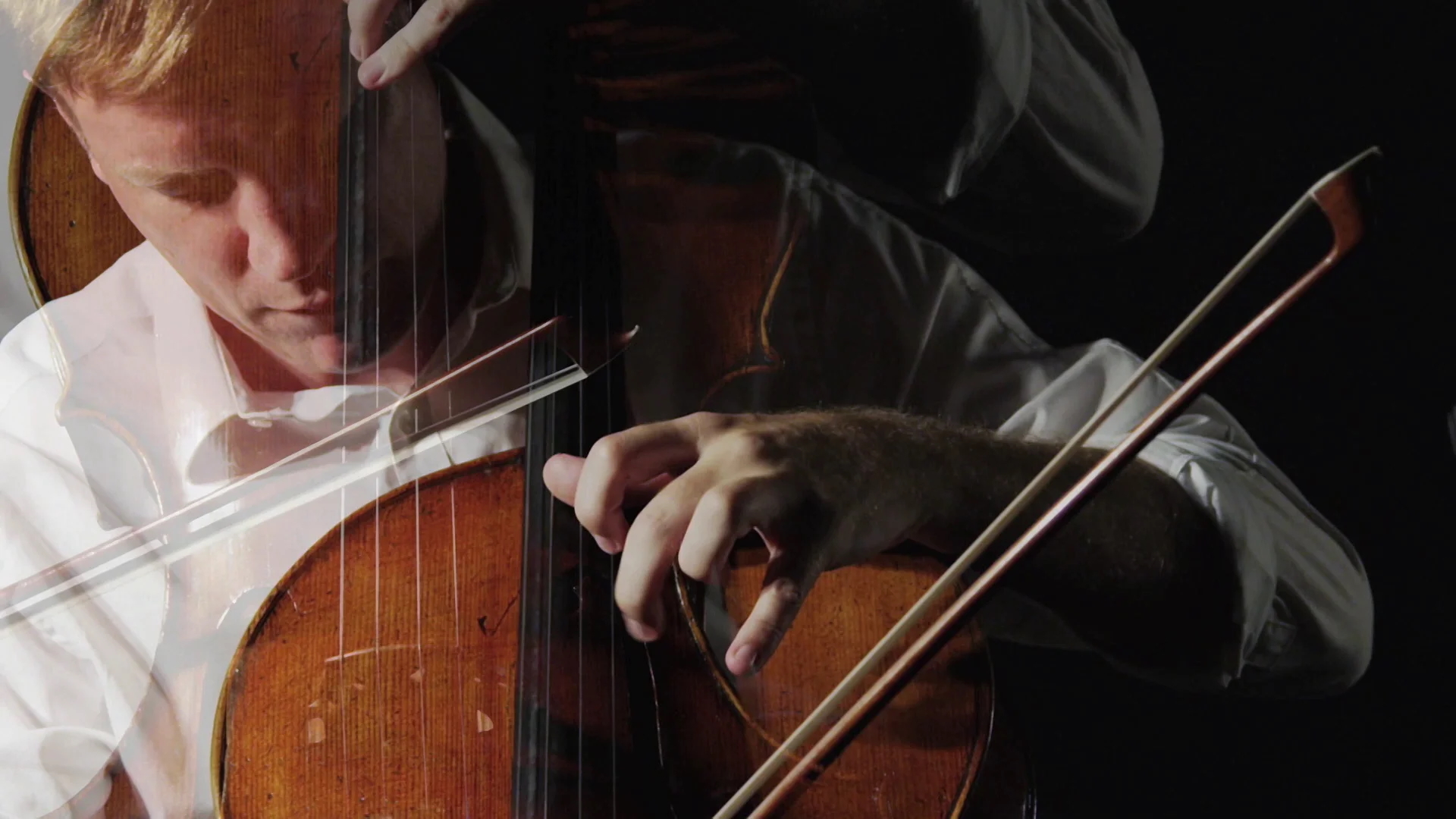
Current event: On September 12th 2026, Conrad Harris performed Morton Feldman~s Trio with Alex Waterman *cello( and Stephen Gosling (piano) at GRAPHIC CONTENT, a series of 17 concerts in New York. On November 21st, as part of the FLUX quartet, he will perform Feldman's second string quartet at St. Michael's Church. For more information and tickets, go here.
If you enjoyed this Conrad Harris interview and would like to know more about his music and upcoming live dates, visit his official homepage. He is also on Instagram, and Facebook.
Terms like “New York School,” are often problematic. How much New York is there in the music of this group of composers, how much of a school was it?
The “New York School” of composers is not such a bad label, in my opinion. Morton Feldman, John Cage, Christian Wolff, and Earle Brown shared a common ethos even though their music was very different.
It is also apt that the name comes from the “New York School” of artists who influenced their music. Feldman and Cage frequently met with Philip Guston, Willem and Elaine de Kooning, Jackson Pollock, Franz Kline, Mark Rothko and others at the Cedar Bar in NYC’s Greenwich Village, famously discussing art and music until closing time.
Do you remember when when you personally first heard a piece by either Brown or Feldman? What was your response at the time?
My first encounter with the music of Morton Feldman was when I was part of a performance of “For Samuel Beckett” in the late 90s.
Shortly thereafter, I began performing his pieces more frequently, “Turfan Fragments” (on viola) with the S.E.M. Ensemble, “For John Cage,” and, after joining the FLUX Quartet in 2004, his “String Quartet No. 2,” which will be presented on the final concert of “Graphic Content” festival on November 21st.
I would say the same about my first experience with Earle Brown’s music. I performed “Centering” in the early 2000’s, also with the S.E.M. Ensemble followed shortly thereafter with his String Quartet with FLUX.
Both first experiences were eye-opening for me in different ways. Brown’s organization of ideas (form) and Feldman’s unique sound.
How much of their original creative impetus still feels current, which ideas are still fresh today, do you feel?
It all feels current to me. None of the music by Brown and Feldman sounds “old.” It is simply the music of Brown and Feldman. No other music sounds like theirs to me.
The open structure of Earle Brown’s music and Morton Feldman’s early graphic scores also feel current by their design. Each time it is performed, you play it differently. One’s approach to the open sections evolves over time, influencing decisions and musical ideas.
John Cage was a sort of a pivotal figure for the scene. How do you feel did Cage's ideas influence both Brown and Feldman?
From what I know, Cage encouraged Brown and Feldman more than anything else, encouraged them to keep doing what they were doing.
There is the famous story of when Feldman first showed Cage a piece of his. When Cage asked him how he did it, Feldman demurred and said he didn’t know. Cage then jumped up and down and shouted something like “Isn’t that wonderful! It’s so beautiful and he doesn’t know how he made it!”
That is excellent encouragement.
What, would you say, are misconceptions about either Earle Brown or Morton Feldman?
I don’t know of any misconceptions.
In the case of Feldman, some listeners may tire of his long duration pieces, though that is highly individual.
Some refer to Feldman as a minimalist. Maybe that’s a misconception. I certainly don’t consider him a part of that school.
Feldman obviously had a deep interest in contemporary art and Earle Brown said: “Music is my material, but art is my subject." Do you think of their music as being “visual” in some form, as concretely describing “space,” or “colour?” If so, in which way?
Both Brown and Feldman were likely more influenced by visual art than music.
After getting to know the music of Morton Feldman, I can’t look at a Rothko painting without thinking of Feldman’s music. Both Rothko and Feldman are known for their large-scale works. The colors in a Rothko fade imperceptibly into another like the rhythms of Feldman’s music.
Feldman was fixated on the ends of notes and how their sound tapers off into one another, like the soft edges in a Rothko painting.
The difference in terms of concept between open form and graphic notation are clear. Do you think these differences are actually audible?
Mostly no, but it really depends on the piece.
As a performer, which of these two approaches have you found to be more interesting/fruitful/enjoyable – and why?
It depends on the material and the performers you work with.
“Projection 4” is a piece for violin and piano that Morton Feldman composed in 1951 and is an example of graphic notation. It leaves much up to the performers, specifying only indications of timbre (in this case pizzicato, arco, and harmonic), pitch register (high, medium and low), and duration (using spatial notation).
One can make decisions prior to performance as to what pitches to play, but this is not ideal. The performer achieves a more improvisatory feel by making decisions in the moment. But it takes time to get comfortable with this way of music-making. I played this piece with Joseph Kubera (an expert in Feldman’s music) and eventually felt comfortable with this approach.
Earle Brown’s “String Quartet” from 1965 is a good example of open form music. There is a great deal more material written in this piece than in “Projection 4.” Most of the pitches, dynamics, timbre, etc. are in the score. What is left to the performers are pitch durations, relative tempi, and in some cases, the order of his modules of musical material.
It has a feeling of a group improvisation, yet with an overall form. One exciting result is that every performance of the work is different.
I thought it interesting that with some of these scores, the results were wildly different, with others remarkably similar. What defines a composition here? Are we really still listening to the same piece?
We are still listening to the same piece, but with different performers, along with their personalities and musical predilections.
What is the difference between performing a painting and performing a graphic score?
When you are “performing a painting,” you have to come up with the rules by yourself. You may need to decide what a certain color sounds like, for instance. Or you just play what you feel when you look at a painting.
A graphic score limits some of these variables, in a good way in my opinion.
How do you prepare for a performance of a graphic score or open form composition? What kind of considerations does it require, how different is the rehearsal process?
As I stated previously, one can make decisions beforehand, although that might not be ideal.
For me, when preparing for a piece written in graphic notation, I like to go through the piece several times. You aren’t necessarily working so much on ensemble, although that me be important. You play the piece and decide which decisions you made are good ones.
I find open form music easier in that regard. Fewer decisions.
How, would you say, does Brown's approach to graphic scores / open forms differ from Feldman's?
Feldman’s graphic scores produced single sonorities, while Brown’s were more dynamic and, to my ears, sounds more improvisatory.
Tell me a bit about the piece you're performing at Graphic Content.
Morton Feldman’s “Piano Trio” was composed in 1980. It has moments of very complex rhythms along side beautiful static passages. Typical of Feldman’s other work, it is almost played almost entirely at a very low dynamic, mostly marked “ppp.”
There is a moment in the piece, about 20 minutes in, when the piano plays a single chord marked “fff.” It is a shock for both performers and audience. He has spoken about his frustration of listeners’ complacency and lack of attention. It is very possible that the loud chord is there to get the audience’s attention and force them to better focus on the music, à la Haydn’s “Surprise Symphony.”
But, the explosive nature of the fff chord also creates the effect of what he has called “after-tremors” when the sound of the piano shimmers and dyes away and we begin to hear the very quiet music emerge and continue.
The trio is one of his first compositions associated with what is considered his late-period. It is long, but not in the extreme. About 90-105 minutes in duration.
What were some of your considerations with regards to the interpretation?
Tempo.
Morton Feldman didn’t indicate a tempo marking in his Trio. Most of his late-period compositions have a tempo indication of 63-66 for the quarter note. Both of his string quartets, from 1979 and 1983, as well as “For Bunita Marcus,” “For Christian Wolff,” “For Philip Guston” and others all have quarter note equals 63-66. Feldman leaves tempo up to the performers in his Trio.
When rehearsing this piece, our trio decided that 63-66 was a little too brisk, and settled on about 58 to the quarter. Feldman said that he wanted the performers to “breathe rather than count.” For us, that meant a relatively slow tempo.
Sound.
Feldman was most interested in a note’s decay as opposed to its attack. He believed that too much focus was given to the beginnings of notes, which propelled the music forward, instead of a note’s sustain and decay, which gave his music a suspended quality.
One of the questions posed by the organizers ahead of the festival was: “Does historical awareness ruin their idealized conception of pure sound disconnected from narrative?” What's your take on that?
It’s highly personal, but both frequent concertgoers and first-timers can have equally memorable experiences.