Published
Name: Dan Pocetti
Occupation: Guitarist, composer, performer, producer
Nationality: Argentine
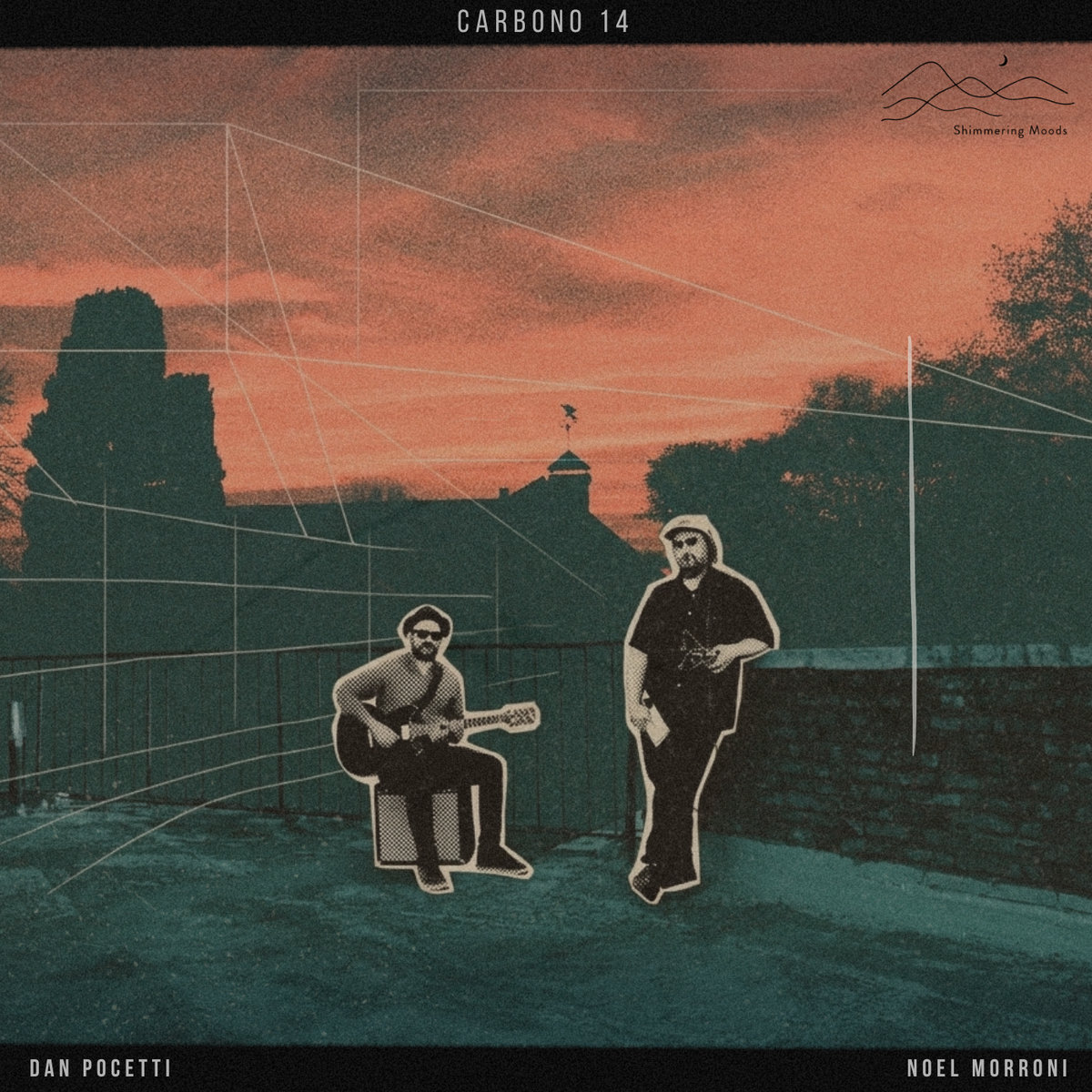
Current release: Dan Pocetti teams up with Noel Morroni for CARBONO 14, out now via Shimmering Moods.
If you enjoyed this Dan Pocetti interview and would like to stay up to date with his music, visit him on Instagram, and bandcamp.
Where does the impulse to create something come from for you?
I think it’s very hard to put into words; I feel it as something organic that has been with me since the very first day I picked up a guitar.
It’s about grabbing the instrument and playing it —that is where the magic starts, something unexpected emerges from that, a new creation of material.
What role do often-quoted sources of inspiration like dreams, other forms of art, personal relationships, politics etc play?
I think all these surreal experiences play a huge role, everything we create is shaped by our lived experiences.
So, when improvising or composing, whatever resonates with us finds its way into the music; the same applies to any art form.
For you to get started, do there need to be concrete ideas – or what some have called a; of the finished work? What does the balance between planning and chance look like for you?
I think the inspiration lies in being surprised by the unexpected.
Often, you try to convey a particular feeling, so the visualization is about successfully capturing that spirit.
Is there a preparation phase for your process? Do you require your tools to be laid out in a particular way, for example, do you need to do; or create early versions?
One thing I try to do every day—and which I’ve always found incredibly inspiring—is to start playing as soon as I wake up.
I like to connect with the music while I’m in that peaceful morning state. There’s silence, and my mind is clear; I haven't been exposed to screens or the noise of the day yet. Often, before I play, I watch videos of music I like—talks or concerts that inspire me to pick up the instrument and create.
I also think order helps visually; when my studio is chaotic, I find it harder to create.
Do you have certain rituals to get you into the right mindset for creating? What role do certain foods or stimulants like coffee, lighting, scents, exercise or reading poetry play?
Not really, but being calm and relaxed always works for me. I think that’s key, though it’s not always easy to achieve.
That’s why I said that playing right after I wake up—either very early or very late—is what I enjoy most and works for me and my process. I also find the silence of the early morning hours peaceful where the mind has space to create and there is no other noises that interfere.
When I’m studying or practicing during the day, I drink a lot of mate. And if it’s at night, I’ll most likely have a glass of Fernet.
For CARBONO 14, what did you start with? If there were conceptual considerations, what were they?
Yes, there were conceptual considerations, starting with the name of the album, the song "Carbono 14" gave the album its name.
I think the concept is inextricably linked to the music. Carbon dating is a scientific method for determining the age of a fossil; I believe it works for specimens up to 50,000 years old. Obviously, I am oversimplifying it for the sake of the explanation.
That’s a vast amount of time compared to our own lifespans. It’s mindblowing to think about all the days and nights that have passed in the universe—times when we weren't physically present, either because we hadn't been born yet or because we had already left this plane of existence. It’s almost too much information for the mind to process; it kind of hacks my brain.
So, this music plays involves with the loss of a sense of time, or tries to reflect how we feel when we lose track of time—that happens when you're having such a great time that you can't tell if an hour has passed or six. That’s magical, yet mysterious. It’s also intangible, personally I Ithink it’s wild.
In the same way, the album journeys from sunrise to sunrise: it kicks off with "Sunrise Meditation"—a contemplative moment ...
... and ends with "O Sole Mio," a song where the sun comes out again after a really intense storm.
So, that sun-to-sun cycle could represent a single day or even thousands of years; it’s surely different for everyone.
For each person listening to the album in its entirety, the perceived passage of time will be different.
Tell me a bit about the way the new material developed and gradually took its final form, please.
We started getting together to improvise with Noel Morroni, and we recorded all the improvisations.
What motivated us was the idea of playing based on the sounds themselves—focusing on the static feel of drones and a minimalist approach—rather than coming from a jazz background, which is where we spent our lives and is still a big inspiration . We liked the recordings, so we decided to make an album.
That’s when I thought about composing—writing melodies that were as minimalist as possible, designed to act as triggers for new sounds.
Many writers have claimed that as soon as they enter into the process, certain aspects of the narrative are out of their hands. Do you like to keep strict control or is there a sense of following things where they lead you?
That’s a good question; it depends on the context, the type of music you’re playing, and who you’re playing with.
On this album, the music is incredibly free—everyone could do whatever they wish, and I think that’s great.
Yet, when you’re playing songs or accompanying singers, you don't have that huge space to mix your own essence and that is not any way bad, just different.
There are many descriptions of the creative state. How would you describe it for you personally? Is there an element of spirituality to what you do?
I think the creative state is a very unique moment; it’s like a bohemian laboratory—something I find spectacular. It’s that feeling of being unable to get up from your chair because you want to finish an idea, or because something returns during the creative process—something good comes back.
I’m not exactly sure what it is, but a very fulfilling sensation returns.
Once a piece is finished, how important is it for you to let it lie and evaluate it later on? How much improvement and refinement do you personally allow until you’re satisfied with a piece? What does this process look like in practise?
To be honestly, it’s always different. I think that’s the appealing thing about everything we’ve been discussing.
Sometimes a song comes together in five minutes and is finished. At other times, it develops over a longer period. I’d say that, generally, I finish them quickly—provided I don’t move on to something else.
It can happen that an idea is nearly complete and many elements are crystal clear, but the reality is that it truly takes shape when you play it with other people and they contribute their own touch to the composition.
That is spectacular; for me, that’s the final touch—it becomes something collective, in a way.
How do you think the meaning, or effect of an individual piece is enhanced, clarified or possibly contrasted by the EPs, or albums it is part of? Does each piece, for example, need to be consistent with the larger whole?
That’s a great question; it made me think about something I hadn't really considered before.
To my mind, the concept of the work as a whole is incredibly important. Albums are meant to be listened to in their entirety—at least, that’s how I see it—and the albums I love are conceived as complete records; I don't believe any track order is random. It’s just like planning a live show—you think about creating different moods. It’s similar.
That’s actually why I spoke about the journey of Carbono 14—going from one dawn to the next.
Wha's your take on the role and importance of production, including mixing and mastering for you personally?
I love sound; I think it’s crucial.
In this case, it’s a very special album for me because I mixed it myself. It was the first time I’d mixed a record of my own; it happened somewhat unexpectedly, and I’m happy with the result. I had total freedom when it came to adjusting to my taste the levels of each sound.
It was an inspiring process, and that same freedom gave me a very clear vision of the tracklist and how the songs unfolded.
What is the balance between composition and arrangement (performance)?
I think it’s similar to what we were discussing earlier; it depends a lot on who is performing it and how they perform it.
A composition that isn't played is like a movie script that hasn't been filmed—it’s just text. I’d love to read a David Lynch script; it must be a spectacular, surreal trip, and surely the actual visuals are completely different.
Performance is everything.
Music and the accompanying artwork are often closely related. Can you talk about this a little bit for your current project and the relationship that images and sounds have for you in general?
The visuals are very important in this project.
During concerts, we play in very dim light, and we have an artist who projects black-and-white images onto the wall. It inspires us while we play and helps the audience connect with something special. It’s amazing.
A lot of people just close their eyes and immerse in the experience.
After finishing a piece or album and releasing something into the world, there can be a sense of emptiness. Can you relate to this – and how do you return to the state of creativity after experiencing it?
I don't think I actually lose that creative state, but you pour a lot of energy into things that are distinct from the creative process itself—like organizing logistics: handling the release, CDs, vinyl, digital music, and so on.
Sometimes, being fully occupied with those tasks can eat into the time and space available for creation.
Creativity can reach many different corners of our lives. Do you personally feel as though writing a piece of music is inherently different from something like making a great cup of coffee? What do you express through music that you couldnt or wouldn't in more "mundane" tasks?
Composing music is about creating something—mixing concepts and inspirations. To me, it’s very similar to cooking; it involves a lot of improvisation.
I never cook using formulas or recipes; I always improvise—like my Nonna cooking, as we say in Argentina, "by eye". This means nothing is measuered, you just know the amount.