

Published
Name: Édouard Ferlet
Occupation: Pianist, composer, improviser
Nationality: French
Current release: Édouard Ferlet's new album Köln Variations is out via Mélisse.
If you enjoyed this Édouard Ferlet interview and would like to know more about his music and upcoming live dates, visit his official homepage. He is also on Instagram, and Facebook.
The piano is at the heart of the Köln Concert and it is also at the heart of your work. What made you seek it out, what makes it "your" instrument, and what are some of the most important aspects of playing it?
There was a piano at home when I was a child, and I took to it naturally, without my parents asking me to. And since I wasn't pushed, I got into it all by myself: I didn't play “the” piano, I played “with” the piano, like a playground, purely for fun, out of curiosity.
I played with the piano the way I played with my toy cars. I saw the keyboard as a construction set, a bit like KAPLA blocks: I could build melodies, chords and rhythms at will! So I started improvising right away. I had a lot of fun with the visual aspect of the black and white keys and the way the keys are laid out on the keyboard, like a maze.
The piano was above all a percussion instrument, and since my parents weren't particularly interested in what I was doing, they didn't forbid me from playing it however I wanted either, even banging on it!
I often see parents who stop their children from banging on the piano for fun: it's the best way to start frustrating a child in learning music.
How would you describe your own relationship with the piano – is it an extension of your self/body, a partner and companion, a creative catalyst, a challenge to be overcome, something else entirely?
The role of the piano has evolved throughout my life. The instrument was a way out of my family environment, and in the end it became a way in. In every moment of my life, happy or unhappy, the piano has always been there to support me and keep me company.
It's strange, I feel like I'm talking about a person, but it really is this piece of furniture with strings that, each time, has managed to lift me up, or at least reconnect me with myself.
When and where did you first hear the Köln Concert? What was your initial response to it?
Honestly, the first time I heard this concert, I didn't get it right away, because I didn't know the history of this legendary concert either.
And for me, at the time, it didn't represent the jazz I was listening to, which was more Duke Ellington, Bill Evans, Miles Davis, John Coltrane, etc. And above all, solo jazz piano was rather boring to me back then.
Thanks to the proposal from the Printemps de Bourges Crédit Mutuel festival, I immersed myself in this record. I discovered a whole spirit that had completely escaped me on first listening, and I discovered a fascinating world around improvisation, the notion of time and of space.
When you were listening to the Köln Concert, at what point in your musical development were you – and how important was it to discover this recording precisely when you did?
When I started the piano, it was a way for me to play with other musicians, and I didn't have the fascination for solo piano that I have now. At the time, I felt that playing the piano alone went against the spirit of music, which is rather about coming together and playing together, improvising and playing on interaction and sharing.
I only understood much later, when a French producer, Philippe Ghielmetti, asked me to record my first solo album, Par tous les temps, that it was also a way of developing one's musical personality and creativity. It could also work without interaction with other musicians, precisely through inner work and reflection.
Many commentators have commented on what made the LP stand out. What made it special from your point of view? How did the album influence your perspective on music in general?
Knowing that the best-selling solo piano album in the world is an almost entirely improvised record gives hope in humanity.
And I think that, since Keith Jarrett almost cancelled this concert, he had to play it in a completely different way, letting go completely, and that gave him an absolutely incredible freedom.
I think that's what you feel in this record: a form of freedom, music that flows naturally, innate.
What are your thoughts on Jarrett's later improvisation albums?
I think the following albums were quite different. Besides, it seems to me that Keith Jarrett isn't particularly satisfied with the Köln Concert.
Personally, I love his whole discography, and I think that this album was indeed central to everything that happens afterwards, as if it were a founding musical element that allowed Keith Jarrett to develop his art from then on.
When the Printemps de Bourges Festival first approached you about setting up a performance centered around Jarrett's album, what was the initial idea – and how did it transform into its final, extremely ambitious form?
When the proposal was made to me, I didn't really think about it, because I had been invited to a very good restaurant! It was only afterwards that I realised the project was seriously ambitious.
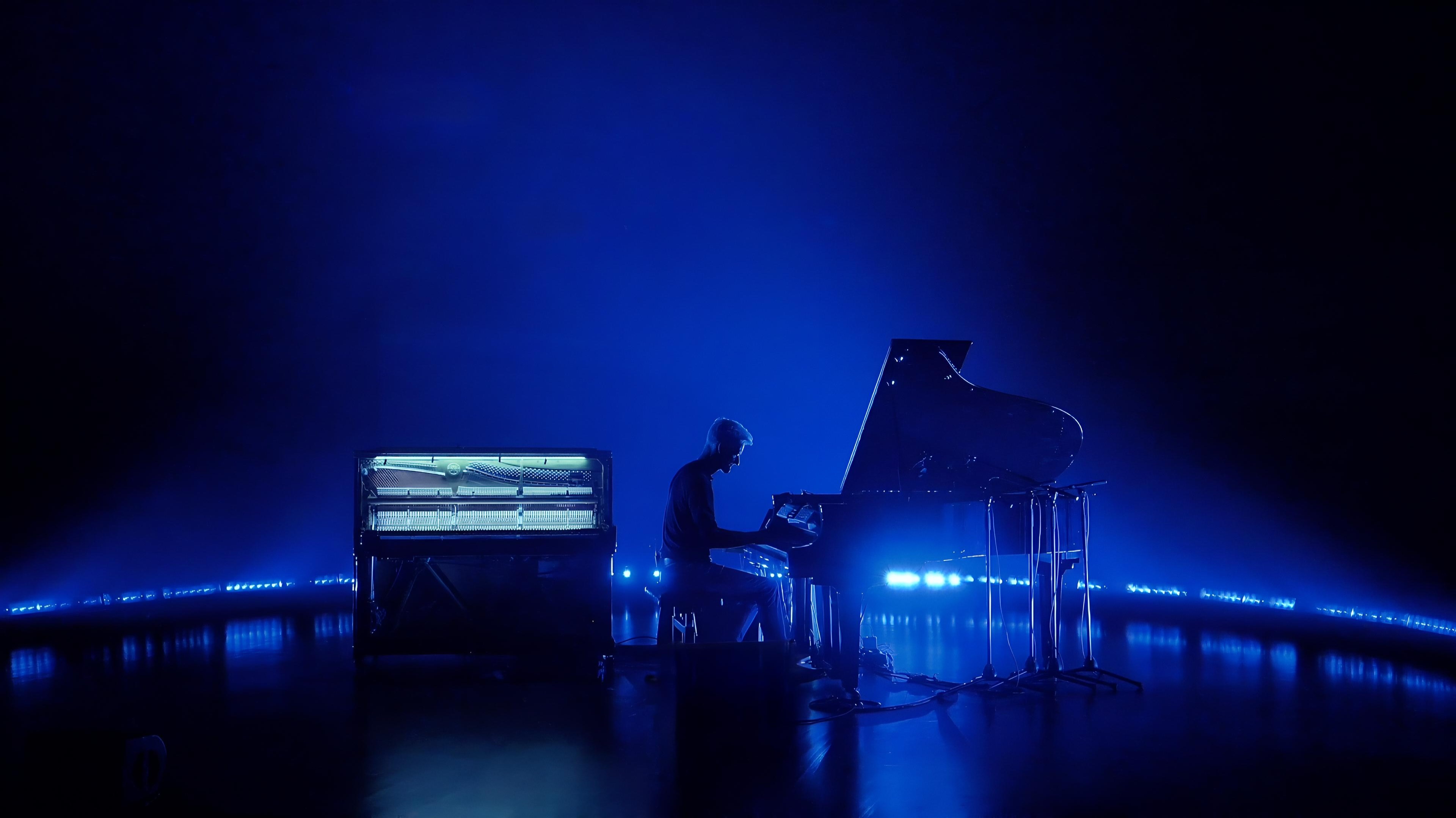
Three conditions had to be met: play with my PIANOïD system, celebrate the 50th anniversary of the Köln Concert and use artificial intelligence. As with most of my projects, I started working in a haze, letting my intuition guide me, without putting too much pressure on myself, because if you look things in the face, it is indeed very intimidating to confront this masterpiece.
Then, little by little, things took shape under my fingers in an organic way, and also with a lot of work, in a balance between these two modes: reflection and intuition.
After listening to an album for a very long time, although the recording stays the same, our perception of it changes. Was one of the points of departure that after becoming such a widely appreciated milestone, the original improvisations of the Köln Concert now felt like "compositions" – and that, by varying them, they could get back their feeling of spontaneity?
In my work as a musician, I am always confronted with these two opposites, improvisation and composition, two practices I appreciate enormously but which are not particularly compatible. What I enjoy most is precisely juggling between the two, without any boundaries.
It often happens at my solo piano concerts that an audience coming more from classical music tells me they enjoyed my concert, thinking everything was written, when a large part is improvised. I take that as a compliment.
Köln Variations is a tribute to Keith Jarrett's improvisations through a work of recomposition.
What kind of qualities were you looking for in the original themes to pick the ones for your own rendition?
I simply kept the passages that moved me the most and that I find the most magical. I didn't try to reproduce them identically, but rather to make them my own, and then offer them in my own way.
Then, little by little, I also added elements that came from me, in the form of compositions and improvisations.
Tell me about how you worked with PIANOÏD to sculpt the results, please.
I invented the PIANOïD system 10 years ago, and it's thanks to all that time spent working on it that I managed to free myself from the technological complexity of this system, and to play it as if it were a simple piano. It's a long process of work and reflection on the relationship between man and machine.
Because I'm in love with the piano and I love electronic music, I wanted to combine my two passions to create this tool, PIANOïD. I would actually love to share it with the young pianists of tomorrow, so that they can develop this piano of the future further.
What were some of the aspects and concepts you ended up with which you would probably not have realised without PIANOÏD?
PIANOïD lets me play everything I couldn't have done on the piano, and above all the unimaginable.
The robotic gesture was invented to imitate the human gesture; now this has been reversed, and I find it rather inspiring to imitate a robotic, mechanical gesture and turn it into something poetic. In my first works with PIANOïD, I precisely didn't want to use this concept, but little by little I realised that this was the whole point: to magnify the impossible.
This means the piano sounds completely different, because it isn't played by a human, and everything we have heard before is completely called into question. PIANOïD is played acoustically as if you were playing a synthesizer, but being played on the acoustic instrument completely changes how the effects feel.
For example, an arpeggiator or a repeater has a completely different effect on a synth and on an acoustic piano. I have also adapted my way of composing to an electronic style, but while composing on an acoustic instrument: that's the whole paradox.
The new pieces are said to be "arranged and re-improvised." Do you feel as though the end result is a composition in its own right? A collaboration through technology? Something else entirely?
These terms correspond to a legal designation, which is absolutely necessary for the respect of intellectual property and the distribution of copyright. But when you are in an artistic process, you no longer think that way.
I have often started from heritage material to recreate a contemporary work, as for example in my albums around Bach, Satie or others ... (Think Bach)
Starting from a musical heritage is very inspiring for me, and strangely allows me to find my inspiration and develop my singularity. It's also a way of honouring and respecting our cultural heritage.
What was the performance at the festival like – I could imagine it must have been quite challenging to realise on stage! Also, how did the pieces change after the concert?
Everything you hear on the album is the same as what I do on stage: there is no editing or post-production.
I am often let down by saying that I use Ableton Live or artificial intelligence: people think I did absolutely nothing in the creative work, whereas in the show, which lasts 1 hour 20 minutes, there are only two minutes of pure artificial intelligence.
But in reality, I find that you don't need to know the creative process to be moved; if anything, it could even prevent it.
I was thinking about how daring Jarrett's improvisations were in their time – in terms of length, scope, stylistic width, and virtuosity, while retaining a clear direction and grounding. Do you rather see a future where these kinds of radical performances will be replaced by technology – or one where they will become even more expansive and radical?
What matters to me is not the length or the virtuosity of a performance, but rather the intention behind it, that is to say being “here and now”, with the audience and with oneself, to offer something that goes beyond us, that is timeless and over which we lose control.
All of this can also be done with machines. What matters to me is the presence of a human who can put themselves into this state of losing control, or rather, that the human trusts their intuition.
And I think that precisely the desire to go even further in technology and artificial intelligence will also force us humans to go even further in introspection, creativity and the search for our personality and our singularity.
It isn't always a purely positive thing to experience your heroes live. Did you ever get to see Keith Jarrett in concert – and if so, what was it like?
Yes, I saw several Keith Jarrett concerts, and for me it was always magical. Perhaps also because, knowing the concert could be cancelled at any moment, it added a tension that could heighten our attention.
In general, when I see my idols, it's rather a source of inspiration and uplift for me, rather than a big blow to my morale telling me I'm not up to it. After all, it's thanks to them that I took up music.