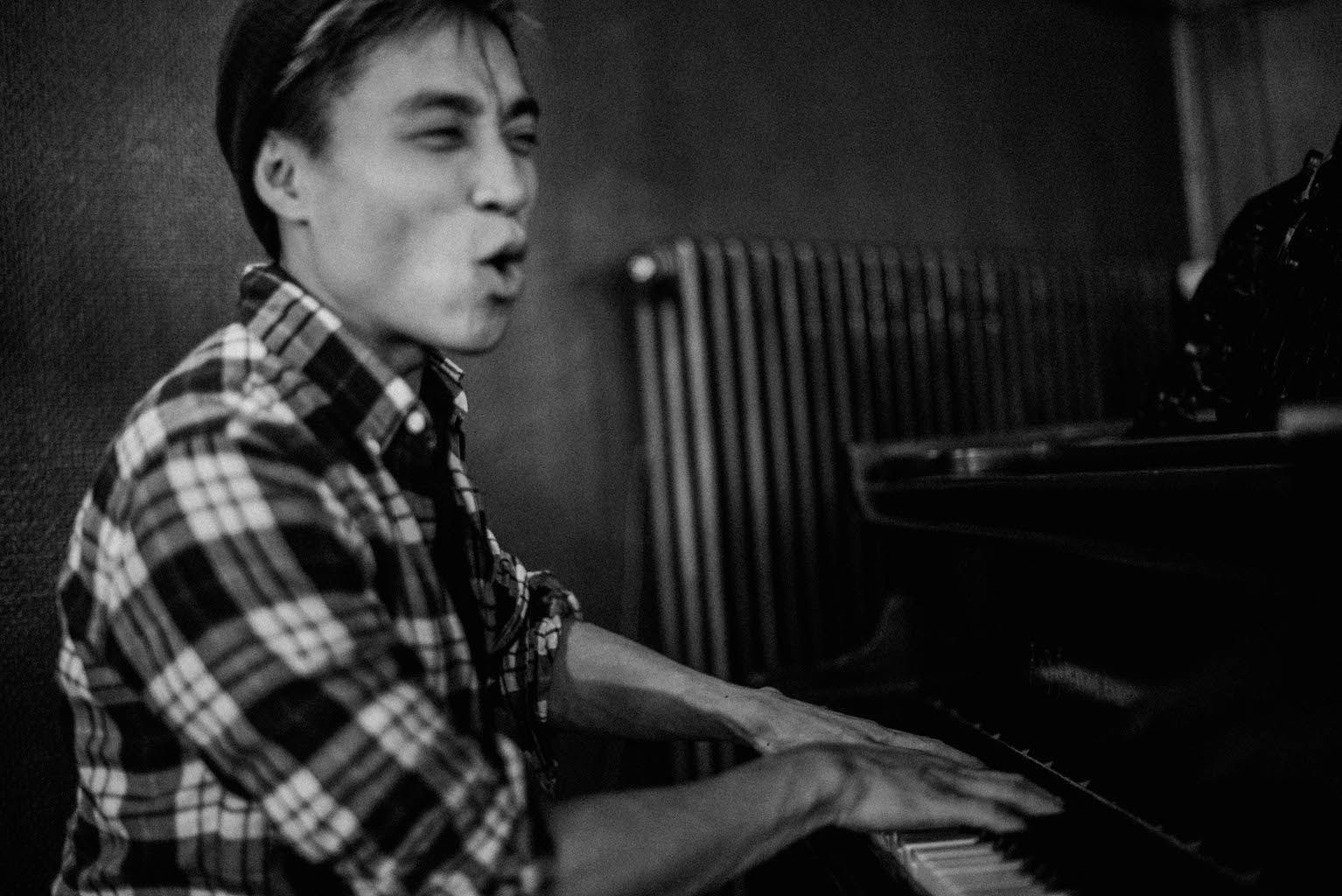
Published
Part 2
Are you acting out parts of your personality in your improvisations which you couldn't or wouldn't through other musical approaches? If so, which are these? What, would you say, are the key ideas behind your approach to improvisation?
Every variable changed in context or environment around the music affects what gets created — including what bits of personality come out. So the answer is yes absolutely. Improvisation requires tuning in to the very present moment, which is a beautiful thing because which personalities surface can be unpredictable.
Improvisation is also a striving for wonder. If I’m not in it or near it, I might start trying weirder and weirder approaches to land closer by it.
In terms of your personal expression and the experience of performance, how does playing solo compare to group improvisations?
Playing in groups requires more focus, on two counts.
First, there’s just so much happening, an explosion of music and energies to respond to — it’s like running through a rainstorm made of candy. Also, playing in groups always feels novel, due to far more hours playing solo and navigating material differently when solo (infinite choruses, opportunity to try permutations, etc.).
In your best improvisations, do you feel a strong sense of personal presence or do you (or your ego) “disappear”?
Yes, the self should dissolve during channeling, improv or not, in or out of the field of music.
That’s an ideal and doesn’t always happen … usually the obstacle to dissolution is not enough familiarity with material (chord changes to be improvised over, or the ability to execute a certain fingering in time, and so on), or insuffcient experience with the situation (such as playing a high-stakes show on not enough sleep).
In a live situation, decisions between creatives often work without words. From your experience and current projects, what does this process feel like and how does it work?
Invisible is best.
When everyone on stage (and also the listeners) are tuned into the moment, listening, and energies are exchanged instantly. It’s like emotional empathy: a magical flow can occur when there’s no acknowledgment or even intellectual involvement: it’s not someone thinking about what to say or even worse, saying “ok now I’ll listen to you speak and I’ll respond to that.”
Stewart Copeland said: “Listening is where the cool stuff comes from. And that listening thing, magically, turns all of your chops into gold.” What do you listen for?
Presence first. Then rhythm, which gets pretty close to what the emotional space is, even if rubato. Then melody and harmonies.
There can be surprising moments during improvisations – from one of the performers not playing a single note to another shaking up a quiet section with an outburst of noise. Have you been part of similar situations and how did they impact the performance from your point of view?
We just wrapped a 5-day exhibition and concert series, leading up to the album release show for Travel Poems. Chapter 3. There is no path back. Before the last show, I played improvised concerts with different musicians each night that I never performed with before.
So, surprises all the way through. When one musician initiates a sudden turn, it’s up to everyone else to receive that impulse however is right for them. Usually it causes at least one other band-member to respond to the call; sometimes, it leads to an instant redirection of the whole voyage.
I have always been fascinated by the many facets of improvisation but sometimes found it hard to follow them as a listener. Do you have some recommendations for “how to listen” in this regard?
I relate to this so often. But I see it as an issue of the improviser’s ability to lead the listener, and not lose them along the way, plus the frame around the improvisation (is it happening during a set at a jazz club; is it a stranger sitting down at a public piano in a train station?).
Even though I am grateful for attentive audiences, and furthermore for experienced listeners well-versed in diverse styles, it’s not the listener’s responsibility to listen better.
My belief in this is so strong, it’s the basis for adding soundscapes to the Travel Poems trilogy, and adding immersive storytelling to the live show. By framing the music within broader ideas — such as taking the listener on journeys, evoking pictures in people’s imaginations, and presenting narrative experiences to be shared by everyone in the same room — we can redefine what it means to “follow” the music.
Nowadays I’m all about finding unexpected ways for people to “get into” the music I’m making — for example, scoring improvisations to photography and subtitles (for the Music Postcards series) and touring a 10-foot tall
“Teleporter Phone Booth” art installation for visitors to physically step into, then be transported through music and sounds. And the premise for the recent art exhibition, titled The Air Is Made Of Music, where 5 collaborating artists interpreted the song-postcards from Travel Poems through their own mediums.
That said, re-contextualization shouldn’t be necessary. Maybe there are outsized rewards for the listener able to follow the most inaccessible of solos, but I have no interest in playing abstract or esoteric or complex-for complexity’s-sake music where most of the audience has no choice but to tune out.
For me the goal is the same as when you find yourself in one of the most amazing conversations you’ve ever had in your life: to go deeper into truth, simultaneously with the other person understanding immediately.
In a way, improvisations remind us of the transitory nature of life. When an improvisation ends, is it really gone, just like a cup of coffee? Or does it live on in some form?
As someone who records everything (even those first shows playing dining halls in college) I might the wrong person to ask, haha. (I even started a project called Proof of Play where every weekday I publish an excerpt of improvisation from the studio.)
But at the same time — and this is huge — replay can never be the same, because even with perfect audio reproduction, the context is different, starting with the fact that being present during improvisation is its own unique experience and relationship, even for a solo musician with themselves.
So full circle: yes, the improvisation is gone. Though we can keep polaroids of it in scrapbooks, which, funny enough, can lead to new art experiences.