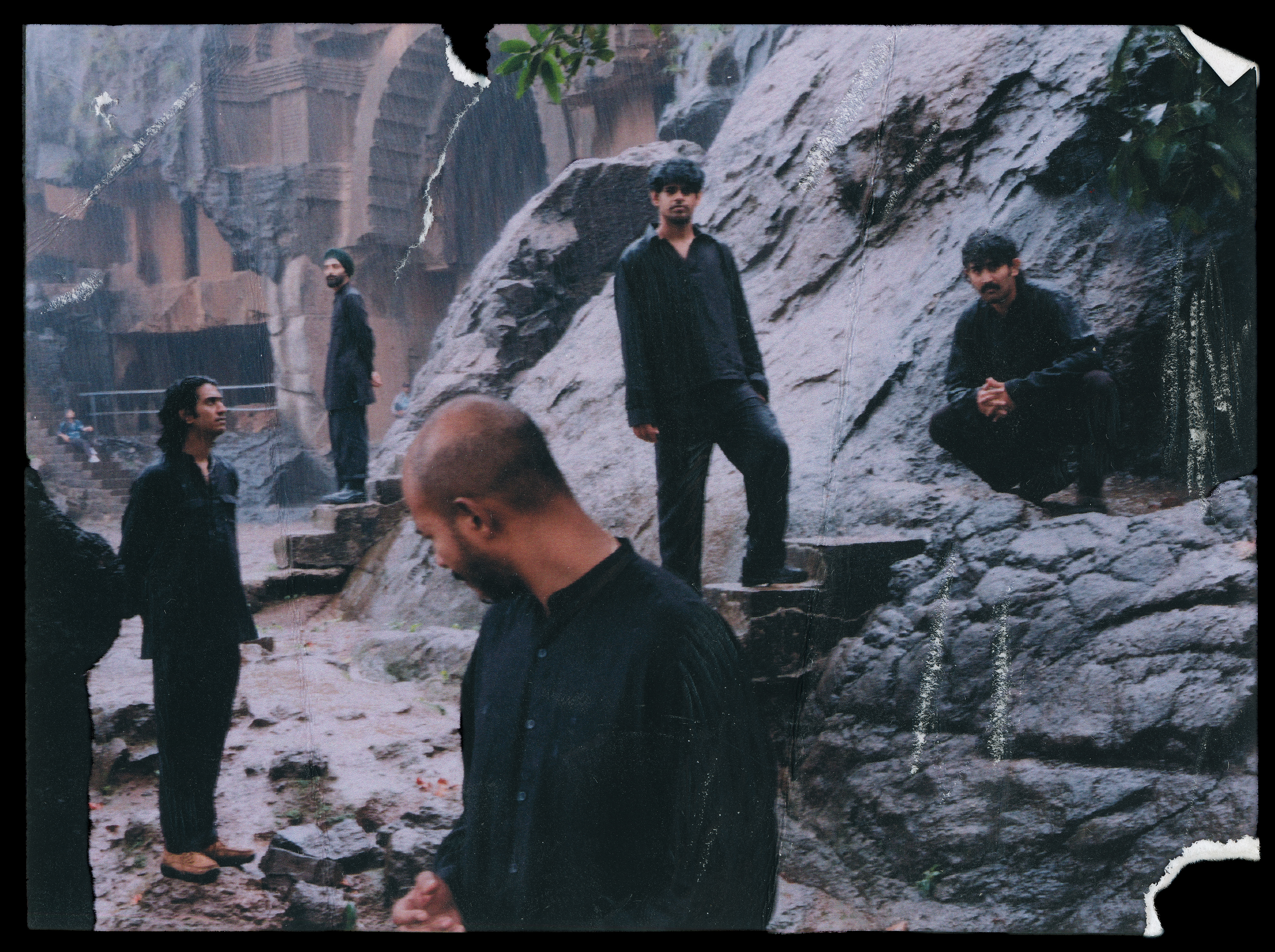
Part 1
Name: EXCISE DEPT
Nationality: Indian
Current release: EXCISE DEPT's new album SHOPNOBHUMI | স্বপ্নভূমি is out October 9th 2026 via Dialled In.
If you enjoyed this EXCISE DEPTinterview and would like to know more about the band, their music and upcoming gigs, visit their official homepage. They are also on Instagram, and bandcamp.
Tell me a bit about the music and art scenes in Mumbai and New Delhi, please. Are there other producers you are in touch with and/or who have an influence on your work?
We largely have worked within our close friend group, which is made up of people doing video, sound, theater, photo and digital art.
EXCISE DEPT would not be what it is without this larger group of creatives and multi-disciplinary folks that have supported us and helped us grow along the way – like Sanjay Das (Philtersoup) who helped us design and build the website. He also mixed the album, performs live on stage with us, and has played an integral part of SHOPNOBHUMI.
This album cycle, we also worked closely with filmmakers Kevin Rathod and Annette Jacob in creating the visual pieces for "NEEND" and "FREEDOM." Kevin is a longtime collaborator who also worked with us for our previous projects and debut album cycle.
As far as our influences go, they come from a variety of media, eras and places, so I can’t say that there’s anything per se within the scene that impacts us significantly. We are generally more inspired by the canon than we are the contemporary. However, we really do support and admire a lot of artists coming out of India at the moment, most of whom are sadly yet to be acknowledged in major press outlets or internationally.
How did the band come together? What do you still remember from the first time you played as a unit?
Karanjit and Rounak were friends in high school, where they initially and very quickly bonded over 90s bollywood films, Indian postcolonial history and internet culture. While they individually developed their practices over 10 years and stayed closely in touch, it wasn’t until 2020 that the group really began to incubate.
That year, Rounak also became closer with Andrew and Siddhant, both musicians and producers also living in Navi Mumbai. As the pandemic took hold, the four huddled in Rounak’s home, making music, processing the widespread sociopolitical upheaval happening across India, and gradually building out the foundational ideologies behind EXCISE DEPT.
Our first few shows were very makeshift and messy – our first ever performance was at an open mic at a bar in Goa. We went on after a stand up comedian and acoustic singer songwriter. The PA system started crapping out because of the amount of bass we were pushing out in our tracks. I’m pretty sure nobody there was ready for it, and some people were definitely a bit frightened by it all.
A year or so later, we eventually began playing at art galleries, smaller DIY clubs across India.
I wanted to briefly talk about your previous album SAB KUCH MIL GAYA MUJHE VOL. 1. It's still a fascinating record - how do you look back on it and in which way was the new material a specific response to how that album ended up?
SKMGM VOL 1 was really a response to the five years that came before it.
2019 was a year of major change for Karanjit and Rounak who had just returned to India after 7-8 years of living and working in the United States. In 2020, everything changed with the pandemic.
Thus, 2021, 22 and 23 really became the years we were processing an alarming amount of death, political conflict, discourse and absurdity on a day to day basis.
We really see those years as a time when the internet became a battleground; politics, vulgarity, violence and culture wars were playing out IRL and online.
The music is a messy summation of all of that stuff – emotional, funny, grotesque and visceral.
There is a quote from the press release of the previous album which I thought was very interesting and still relevant for the upcoming new one: “EXCISE DEPT doesn't claim to know what it means to be Indian, and in turn, does not claim to represent Indian-ness. Nonetheless, it is undoubtedly and unquestionably Indian.” Can you talk about what this means?
We’ve always maintained a bit of skepticism and resistance towards the South Asian diaspora. Even today, when it seems like South Asian cultural ideas and heritage are sort of having a moment online, we see a lot of South Asian people playing up their identity in an effort to gain a seat at the table.
Personally, we were very interested in making a record that was obviously influenced by postcolonial ideas, but we wanted to be very careful about what makes us “Indian”. For instance, one example is that SKMGM Vol. 1 doesn’t really have any samples from what one would recognize as “Desi” music. Yet, it is an extremely Desi hip hop record, full of references only known to particular communities within India.
Another unmistakably Indian thing about this record, and the collective as a whole, is that it deconstructs a lot of ideals and values that “India” was founded on. India too, was a sort of post-colonial project, a grand experiment, much in the way the United States is often talked about. In that sense, a lot of these values of self-actualization, secularism and pluralism are actually original ideas that ‘India’ was forged with.
So we’re sort of celebrating those values but also heavily critiquing them, knowing what we know today. It seems much of these ideals might just be forgotten very soon. There was once an air of optimism in India especially in the 1990s. A lot of that began changing as we became adults, especially in the late 2010s.
On SHOPNOBHUMI, you are making very different music and making it very differently, too. What defines the band, if not style, genre or any of the other typical characteristics?
We’ve all been musicians and producers in our own ways much before ED was a project.
Rounak makes alternative, folk, rock and experimental music with his solo project, Andrew has indie folk releases under his name, and Siddhant has worked as a bassist and composer under several projects in Mumbai. Karanjit and Rounak specifically always had an interest in ambient and drone music, and Siddhant and Rounak both work as media composers outside ED.
The new album is sort of a gathering point for all these new influences and a desire to take a sharp left turn away from making hip hop. We are instrumentalists after all, and we were keen on making something that was as messy as SKMGM, but birthed from live improvisations and experiments.
The press release mentions “family memories, political history and feelings of anxiety, alienation and surrender” as influences. Tell me about those, please. Do you tend to “store” memories in images or sounds?
The last question is spot on.
I think especially in our collective imagination and indeed the larger imagination of Indian people, memory and history are rich, both visually and sonically. The 1947 partition of India, Pakistan and eventually Bangladesh was the core historical moment that prompted the ideas of alienation and separation throughout SHOPNOBHUMI.
1947 is a very multidimensional idea in India – it’s something we’ve seen portrayed in the media, in movies, and in oral history. It’s something we see reflected in nursery rhymes, songs we rote-learnt in school. There is a deep seated trauma in that, and it’s the exact tension that is the wellspring, the heart of the new album.
What were the improv sessions to SHOPNOBHUMI like?
SHOPNOBHUMI unravelled very organically, from many days, weeks and months of experimentation, calling upon patriotic songs, folk songs we learnt as children, reimagining those with synths, samples, noise, and much more.
The band is a living breathing thing, I’d say it’s characterized by slow, deliberate pacing, and very emotional high points. We had a lot of instruments plugged in and spent a lot of time freely writing and recording at home, as we always do.
We also integrated a few studio sessions this time thanks to the support from Dialled In Records – we spent a few days recording at Island City Studios in Mumbai, and in June 2026 also recorded a few tracks at Abbey Road during our trip to the UK.
Why was improvisation as a good tool for the new album to deal with precisely the topics mentioned above?
Our general approach to the creative process is collage-y from the start.
We like to place multiple ideas and sounds and images in conversation with one another, and find unexpected harmonies and dissonances in that process. Improvisation leaves us very open and vulnerable as musicians and writers, and its exciting and interesting to occupy that space.
Compared to SKMGM VOL 1, the music in this album was a true effort of improvisation, composition and arrangement, a lot of meta-sampling of sounds that keep re-appearing throughout the album too. In some ways, I suppose this mimics constantly re-written ideas of Indian independence, the continuous self-correction of one’s memories and the faults of collective remembering.