Published
Name: EYM Trio
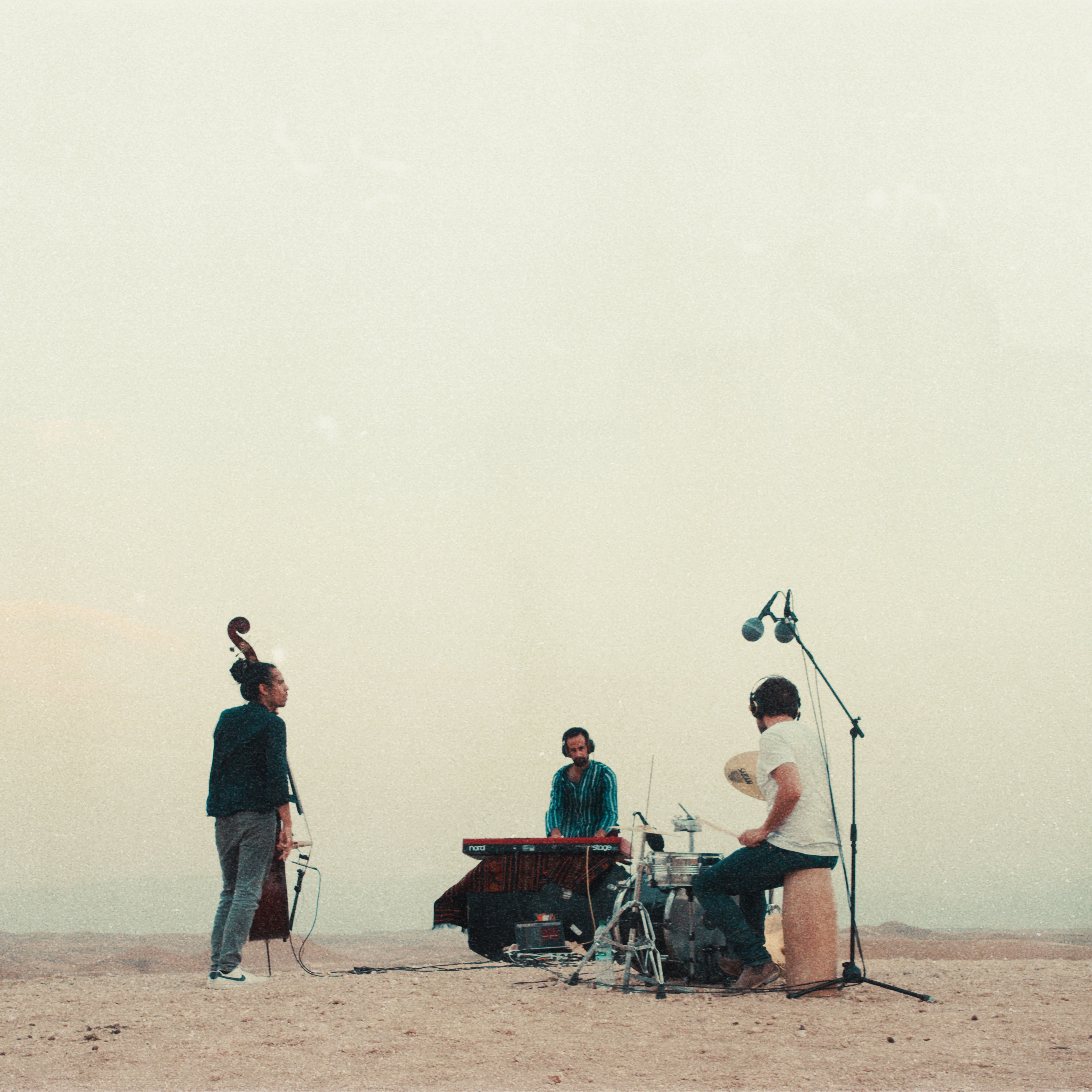
Members: Elie Dufour (piano), Yann Phayphet (double bass) Marc Michel (drums)
Nationality: French
Current release: EYM Trio's new album Nomad Sessions Vol. 1 is out via Ohrwurm.
If you enjoyed this EYM Trio interview and would like to stay up to date with the band and their music, visit their official homepage. They are also on Instagram, Facebook, and bandcamp.
There have been many fascinating examples in jazz of cross-cultural collaborations. Which of these do you personally enjoy and where there possibly any which had a direct influence on this project?
I think what inspired us in the first place wasn’t so much cross-cultural fusion, but traditional music itself.
In the early stages of the project, we drew a lot of inspiration from Eastern European traditional music, Bulgarian music in particular. In fact, a few years ago, we arranged a traditional piece called “Gankino Horo” for one of our albums.
Later on, Elie, the pianist, became interested in many other musical traditions as well, including North African and Indian music..
The NOMAD SESSIONS is taking the idea of “world music” very literally. In its scope, I find it incredibly inspiring and at the same time almost ridiculously ambitious :-) How did you move from this being a mere thought to an actual plan?
Before starting this project, we were already touring abroad quite a lot, and we wanted to find a way to share what we were experiencing with other people. In a way, the idea behind this project is almost to take the audience on tour with us. That’s where this slightly crazy idea came from.
On the technical side, we’re lucky that nowadays there are so many small gadgets and pieces of equipment that we can easily carry around in our suitcases ;)
I also have to admit that the project would never have been possible without the financial support of our publisher, which allowed us to purchase the equipment we needed.
You've referred to the performances captured on the road as “adventure music.” What's wrong with a little minimum safety when making music?
With a project like this, it’s very easy to make life complicated for ourselves. In fact, I can’t remember a single shoot that was actually easy!
I think music, especially improvised music, is directly connected to the context in which it is played. That’s why I find it interesting to put ourselves in these challenging situations: they bring a new dimension to the music and inevitably make our compositions sound different from the way they would in a studio or in a concert setting.
As someone who spends far too much time behind his laptop at home and would like to get out more – how challenging were the logistics and finances of the project?
As I mentioned earlier, the equipment was funded by our publisher. We also take advantage of our tours abroad to shoot these videos, so there aren’t really any additional travel costs involved.
On the other hand, the logistics once we get there,finding instruments, a location to shoot, and a camera operator, are usually arranged just two or three days beforehand. It’s always quite challenging because, before we leave, we generally have almost no contacts on the ground.
But we’ve been incredibly lucky. Almost everywhere we’ve gone, we’ve met extremely kind, generous, and helpful people along the way who have helped us make these sessions happen. It has actually given me a lot of faith in humanity.
One of the things that has always intrigued me is the concept of music as a language. How did the experiences of the NOMAD SESSIONS influence your perspective on this, especially in terms of the overlaps and differences?
Yes, I have to admit that the idea of music as a universal language is something I find very mysterious, yet undeniably true. We’ve been to many countries where we didn’t share a common spoken language with the people we met.
I particularly remember one session in India, on a street in Bangalore, where the people around us spoke almost no English. When we started playing, people stopped for a moment to listen. Some reacted by moving to the music or simply smiling. There really is a connection happening, just in a different way. I find that very beautiful.
I’m not an expert in linguistics, but I actually think that music is a language in its own right. We have rules, grammar, spelling, and so on—it’s simply that the “words” carry a different kind of meaning.
Would you say that jazz lends itself particularly well for the kind of situations and conversations you were looking for – if so, in which way?
Yes, I think jazz is particularly well suited to human interaction because it is an improvised form of music. This means that there are genuine conversations happening between us through the music.
Recently, we’ve done several tours with an incredible Indian singer, Varijashree Venugopal. Our respective musical cultures are obviously very different, but despite that, we’ve always felt a very strong connection in the way we interact and communicate musically.
How different were the understandings of jazz for your collaborators? What does the term “jazz” mean globally, do you feel?
Haha, if you asked several jazz musicians at a jam session to define jazz, you could probably spend the whole night debating it!
Historically, jazz was a much more clearly defined genre, with its traditional forms and influences, blues, Broadway songs, bebop, and so on. Today, the music has evolved so much that it has become very difficult to define.
But if I had to, I would say that jazz is about playing improvised music, having genuine conversations between musicians through music. The “grammar” of that language comes from the influences that resonate with each of us, as well as, of course, from our knowledge of the jazz tradition and its standards.
Improvisation was obviously an essential part of the project, but there are remarkably individual approaches to improvisation from country to country. What did you learn and perhaps also integrate into your practise as a result of the NOMAD SESSIONS?
The NOMAD SESSIONS are essentially concerts performed under very different conditions. I would say that most of what we’ve learned has actually come from playing together as a trio for more than fifteen years. Each of us brings different ideas to the music, and playing so many concerts together has helped us grow musically and discover new territories that we can explore.
We’ve also been fortunate enough to collaborate with many musicians who have greatly enriched us, both as a trio and individually. I’m thinking in particular of Mohammed Abozekry, Varijashree Venugopal, Mike Moreno, Gilad Hekselman, BC Manjunath, and many others.
You recorded in wildly eclectic situations. What impact did factors such as time of day, weather, surroundings and stress levels have on the music making?
Everything has an impact on the music. If a place has a particular kind of reverberation, we’ll naturally play differently, and we can use that reverb to give the music a different color.
In the same way, the instruments we find inevitably influence how we interact with them. Finding a drum kit, in particular, is always a challenge, and I think almost every time we’ve ended up with kits that were in very poor condition, or sometimes practically toys!
But that’s exactly what makes it interesting, because it pushes us to play differently and explore new possibilities.
There are fundamentally two different approaches to cross-cultural collaboration: Both sides move towards each other for a fusion or each side stays within its limits and trusts something beautiful will emerge. How did that pan out for you in practise?
Yes, absolutely. Cross-cultural fusion is always very difficult to achieve, because you have to avoid falling into clichés while also making sure that everyone has enough space to express themselves in their own musical language.
I’m not saying that we’ve necessarily managed to achieve that perfectly, but it’s certainly what we aim for whenever we collaborate with other musicians.
One example is our work with Varijashree Venugopal, who comes from the Carnatic music tradition of South India. We’ve just recorded our second album together, which will be released in 2027. We’ve been playing together for several years now. We recorded our first album some time ago and have toured extensively together, both in France and abroad.
I feel that all these years of collaboration have allowed us to grow musically alongside one another and gradually build a space where we all feel at home, and where each of our musical cultures can express itself freely.
There is a tendency to believe that in non-western countries, music is more deeply embedded into daily life. Based on the concrete experiences of your travels, would you say this is true? And if so, what are the effects?
Yes, I think every country has a different sensitivity to music.
I particularly remember a tour in Colombia, where even the mainstream music you would hear on the radio in a taxi was incredibly rich, with so many interesting rhythmic and harmonic ideas. I think that reflects the special place music holds within a culture.
I was thinking how many positive experiences you had on these trips. Can music really act like a political bridge for bringing people together on a wider scale or is it ultimately powerless in the face of political pressure?
Absolutely, I think music can have a real impact on people. Politics operates through language and words, and in a way, that makes it easier to lie to and mislead people. I think that is one of the main problems.
Music, on the other hand, works through emotion and can reach people on a deeper level. Through music, you have to communicate something sincere, because that sincerity is what makes it beautiful. You can’t really lie through music.
For that reason, I believe music can genuinely help bring people together and perhaps help us find a better future.
The release captures, I would presume, only a fraction of what you recorded. How did you go about selecting the music? What made one recording “better” in terms of the project than another?
It was quite difficult to choose the tracks, because we actually have almost enough material from the NOMAD SESSIONS to make two albums.
We didn’t really select them based on which recordings were “the best.” Instead, we tried to create a tracklist that tells a coherent story, with a natural balance between ballads, more intense pieces, and different moods throughout the album.
Many of the recordings were first or second takes, sometimes taken in extremely difficult circumstances. Perhaps, just a few minutes later, they would not have reached the same quality. Is there anything we can say about what makes one moment magical and another mundane?
What makes a recording magical is when the conversation between the musicians is meaningful. If the conversation feels flat, there isn’t much interest in listening to the dialogue. But when everything that is being said feels relevant and gives each musician something to respond to and build upon, then it becomes truly interesting to listen to.
That, to me, is what makes a recording magical. In fact, I don’t think there is much point in doing too many takes, because at some point it becomes an exercise in repetition rather than spontaneity. You begin to lose the sincerity of what you are saying through the music, and in my view, that makes it less interesting both for the musicians and for the listener.
Just like field recordings, the tracks on the NOMAD SESSIONS capture a lot of one inspired moment. What, would you say, is it that sound and music can not capture in a recording?
If we are sincere enough and truly connected through the music, I think a recording should be able to capture everything. Being a musician means being sensitive to whatever is happening around you and, in some way, translating it into the music.
If we fail to convey everything we experience and feel in that moment, then perhaps we are no longer being completely sincere. And to me, that is not what we should be aiming for.