Published
Name: Fanatico X
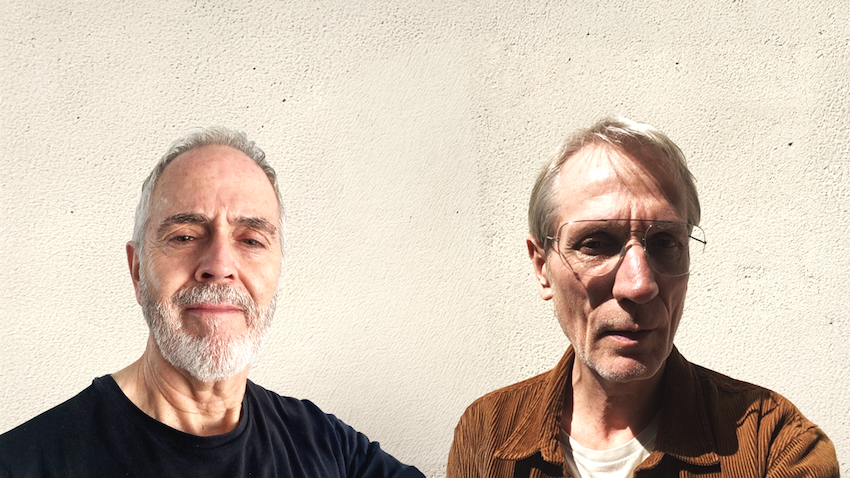
Members: Mathias Schaffhäuser & Jorge Socarras
Nationality: Cuban-American (Jorge Socarras ), German (Mathias Schaffhäuser)
Current Release: Fanatico X's new album Beneath Your Feet is out October 10th 2025 via GMO. Stream the album here and order your physical copy here.
Recommendations for Cologne, Germany: Mathias: In Cologne, where I've lived since I was 25, there aren't really any great sights, even though the cathedral is world-famous—but it's mainly just very big and not really beautiful. But the city has a good vibe, and a lot of things are well balanced without being able to put your finger on it. Unspectacular, but somehow endearing.
Recommendations for Madrid, Spain: Mathias: Jorge: The streets of Madrid are always interesting!
Topics that we're passionate about but rarely get to talk about:
Mathias: The fact that we are hurtling through space on a small sphere. Incredible. But I don't really like talking about it.
Jorge: Consciousness as the wellspring of everything!
If you enjoyed this Fanatico X interview and would like to know more about the band and their music and upcoming live dates, visit them on facebook.
Where does your impulse to create come from? What role do often-cited sources of inspiration such as dreams, other art forms, personal relationships, politics, etc. play?
Mathias: My biggest impulse is simply the joy of making music. For me, it's one of the most enjoyable activities there is. And since I always have ideas (not always good ones, of course), I can actually get started at any time.
Jorge: For me creating has always hinged on the inherent need to express myself, to communicate ideas, feelings, moods. I basically can’t help it, and am not at my best if I am not creating, whatever the form or medium.
Do you need concrete ideas—or what some people call a “visualization” of the finished work—to get started? What is the balance between planning and chance for you?
Mathias: Planning doesn't play a big role in my creative process. Most of the time, pieces start with improvisation or vague ideas, then I might think of a sample I've always wanted to use, and suddenly the piece takes a completely different direction than I had imagined two minutes earlier.
When pieces are created on the guitar, especially for lyrics that are already finished, the specifications are naturally more influential. In other words, there is no set approach; chance plays a big role for me at all levels of composition.
Jorge: In the case of collaborating with Mathias, he often provides a basic musical concept that I can then play with. That said, I am very visually oriented, and I came to music from a visual art background.
Is there a preparatory phase for your process? Do your tools have to be arranged in a certain way, do you have to do “research” or create “early versions,” for example?
Mathias: Nothing like that.
Jorge: Me neither. It just comes.
Do you have certain rituals to get yourself in the right mood for creating? What role do certain foods or stimulants such as coffee, lighting, scents, exercise, or reading poetry play?
Mathias: Again, none of that matters to me.
Jorge: Ditto.
What did you start with for Beneath Your Feet? If there were any conceptual considerations, what were they?
Jorge: One significant factor was a longstanding desire I had to cover the song “White Rabbit,” and I think this helped partially shape the album concept.
Please tell me a little about how the new material came about and gradually took its final shape.
Mathias: There's a different approach to almost every piece.
Covering “White Rabbit,” for example, was suggested by Jorge, who has a strong connection to the song. I then looked into the original, which I hardly knew (yes, honestly!), and pretty soon I had the vision that I would like to have Maureen Tucker on drums.
Of course, that wasn't possible for several reasons, so I programmed a beat that reminded me of her playing style with Velvet Underground. And that's how the song came about.
At some point, a mistake while working with Ableton Live resulted in an interesting loop, which became the starting point for the ambient version of the song, which I then edited in front of the actual cover version. So in the end, the entire piece was a combination of relatively extensive planning and pure coincidence.
The songs “Beneath your feet” and “Oh to roam,” on the other hand, are examples of the most typical FANATICO X working method – I improvised beats and bass lines, built an instrumental track that could have developed into a club track, but sent these sketches to Jorge, who then saw if he could come up with lyrics and melodies for them, which he did magnificently for both.
Next, we recorded the vocals, and I produced and arranged until the versions you hear now emerged from the material.
What do you think makes good lyrics? What are your own ambitions and challenges in this regard?
Jorge: Coming from an art and literary background, for me how something is conveyed is as important as the idea or feeling itself.
In other words, style is as important as content.
Which areas/themes/topics recur in your song lyrics?
Mathias: Love, religion, and the nature of truth.
Jorge: Agree.
Many authors claim that certain aspects of the narrative are no longer in their control once they enter the process. Do you want to maintain strict control, or do you prefer to let yourself be guided by where things take you?
Mathias: I don't really believe in such processes; they are more like metaphors for a specific personal workflow. Coincidence, control, spontaneity—in the end, I think it all springs from the brain of the creator.
There are many descriptions of the creative state. How would you describe it for yourself personally? Is there a spiritual element to what you do?
Mathias: I wouldn't call the state spiritual, because it arises from within me; it's part of my biology, my body. But it can be intoxicating, excessive, and of course frustrating and exhausting.
Often, however, creative work is simply everyday life with all the good and annoying aspects that everyday life and work entail.
How important is it for you to let a work rest after it is finished and evaluate it later? How much improvement and refinement do you personally allow before you are satisfied with a work?
Mathias: Letting works rest and then re-evaluating them is definitely a good thing, and I try to take that to heart, but I'm often too impatient and want to publish everything quickly.
Sometimes I regret that, but ultimately, almost all artists still find things in their works that they would like to change, even years later—regardless of whether they had long periods of rest before publication or not.
In your opinion, how is the meaning or impact of an individual piece reinforced, clarified, or possibly contrasted by the EPs or albums to which it belongs? For example, does every piece have to fit in with the bigger picture?
Mathias: Of course, context plays a role; there are feedback loops and influences. But I wouldn't overestimate that.
To many critics and fans, our albums and also my solo albums often seem like concept albums, but virtually none of them were actually intended as such.
Jorge: I think often the context comes with or even after the assembling of pieces.
In terms of your contribution to a song, what is the balance between composition and arrangement (including production, mixing, and mastering)?
Mathias: Most of the time, the basic musical ideas—as described above for “Beneath your feet” amd “Oh to roam” —come from me, then Jorge writes the lyrics and creates the vocal melodies, which we then record and incorporate, which of course inspires me to compose further elements and then bring it all together into a well-integrated whole—in other words, to arrange and produce the song.
Jorge: Yep.
Music and the accompanying artwork are often closely linked. Can you talk a little about your current project and the relationship between images and sounds for you in general?
Mathias: That plays virtually no role for me. If I'm not mistaken, the artwork for our albums has always been created after the musical process. Right, Jorge?
Jorge: Yes. We often know what we don’t want, and when we work with an artist or designer we like to give them the opportunity to be inspired by the music and see what they come up with.
After you've finished and released a piece or album, you can feel a sense of emptiness. Can you relate to that—and how do you get back into a creative state after that experience?
Mathias: Most of the time, I take a break after intense production phases because I'm really groggy and my mouse hand is acting up, but after a few weeks, my fingers quickly start itching again. As I said above, I just enjoy making music, and I quickly miss it.
Jorge: I turn to writing to mitigate the comedown.
I'd like to hear about the feedback you've received from listeners or critics, what they think of your songs or how they've affected them – have there been any “misunderstandings” or have you perhaps even gained new “insights”?
Mathias: We're not overwhelmed with feedback, but I notice time and again that there are regularly very warm and personal statements—often from people who appreciate niche music and, as a radio DJ put it in a piece of feedback, somewhat “quirky songs.”
Jorge: I think often people are surprised at the range and unpredictability of the music.
Creativity can reach many different areas of our lives. Do you personally feel that writing a piece of music is fundamentally different from something like making a good cup of coffee? What do you express through music that you couldn't or wouldn't express in more “everyday” activities?
Mathias: I can't dance to coffee and I can't drink music. Everything has its place in the world. 😁
Jorge: For me life without art can be bleak, so I have to be either be making it or experiencing it regularly.