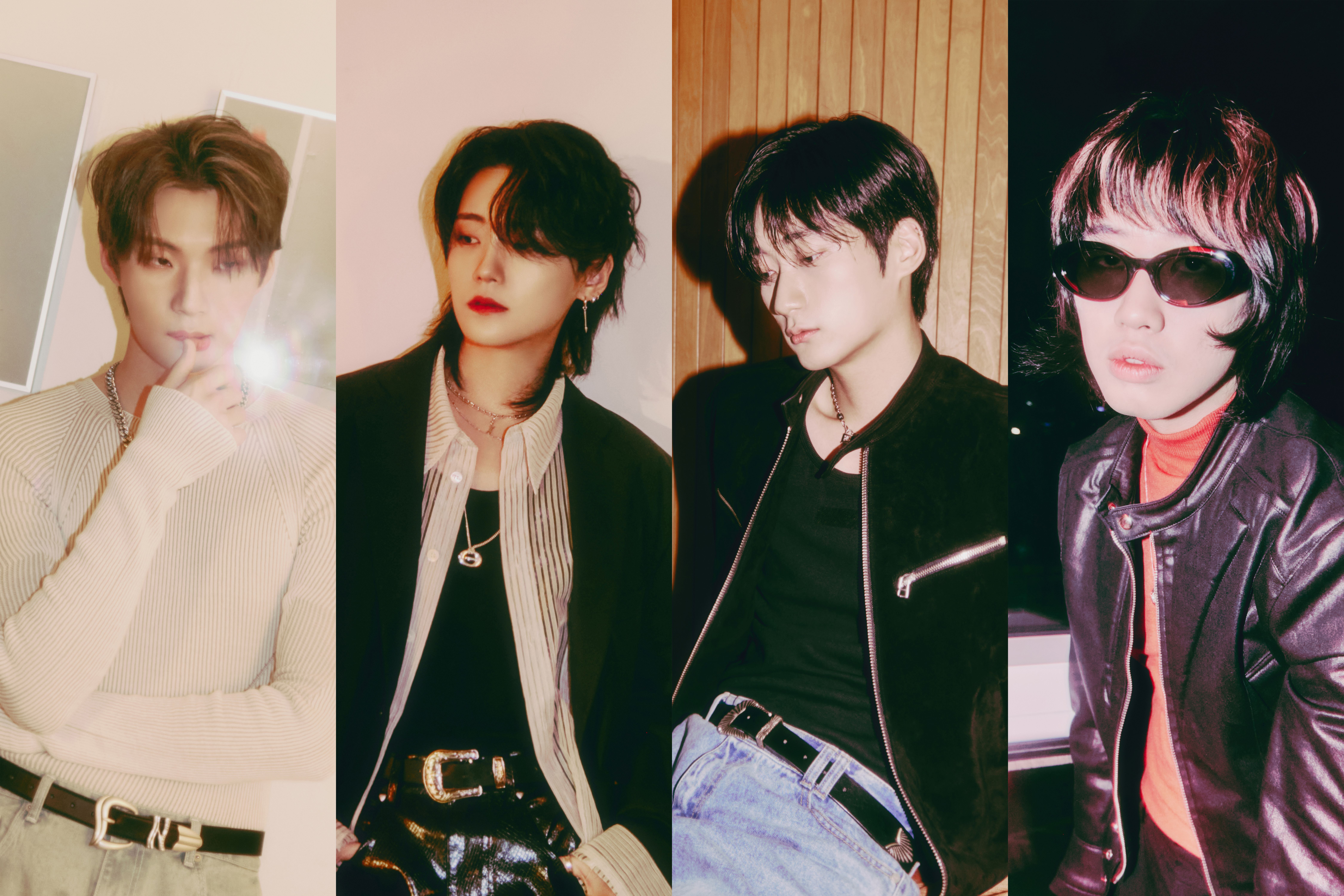
Part 1
Name: Touched
Members: Yunmin (vocals, guitar), Kim Seungbin (drums), John B. Kim (bass), Chae Dohyeon (keyboard)
Nationality: South Korean
Current event: Touched will perform at 2024's Reeperbahn Festival. For more information about the Korea spotlight of the event and for buying tickets, go here.
Recommendations:
Yunmin: Book - Art & Fear by David Bayles // Painting - Self-Portraitby Basquiat
Kim Seunbin: Stevie Wonder - Songs In The Key Of Life // Nuno - Schizophonic (1997)
John B. Kim: C.S Lewis - The Chronicles of Narnia // J.R.R Tolkein - The Lord of The Rings
Chea Dohyeon: The Beatles's album - Sgt.pepper's lonely hearts club band // The Bible
If you enjoyed this Touched interview and would like to know more about the band, their music and current live dates, visit them on Instagram, and twitter.
When I listen to music, I see shapes, objects and colours. What happens in your body when you're listening? Do you listen with your eyes open or closed?
Yunmin: I like to draw a background that matches the music in my head.
Kim Seungbin: When I listen to music, my body automatically starts moving. I naturally groove to the rhythm of the music I'm hearing.
John B. Kim: I usually imagine places or scenes.
Chea Dohyeon: When I listen to music, I tend to focus more on my emotions. After listening to music, I often describe the sounds by expressing them in shapes and colors.
Entering/creating new worlds through music has always exerted a strong pull on me. What do you think you are drawn to most when it comes to listening to and creating music?
Yunmin: Inspiration! And being a little more true to what I feel and want to express without being swayed by something.
Kim Seungbin: Inspiration and experience, along with the musical ability to bring them to life.
John B. Kim: I believe that values are the most important thing.
Chea Dohyeon: A perspective on the world.
According to scientific studies, we make our deepest and most incisive musical experiences between the ages of 13-16. What did music mean to you at that age and what’s changed since then?
Yunmin: At the age of 16, I lost a friend in an accident. It was due to the greed of adults. During the unstable period of my adolescence, music comforted my troubled heart, which was filled with rebellion against the world and a sense of betrayal by adults.
The catharsis I experienced at that time led me to pursue a path as a musician because I wanted to become someone who could offer the same comfort to others.
Kim Seungbin: The music I listened to during that time ended up having the greatest influence on my music now.
John B. Kim: It meant being like a friend that brings joy and comfort in between the moments of life.
In the past, I found comfort in other people's music, but now that I want to be comforted and offer comfort through the music I create, I’ve become more intentional about the meaning I want to convey.
Chea Dohyeon: At that time, I began to develop an interest in music and became fascinated with 80s and 90s pop and rock music.
Tell me about one or two of your early pieces that you're still proud of (or satisfied with) – and why you're content with them.
Yunmin: I don't have a piece of work that I'm completely satisfied with, and I don't think I ever will. It's sad that I can't be satisfied with my efforts, but I also believe that this feeling will lead to better work because it always has.
However, if I were to consider any work to be worthy of pride, it would be every song I've written. Regardless of their level of completion or the satisfaction they bring, they are the results of my emotions.
Kim Seungbin: The song 'Night View,' which we released last year, is one of the tracks I'm most satisfied with.
When I listen to 'Night View,' it resonates with me emotionally, which is why I feel the most satisfied with it.
John B. Kim: "The Dawn Star" is our debut song, and I believe it’s a track that touches both myself and others.
Chea Dohyeon: To be honest, I don't have one yet.
What is your current your studio or workspace like? What instruments, tools, equipment, and space do you need to make music?
Yunmin: It seems like having more equipment makes things more convenient, but all I really need is a recorder, a guitar or piano, a small room as a workspace, and myself.
Kim Seungbin: I do my personal work at home. The essential equipment includes a reasonably powerful computer, an audio interface, an electric guitar, a microphone, and at night, the courtesy of being considerate of the neighbors.
John B. Kim: Basically, I think you can create music with just an acoustic guitar, a notebook, and some writing tools.
Chea Dohyeon: An upright piano and an acoustic guitar.
From the earliest sketches to the finished piece, tell me about the creative process for your current release, please.
Yunmin: My preferred approach is to first write the thematic line, melody, and lyrics that define the character of the song, and then arrange it.
Kim Seungbin: It varies depending on the time. But these days, when someone brings a simple guide, we all gather in the studio to discuss what story we want to tell. Then, each of us adds our own sound as we work together to complete the music.
John B. Kim: It varies from song to song, but in the early stages, one of the members usually brings in a rough sketch of a song. We then try playing it together or start layering instruments in the studio while recording. During this process, we experiment to find the right playing style and tone, and we go through multiple rounds of revisions and improvements over time.
Once the final guide is ready, we use it as the foundation for the actual recording and production of the track. These days, we sometimes work together from the sketching stage itself.
Chea Dohyeon: My usual approach to composing involves playing a foundational instrument while working on the melody and lyrics, then adding layers of sound to color the piece. Sometimes, I work differently, but this is my general method.
What role and importance do rituals have for you, both as an artist and a listener?
Kim Seungbin: For me, these days, I find that I feel more satisfied when I'm in a somewhat emotional state rather than being too rational while listening to music or performing. So, sometimes I do a bit of mind control to bring out my emotions, and occasionally, I might have a little drink as well.
John B. Kim: I don't have anything specific.
Chea Dohyeon: I believe that the repetitive actions of the past can shape the future.
Are you acting out parts of your personality in your music which you couldn't or wouldn't in your daily life? If so, which are these?
Yunmin: A feeling of depression
Kim Seunbin: Sadness, loneliness, and solitude—those negative emotions. They don't usually show up, and I don't really want to reveal them, but I think I want to express my hidden emotions through music.
John B. Kim: The intense excitement I feel during live performances is something I rarely express in everyday life.
Chea Dohyeon: People often see me as a cheerful person, but it's only through music that I can comfortably express my sadness. I'm the kind of person who finds it hard to talk about my struggles with others, and I don't easily trust imperfect humans.
Music is like a pathway that allows me to face the wounds within myself, much like when I pray and communicate with God.
Late producer SOPHIE said: “You have the possibility [...] to generate any texture, and any sound. So why would any musician want to limit themselves?” What's your take on that?
Yunmin: I don’t think I can express everything as well. Is it because of the strong tool called personal values? Just as people perceive and express the same texture differently when they see and touch it, I believe this sometimes becomes an element that shapes an artist's distinct style.
Kim Seunbin: I agree.
Chea Dohyeon: People come together to form a society, and within that society, a common way of thinking (the majority's perspective) emerges. Over time, those who hold unconventional values are seen as strange and are often ostracized.
As music creates history, certain forms and knowledge accumulate, and that knowledge ends up confining us within a boundary.