Published
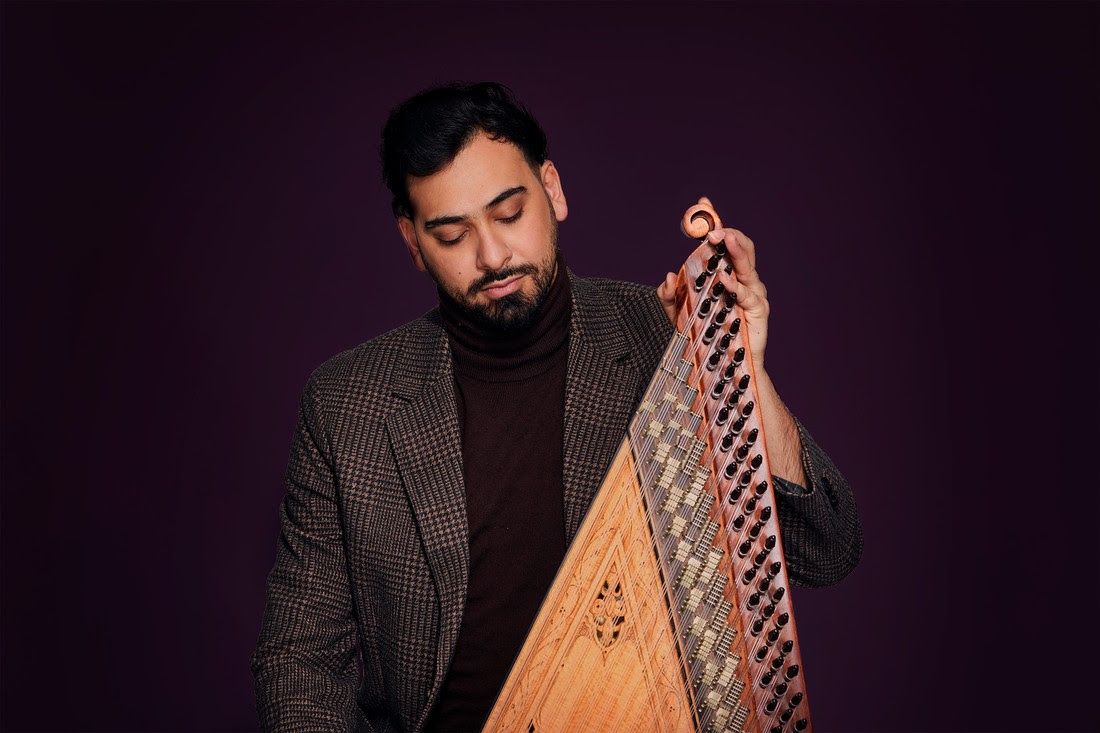
Name: Firas Zreik
Nationality: Palestine-born, New York based
Occupation: Composer, improviser, kanun player
Current release: Firas Zreik's new album Tarabesque is out via Maqām Records.
Shoutouts: I think Amir ElSaffar through his work as a composer and innovator, and more recently as the founder of Maqam Records, is taking a tremendous leap carrying the tradition of Maqam, by not only preserving it, but also enriching it, and inspiring a generation of Arab musicians to take that step forward towards organic innovation between the richness of their roots, and the hospitality of jazz.
Things that I am passionate about but rarely get to talk about: I’m passionate about chess, I think it’s the most beautiful game ever created. It always amazes me how rich it is, despite all the internalized patterns that you acquire, no match is like the other.
I’m also deeply passionate about literature and poetry, particularly in Arabic, but also global literature. I relish reading the works of Dostoevsky, Garcia Marquez, Saramago & Baldwin.
In terms of a physical sport, ping pong is my absolute favorite, I won four tournaments in college, and I still enjoy it whenever I find the chance to play someone good!
Other passions include cooking, history, philosophy, geography, cinema & soccer.
If you enjoyed this Firas Zreik interview and would like to stay up to date with his music, visit his official homepage. He is also on Instagram, Facebook, and bandcamp.
How were you introduced to Maqam?
I was born into it. I’m a Palestinian musician, grew up in the Galilee, in a musical family, surrounded by music.
Maqam is the main vocabulary of our folkloric music as well as classical music. But I only started to study it and dive into it when I picked up the Kanun.
What were some of the performances, and recordings of Maqam that drew you in?
All of Wadih AlSafi’s live concerts and works, …
... Umm Kalthoum live works, Fairouz’s albums.
Then instrumentalists such as Mohammed Abdo Saleh and composers like Sunbati.
Does the creative state of playing Maqam feel different compared to, say, playing Western improvised music?
I think any form of improvisation in any art medium is the product of a pre-conceived vocabulary.
If a rapper is free-styling, they’re not inventing a new alphabet, they’re using words they know. If a contemporary ballet dancer is improvising, they’re not coming up with new moves, they’re creating a combination of moves that they’ve practiced individually for years. Same for bebop artists, their improvisation is very much based on a specific vocabulary and style.
Improvisation in Maqam is no different. There are many phrases and structures that are acquired through practice, listening and imitation, and with time they become the property of the artist to contextualize in their own artistic voice.
How would you describe your own learning curve in terms of performing Maqam?
Very intuitive at first, meaning I knew the sound of Maqam through the passive exposure to our folk music and classical music.
Then, when you pair that with an instrument that not only can produce the sounds of Maqam, but in itself is a sonically integral part of those musics, you get a technical and theoretical manifestation of it. Then diving into active listening, imitation, or transcribing, like any other oral music tradition.
But I think the four pillars of my learning curve were: Repertoire, improvisation, ornamentation and theory.
What were some of the musical experiences which planted a seed for your interest in jazz?
My sister was trained as a jazz pianist when we were growing up, I remember her playing through standards. That was my initial interest, listening to Ella Fitzgerald and Louis Armstrong.
Then I got exposed to great fusion musicians like Dhafer Yousef, Aziza Mustafa Zadeh, Ziad Rahbani and Husnu Senderlrici, which further drew me to the openness of trying various vocabularies.
Then I came to Berklee, where I majored in Jazz Composition, and dived into the realms of swing, bebop, blues, ballads, big band writing, advanced harmonic concepts and beyond, and that really enriched my overall sound, taste, and vocabulary.
Composers like Oliver Nelson, Charles Mingus, Duke Ellington and Billy Strayhorn have really inspired my writing.
As for performance, improvisers like Lee Morgan, Oscar Peterson, Bill Evans, John Coltrane and Freddie Hubbard contributed tremendously to some of my vocabularies, but mostly inspired curiosity and courage in me as a performer and improviser.
What does the term jazz mean today, would you say?
To me, it means a certain level of openness, to feel comfortable in uncomfortable situations (musically).
I don’t ever claim to be a jazz musician and I have tremendous respect to those who do. I consider myself a good friend of the tradition and an everlasting patron.
Jazz has always had an interesting relationship between honoring its roots and exploring the unknown. What does the balance between these two poles look like in your music?
That’s a fantastic way of articulating it; honoring the roots doesn’t mean being stuck in a loop, and exploring the unknown doesn’t mean denying your roots, it’s the beauty of balancing these two to have an ever-growing, organic evolution of the arts.
And that’s precisely how I approach my music; to me it feels timeless, in the sense that can carry so much historical depth, yet still feels like it was made tomorrow.
There’s something so special about exploring sounds you’re familiar with and tweaking them with authority.
How, would you say are your live performances and your recording projects connected at the moment? How do they mutually influence and feed off each other?
We recorded the music after it was shaped by live performances. Unlike my previous album - Salute (2023), or my first EP - Solo (2021) ,where I wrote and recorded everything during lockdown, when no live music was happening, and only got to perform the music after the release of the albums (and the lifting of lockdown).
With Tarabesque, the music has been brewing for some time, taking shape onstage, until it finally ripened enough for the studio.