

Name: Giulio Aldinucci
Nationality: Italian
Occupation: Composer, producer, sound artist
Current Release: Giulio Aldinucci's new album Materia is out September 18th 2026 via Karlrecords.
If you enjoyed this Giulio Aldinucci interview and would like to find out more about his music, visit his official homepage. He is also on Instagram, and bandcamp.
When I listen to music, I see shapes, objects and colours. What happens in your body when you're listening? Do you listen with your eyes open or closed?
Sometimes I feel very lucky because I'm able to clearly separate being a listener from being a composer.
In other words, the analytical tools I possess only come into play if and when I choose to use them. This allows me to surrender fully to the experience of listening, without the "technical" interference that professional habits might otherwise impose.
Every listening experience is unique and unrepeatable, and this awareness changes the way I approach each one. I often close my eyes, and colours are the visual elements that appear most frequently. Sometimes forms emerge that I would describe as geometric abstractions; I only rarely see figurative images.
Occasionally, I open my eyes and, even if I happen to be in a beautiful place, it pales in comparison with what I had just been hearing and seeing with my eyes closed.
How do listening with headphones and listening through a stereo system change your experience of sound and music?
Listening through headphones erases the acoustic essence of the space I’m in.
It transports me, acoustically, into another space altogether.
Tell me about some of the albums or artists that you love specifically for their sound, please.
I’m an eclectic listener. The artists, compositions, and albums that have shaped my relationship with sound are as diverse as they are numerous.
For me, in electroacoustic music, musical form and sonic material are two aspects of the same reality. A unique musical language calls for a unique sonic identity. Too often, even beyond commercial music, sound is treated as something that can be added afterwards, a kind of "dress" for the music, rather than as an intrinsic part of the composition. This separation, often driven by the urge to standardise, ultimately leads to aesthetic uniformity.
It is no coincidence that so many listeners today remark on the excessive sonic homogeneity of contemporary ambient and electroacoustic music.
Do you experience strong emotional responses towards certain sounds? If so, what kind of sounds are these and do you have an explanation about the reasons for these responses?
I experience two kinds of intense emotional responses to certain sounds.
The first is deeply personal and connected to memory: the distinctive reverberation of a football hitting the wall of the small pitch a few metres from the house where I’ve always lived; the song of crickets; the soundscape of my local woods, so unmistakably familiar to me and yet capable of changing from one metre to the next …
The second has to do with physics. It happens outdoors, when a sound fills space with frequencies, bursts into the environment, overwhelms everything else, and makes the space itself resonate.
"Every angel is terrifying."
There can be sounds which feel highly irritating to us and then there are others we could gladly listen to for hours. Do you have examples for either one or both of these?
Unlike many people, I don’t find any ordinary everyday sounds inherently irritating. What I truly hate are all sounds associated with violence and oppression.
I could listen endlessly to the sound of the waves here on the Tuscan coast, along the Tyrrhenian Sea. It’s a kind of white noise suspended between water and wind, with high frequencies that seem to emerge from the sand itself, at the threshold of audibility.
It feels as though thoughts are carried away, washed clean, and returned. Endlessly.
Are there everyday places, spaces, or devices which intrigue you by the way they sound? Which are these?
Every place has its own distinctive acoustic fingerprint, even those we’ve grown accustomed to calling "non-places." Wherever I go, I listen with curiosity. I love the sound of the woods where I walk every day just as much as the sound of nearly empty university corridors in the late afternoon.
More generally, I’m fascinated by the rhythms that emerge from the interplay of everyday sounds, and by the way we unconsciously synchronise our actions with them: pens moving across paper and pages being turned in a library; car doors and boot lids opening and closing in a parking lot; the chorus of footsteps and impatient tapping as people wait in line at the post office.
Have you ever been in spaces with extreme sonic characteristics, such as anechoic chambers or caves? What was the experience like?
Yes, although the experiences were fairly brief.
Extreme situations remind us of the importance of appreciating and preserving what we call normality.
What are among your favourite spaces to record and play your music?
I take field recordings constantly, everywhere. When I travel, I use a Sony PCM-D100, which offers the right balance between sound quality and portability, while remaining compact enough to carry everywhere.
As for composing and recording musical material, whenever possible my home is the centre of everything. Just to give you an idea, my living room is a large open-plan space where, instead of a kitchen area, my studio is located. This allows me to compose and record comfortably at any moment, in a place where I feel completely at ease.
The entire system is always ready to record at the press of two buttons.
Do music and sound feel "material" to you? Does working with sound feel like you're sculpting or shaping something?
I experiment constantly, and even compositions that may sound quite similar often emerge from very different creative approaches.
In recent years I’ve focused on an idea of sound as matter, something that can be shaped into complex forms by removing excess material from a dense sonic mass. It’s a dialogue between accumulation and subtraction: a way of constructing compositions from highly frequency-rich sonic material, with the aim of revealing what lies hidden within the raw sonic mass.
The parallel with sculpture is intentionally obvious, and it’s also useful in order to create a contrast with what comes next. Unlike sculpture, however, in music time itself can also become matter. Sounds can be broken down into milliseconds and reassembled in a different order, moving beyond traditional notions of rhythm and duration.
It seemed only fitting to call the album that brings together these works Materia (Matter).
How important is sound for our overall well-being and in how far do you feel the "acoustic health" of a society or environment is reflective of its overall health?
In mass culture, it seems to me that the more people "see", the more they believe they “know”. The constant media bombardment - from television to image-driven social media - has taken this tendency to disregard the non-visible to an extreme.
Paradoxically, despite the wealth of scientific research on noise pollution, we continue to generate even more of it in response to a profound horror vacui, which, ultimately, is nothing more than a fear of thinking and of being alone with ourselves.
A society can only be truly healthy if it is acoustically healthy as well.
Sound, song, and rhythm are all around us, from animal noises to the waves of the ocean. What, if any, are some of the most moving experiences you've had with these non-human-made sounds?
I love quiet places, and one of the reasons I live in the countryside is precisely for its silence. Among my most powerful experiences, I like to mention one involving sounds that might seem entirely ordinary.
During the 2020 lockdown, in a woodland near my home that I know intimately, the absence of distant human-made noise (such as cars and even airplanes) allowed me to hear something I had never noticed before: the faint sound of the wind gently brushing across the dry oak leaves covering the forest floor.
Many animals communicate through sound. Based either on experience or intuition, do you feel as though interspecies communication is possible and important? Is there a creative element to it, would you say?
I’m also a linguist and an animal rights advocate, so animal communication fascinates me deeply.
Many studies have shown that domestic animals produce certain vocalisations specifically to communicate with us. To me, this represents a creative evolutionary step.
Tinnitus and developing hyperacusis are very real risks for anyone working with sound. Do you take precautions in this regard and if you're suffering from these or similar issues – how do you cope with them?
Fortunately, I don’t suffer from either condition.
Using high-quality studio monitors certainly helps reduce listening fatigue, even during long mixing sessions. It’s also important to take precautions when attending live events.
We can surround ourselves with sound every second of the day. The great pianist Glenn Gould even considered this the ultimate delight. How do you see that yourself and what importance does silence hold?
Silence creates a physical and mental space for perception. We can distinguish the sounds around us only if the acoustic space through which they propagate is not already saturated with competing dynamics and frequencies.
Being surrounded by sound is the ultimate delight, provided that each sound retains its own identity rather than dissolving into an indistinct acoustic mass.
For example, I love the sounds of my kitchen in the morning. But would I still be able to hear them if my window overlooked a heavily trafficked street and the insulation were poor? The clatter of trams would almost certainly drown out the delicate tapping of a teaspoon against the rim of a half-full cup of tea.
Seth S. Horowitz called hearing the "universal sense" and emphasised that it was more precise and faster than any of our other senses, including vision. How would our world be different if we paid less attention to looks and listened more instead?
Reflecting on sound means going beyond the visual, beyond illusion.
I can’t help thinking of Guy Debord's reflections; capitalism first reduced human life from the value of mere biological existence to that of economic possession, and then ultimately to the mere visual appearance of commodities.
We must learn to think beyond the visual in order to truly learn how to see. And the arts related to sound offer us one possible way of doing so.

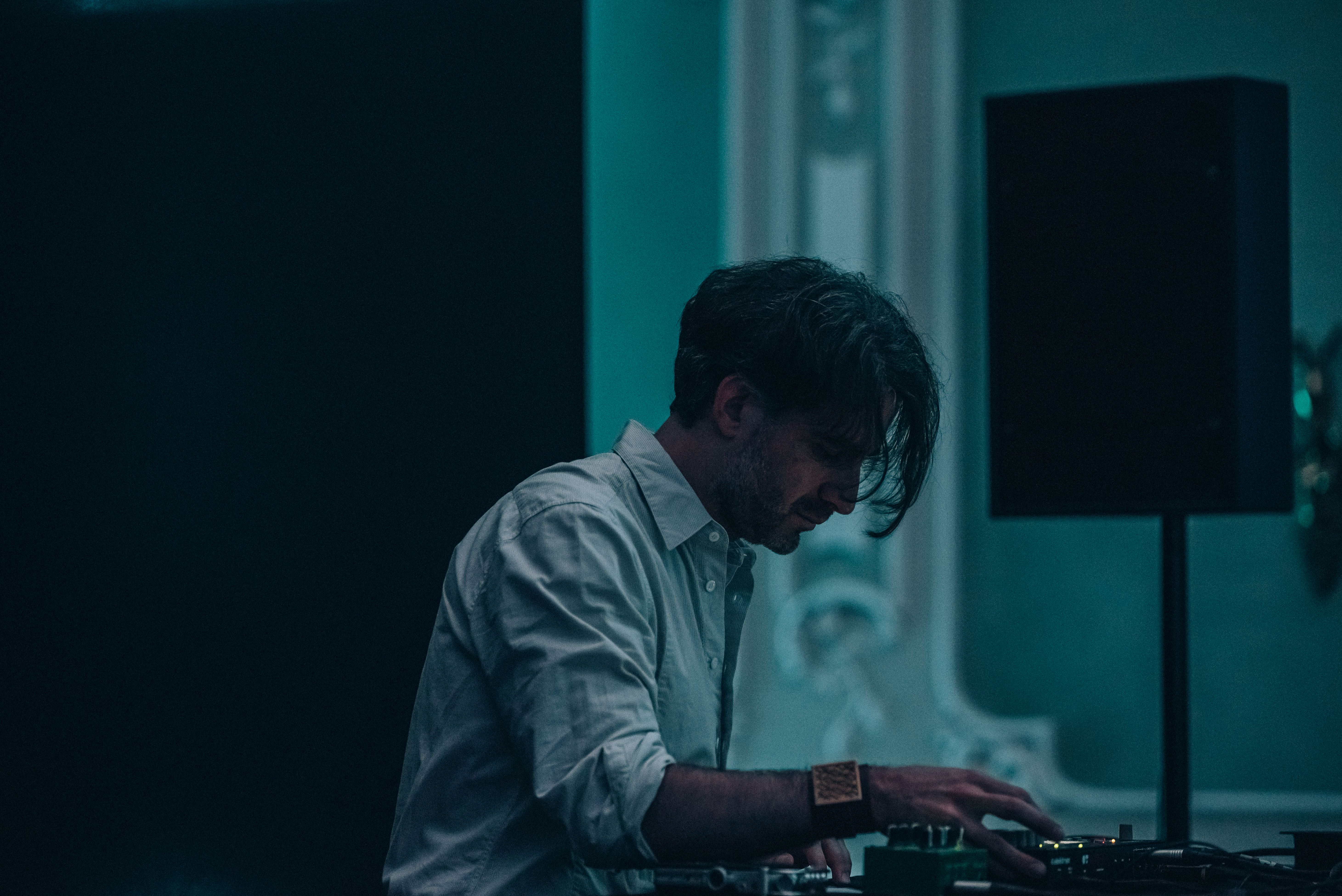 Giulio Aldinucci Interview Image by Krzysztof Karpiński
“A society can only be truly healthy if it is acoustically healthy as well.“
Video
