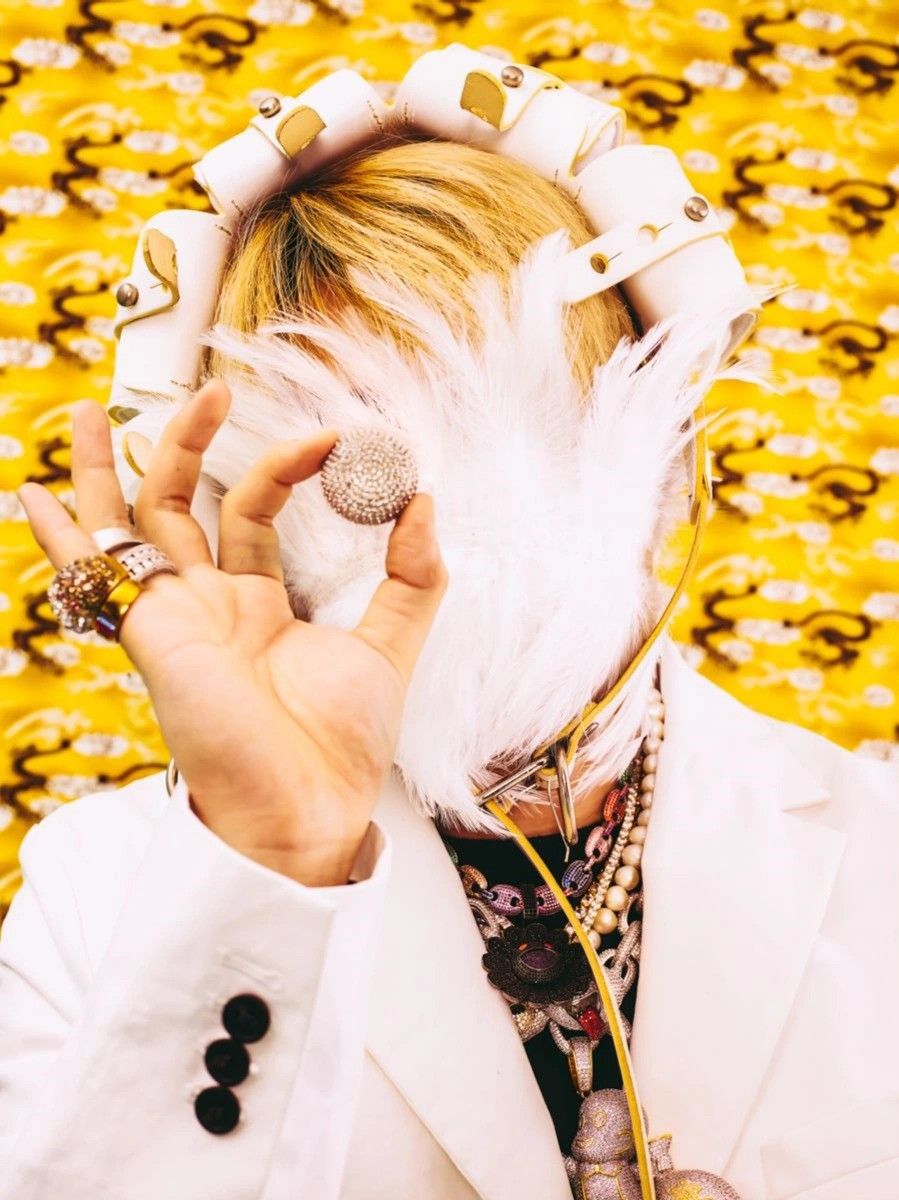
Published
Name: GOLDBUUDA
Nationality: Korean
Occupation: Rapper
Current release: GOLDBUUDA's new album LEVEL UP OR SHUT UP is out now. His latest collaboration with Lil Cherry, "Yummy 88" is also available.
Current event: GOLDBUUDA and Lil Cherry are among the artists performing at the 2026 edition of London's K-Music Festival. For more information and tickets, go here.
Hometown Recommendations: Seoul at night without a plan. Don’t just go to the places TikTok tells you to go. Take the subway somewhere, walk around, eat something at 2AM, get lost a little. That’s a better Seoul experience.
Things I am passionate about but rarely get to talk about: Building worlds around artists. I’m almost as interested in that as I am in making songs. How a group of artists can create their own language, symbols, aesthetics, economy and eventually their own culture. That’s what I’m trying to experiment with through SAUCE 1UP. I don’t want to just make records. I want to build a universe people can enter.
If you enjoyed this GOLDBUUDA interview and would like to find out more about his music, visit him on Instagram, Facebook, and tiktok.
What were some of the musical experiences which planted a seed for your interest in hip hop?
I was a B-boy before I was really making music, so hip hop entered my body before it entered my brain. Then I moved to Miami when I was around eleven, and that changed everything. Southern rap, bass, crunk, all that loud and colorful energy was just around me.
Later I came back to Korea carrying all of that with me. So I think my music has always been this weird collision — Korea, Miami, Seoul, internet culture, club music, whatever I’m obsessed with at that moment.
I never really learned hip hop as one fixed tradition. I experienced it as a world you could build yourself.
What does the term hip hop mean and stand for today?
Freedom. That’s probably the simplest answer.
People argue about what hip hop is and what isn’t, but hip hop has always been stealing things, flipping things, breaking rules and making something valuable out of what you have.
So to me, if hip hop becomes too obsessed with protecting a definition of itself, that’s almost anti-hip hop. The spirit is more important than the genre.
Is hip hop a way of life for you?
Yeah, 100%. And not in some romantic “hip hop saved my life” way. It literally changed how I look at things.
Sampling is a mentality. Remixing is a mentality. Making something expensive out of something cheap is a mentality.
Even outside music, I’m always thinking like that. Clothes, videos, design, business, whatever. You take whatever is around you and sauce it up. That’s hip hop to me.
What are the key ideas behind your approach to creativity?
I like things that technically shouldn’t work together. Cute and evil. Luxury and trash. Korean traditional sounds and futuristic synths. Something very stupid next to something very serious.
When everything makes perfect sense, I get bored. I want there to be a little bit of danger or confusion in the music. Like, “Why the fuck did they do that?” And then ten seconds later you’re addicted to it.
That’s usually a good sign.
Where does your inspiration come from?
Mostly curiosity. I don’t really wake up thinking, “Today I need to express this emotion.” Sometimes I just hear one sound and it makes me want to build an entire universe around it.
The internet is obviously a huge part of that. Fashion, games, memes, old Korean music, random YouTube videos, conversations, sounds from the street — everything becomes material.
I think artists today are processing an insane amount of information every day. My job is not necessarily to comment on all of it. My job is to mutate it into something that feels like me.
How do you balance honouring hip hop’s roots and pushing it forward?
I don’t consciously try to balance it. The roots are already inside me. I grew up with hip hop, I danced to it, I studied it, I produced it. So I don’t feel like I have to put an obvious boom bap drum break somewhere to prove that I respect history.
For me, respecting the people before us means having the same courage they had. They weren’t trying to recreate the past. They were trying to make some shit nobody had heard before. That’s what I want to do too.
What role do electronic tools and AI play in your creative process?
Technology has always been part of hip hop. Sampler, drum machine, Auto-Tune, laptop — people complain about every new tool until it becomes normal. So I don’t really have a moral panic about AI.
For me the important question is: does the tool make your imagination bigger, or does it make you lazier?
I use technology heavily, but I still want the final decision to feel human. Mistakes, weird timing, ugly sounds, unexpected choices — that’s usually where personality lives.
Tell me about the sounds and creative community of your current hometown.
Seoul is strange because everything moves extremely fast, but at the same time Korean society can be very conservative. I think that tension creates interesting artists.
There’s a huge mainstream industry here, obviously, but underneath that there are kids making completely insane music in tiny rooms. Rap, electronic music, rage, hyperpop, punk, fashion, visual art — everything is mixing together.
That’s also part of why I started building SAUCE 1UP. I don’t just want to release my own music. I want to create an ecosystem where weird artists can meet each other, collaborate and level each other up.
Korea doesn’t need another copy of an American scene. I want to see what happens when we build our own mythology.
How do you see the role of sampling in hip hop today?
Sampling is one of the most beautiful ideas in hip hop. You can take something that already has a history and give it another life.
Recently I’ve been especially interested in Korean traditional sounds and folk material. Not because I want to make “traditional Korean hip hop,” but because I want to hear what happens when those sounds enter a completely different future.
I like when you can’t tell if something is ancient or from 2050. That’s the sweet spot.
What role does improvisation play in your creative process?
A lot. Sometimes the first stupid thing you do is better than the thing you spend three hours trying to perfect. Especially vocals.
Lil Cherry and I work like that a lot. A sound, a word, an accent, a weird melody can become the entire identity of a song. I don’t think every vocal needs to start with meaning.
Sometimes sound comes first and meaning catches up later.
Is there still space for genuinely new ideas in lyrics and vocals?
Definitely. Actually I think the human voice is probably one of the biggest areas left to explore.
Rap doesn’t have to be just “rapping.” The voice can be percussion. It can be texture. It can be a character. You can change languages, accents, pitch, rhythm, personality.
Lil Cherry is a great example of that. A lot of what makes her music unique isn’t just what she’s saying — it’s the way she attacks words and turns language into sound.
I’m interested in that space where you almost stop asking, “Is this singing or rapping?” Who cares? Does it sound crazy?
How important are live musical experiences to you?
Very important because that’s when you find out if your music actually has a body.
In the studio you can convince yourself that anything is good. Then you play it in front of people and immediately understand what works. Certain sounds become ten times bigger. Certain parts you thought were important suddenly don’t matter at all.
The crowd teaches you things your speakers can’t.
How are your live performances and recording projects connected?
They’re becoming more connected all the time.
When I produce now, I sometimes already imagine what that moment is going to feel like live. Where does the crowd explode? Where does everything suddenly disappear? What happens if the beat becomes uncomfortable for five seconds? And then playing the songs live changes how I approach the next records.
It’s like a feedback loop. Studio → stage → studio → stage.
Who deserves a shout out for taking hip hop into the future?
Honestly, the weird kids. The artists making music in bedrooms who don’t even know what genre they’re making yet. That’s usually where the future starts. By the time the industry has a name for something, it’s already happened.
That’s also what I want SAUCE 1UP to represent. Not “we know what the next sound is.” More like: let’s create a place where the next sound is allowed to happen.
Where do you see music going in the not-too-distant future?
I think genre is going to matter less and worlds are going to matter more.
An artist won’t just be a person releasing songs. Music, visuals, fashion, characters, games, communities, live experiences — all of these things are already starting to become one language. AI will probably accelerate that like crazy.
But ironically, when everybody can generate everything, I think personality becomes more valuable. Taste becomes valuable. Anybody might be able to make a perfect song. But only you can make your universe.