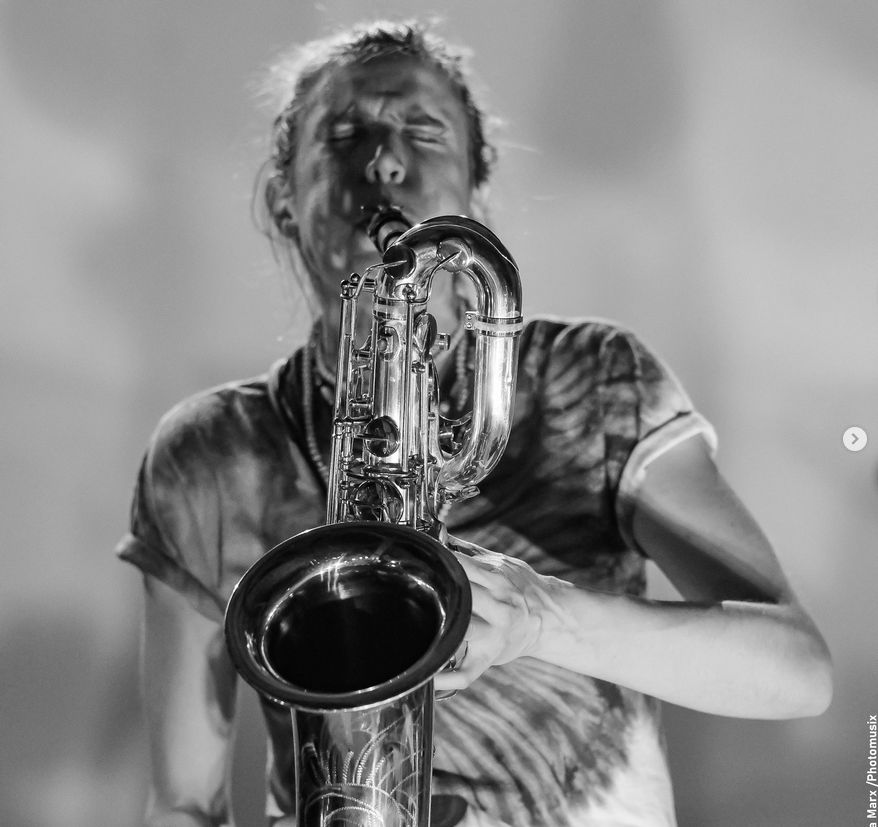
Published
Name: Hanne De Backer
Nationality: Belgian
Occupation: Saxophonist, clarinet player, composer, improviser
Current release: Hanne De Backer's album the moon appears when the water is still is out via gabbro. Alongside Hanne on bass clarinet and baritone say, it features Andreas Bral (piano, harmonium) and Raf Vertessen (drums). Her new work, GROUNDSPEED, is not available for audio streaming yet, but can be bought on CD from, for example, the Sound in Motion store. It will be on her bandcamp player as of November 20th 2025.
Current event: Hanne De Backer will perform at Brand! Festival 2025, its 10th anniversay edition. The event will take place from November 26th to 29th 2025 at the nona arts center in Mechelen. Fore more information and tickets, read our interview with Brand! festival organiser Bart Vanvoorden.
Recommendations for Brussels, Belgium: Well, one thing seems impossible, but maybe I will turn this question into the promise to myself that I still have to go and search for the house of Karl Marx who lived two or three years in Saint-Josse in Brussels and wrote the Communist Manifest while being here. It’s a forgotten thing in the history of Brussels apparently and there’s no sign whatsoever on the house itself, but it might be a nice activity to ask around and get to know people in Brussels when you’re here.
If you enjoyed this Hanne De Backer interview and would like to stay up to date with her music, visit her on Instagram, and bandcamp. For more information about g a b b r o, visit that project's homepage.
What were some of the musical experiences which planted a seed for your interest in jazz?
I think my interest was created by the instrument itself. I started playing the alto saxophone when I was ten years old or something. I wanted to go and play soccer, but my mother sent me to the local music academy instead.
However, it was a very traditional way of learning music, we first had to learn theory, learn to read notes etc. and then after one year we could start playing an instrument but also only classical music.
Then after a while, I automatically started looking for other music that was connected with the horn. I remember I started borrowing CDs from the library with the label JAZZ on it, I think I borrowed every CD from the W.E.R.F. label that time, with a lot of Belgian artists like Ben Sluijs, Octurn, Aka Moon.
But I would also take CDs by Joshua Redman, Charlie Haden, Antonio Carlos Jobim, Stan Getz, Miles Davis. Then sometimes I would go and buy a CD and I think one of my first CDs was Blue Train by Coltrane.
I had never heard of him, but I thought the cover looked nice because there was a cool guy with a tenor on it and when I listened to it I was just blown away.
What does the term jazz mean today, would you say?
I think in general, artistic evolutions go faster then our capacity to really understand and explain what is happening. So to keep using the word jazz nowadays also often feels strange to me.
I studied jazz at the conservatory in Belgium and Finland, and as a genre and art form it has had a profound impact on me, but I don’t consider myself as a jazz musician. I think jazz is an enormously rich tradition but I think the word is used too often and freely.
Musicians nowadays live in such a different world and have access to so much more information and music … There are many other genres of music, technological revolutions and art forms that have their impact on a lot of what is musically going on today I think.
Where do most of your inspirations to create come from – rather from internal impulses or external ones? Which current social / political / ecological or other developments make you feel like you need to respond as an artist?
From both. All my work comes from within but what is within is affected by the world that surrounds me.
So of course my work is a reaction to the current state of the world but I don’t really feel the need to explain my work itself. I hope my work and the projects I engage in can speak for themselves.
Tell me a bit about the sounds & creative directions, artists & communities, as well as the colleagues & creative hotspots of your current hometown, please. How do they influence your music?
Here in Brussels I am part of a saxophone collective La Nuée lead by the German alto player Johannes Eimermacher. We have been doing a lot of research on the instrument for the passed years and the collective has definitely influenced my use of extended techniques on the instrument.
Johannes pushes us to dig deep in a certain technique, whether it is about multiphonics, different embouchures, only playing with air without making tones, quarter tones, circular breathing … We dive into it deeply but still very playfully. We play compositions but always leave space for improvisation and making the technique your own.
Since I moved to Brussels three years ago, I also became a member of VOLTA which is a house and community for musicians in Brussels. My main reason to be in Volta is to practice my instruments and have rehearsals. But it has been very inspiring to do it in a place where you constantly meet other musicians who are active in a very wide range of different styles. I think it is inspiring to share thoughts about anything actually, your practice, the music, the organization of concerts and stuff, life in general …
VOLTA definitely means a lot to me here in Brussels, both on a practical, social and musical level.
Thanks to technological advances, collaboration has become a lot easier. What have been some of the most fruitful collaborations for you recently and what approaches to and modes of collaboration currently seem best to you?
I am not the best student in the classroom regarding technology I would say. It was because of my good friend Seppe Van Grieken and director of photography of our first film ‘As We Walk’ that I managed to learn how to work with the editing program Da Vinci Resolve.
Seppe assured me that even though I’m not good with computers, I needed to do the editing myself because I was the best person the connect the footage with the music.
So I spent first a whole month of learning how to work with Da Vinci on Youtube before starting to label all the footage and then making the first edits.
The editing of ‘As We Walk’ was a long and solitary process of two years. But it was also a great experience to activate a sort of different part of my creative brain, one that works with a different pace than the one that I use when I play improvised music. In a way I think it changed a bit how I look at creative processes. Some of them are almost instant, others take years, or even a lifetime, or even more … it is all okay.
So slowly I am learning to work on different projects at the same time, but some might be over a rather short period of time, like a certain music project for a festival, or a record, others can take again many years like with ‘As We Walk’, others I might not finish in this lifetime.
I think all of my collaborations nowadays started off with a personal encounter, but of course technology makes it lot easier to work with people from different countries and continents just communication-wise.
How, would you say are your live performances and your recording projects connected at the moment? How do they mutually influence and feed off each other?
All of the albums by g a b b r o have their origin in recordings that were somehow also a performance. The movie ‘As We Walk’ only consists of music and recordings that were made during our performance on March ’21, when we walked the whole Belgian coastline together with a camel and played improvised sets along the way.
Our second album Granular was based on a series of vocal workshops I gave together with Marc De Maeseneer in the prison of Antwerp.
Groundspeed, our new album now has a direct connection with Casper Van De Velde and me travelling and playing music from Brussels to Gabbro in Italy. On that trip, we played and recorded a set with guitarist Raphael Vanoli in The Vosges.
At first I wanted to release that recording, but it felt like there was still so much more to dive in musically, so we continued working together and did several weekends of rehearsing in Brussels and Amsterdam to then finally head to the studio. The album itself is the result of our recordings in the studio, but also consists of field recordings from the day we played in the forest in front of a group of children from the closeby asylum centre.
With the projects of g a b b r o there’s always more happening than just recording in a studio, whether it’s a journey, playing on locations that are out of our comfort zone, special encounters … I think this creates something different between the musicians and has it’s effect on the music that is made.
Also, when the records are released and we go touring, the recordings and especially the edits I make have their effect on the music as well, it gives more direction and cohesion to the sound of the band. The music is still open, but a certain vocabulary and trust has grown which deepens the live performances further.
Are there approaches, artists, festivals, labels, spaces or anyone/-thing else out there who you feel deserve a shout out for taking jazz into the future?
I get a lot of inspiration from the independent artists that I have been working with the last couple of years.
I am enormously grateful for getting to know the people from The Ex for example. Their way of taking matters into your own hands, setting up collaborations, their hospitality, humor and friendship and constant curiosity in music and other artists is really something I haven’t experienced anywhere else.
On their 40th anniversary festival where I had to play with Christine Abdelnour and Ada Rava, on the same night I would listen to Brader Musikii, Thurston More and Paal Nilssen-Love, Ethiopian musicians and Keiko Shichijo playing the beautiful piano music of the Armenian composer Komitas Vardapet.
It was just incredible and such a heartwarming night …
[Read our Christine Abdelnour interview]
[Read our The Ex's Andy Moor interview]
[Read our The Ex's GW Sok interview]
What, would you say, are the key ideas behind your approach to improvisation?
My approach is that I try to know my instrument the best way I can, keep on practicing, listening to music, go to see concerts, also opening up to other instruments, other art forms …
Also, I try to get to know and accept myself the fullest possible. Then the third is to be grateful, for the people that I am playing with, the people I am playing for, the people that are organizing …
I think all these things are equal important in order to start an improvisation that is meaningful.