Published
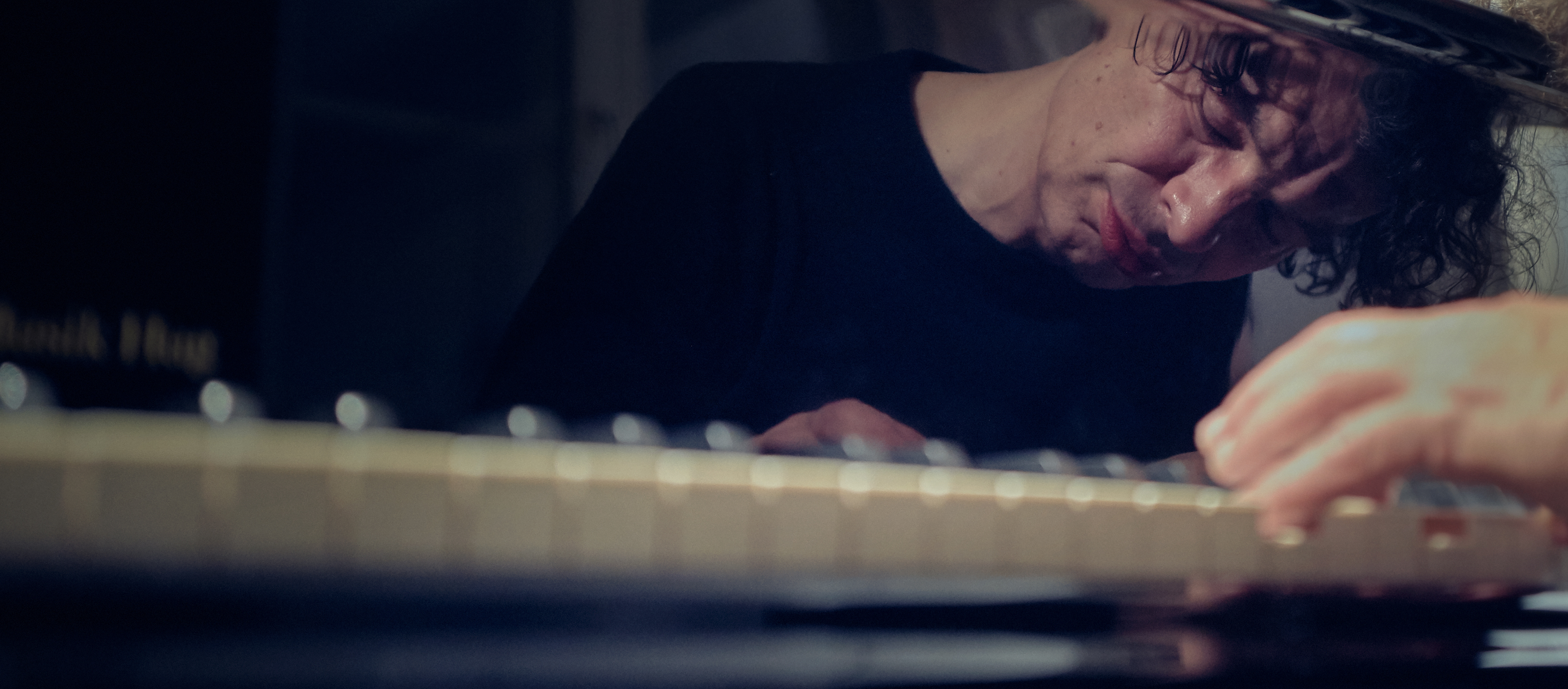
Name: Harald Blüchel aka Cosmic Baby
Occupation: Composer, producer, pianist
Nationality: German
Recent release: Harald Blüchel's new album No Ordinary Moments is out November 13th 2026 via Evantgarde.
If you enjoyed this Harald Blüchel interview and would like to find out more about his work, visit his official homepage. He is also on Instagram, and Facebook.
Are there examples of minimalism in music – and outside of music - that impressed you early on?
Friends of my parents had furnished their entire apartment in the Bauhaus style … I always felt very comfortable there …
I remember that, even as a child, I found pieces like the Le Corbusier cantilever chair to be truly beautiful …
In this context—and significant for my entire life story—is the fact that, from the very beginning, I had a tendency to feel overwhelmed by an "excess" of anything: whether it was too many toys, too many people in a room—in short, too many impressions, stimuli, materials, notes, or objects all at once …
Were you ever interested in minimalism as a style – from the Philip-Glass-variety to solo instrumental work to minimal techno? If so, tell me a bit about your interest in this.
It all began with a profound fascination for repetition, which I experienced as early as my childhood: if I liked a word, I would say it over and over; if I liked a musical phrase while playing the piano, I might repeat it for half an hour. If I particularly enjoyed a story, I wanted to hear it again and again.
Around the age of fourteen, I first encountered pieces from the American "minimal music" movement; I was ignited on every level of my being—every pore of my body vibrated and resonated in response.
When, around the same time, I also discovered German groups such as Can, Cluster, Tangerine Dream, and Kraftwerk, my musical socialization was, in a sense, complete.
[Read our Tangerine Dream interview]
[Read our Tangerine Dream interview about improvisation]
[Read our ex-Tangerine Dream's Johannes Schmoelling interview]
[Read our ex-Tangerine Dream's Steve Jolliffe interview]
[Read our ex-Tangerine Dream's Paul Haslinger interview]
[Read our Cluster's Roedelius interview]
I would identify 1977 as the year that provided everything I needed—musically speaking—to develop my own formal language: the legacy of the modern classical avant-garde—from John Cage to Philip Glass, Steve Reich, and Karlheinz Stockhausen—combined with the futuristic pop sensibilities found in the electronic music of artists like Hans-Joachim Roedelius, Chris Franke, and Giorgio Moroder.
I saw no contradiction here; on the contrary, in my world, all of these elements belonged together and made perfect sense.
During my composition studies at the Berlin University of the Arts, I became part of the burgeoning techno scene; the energy there provided the spark that triggered an explosion of creativity within me. This paved the way for albums like Stellar Supreme and Thinking About Myself—works now regarded as seminal, style-defining classics.
Do you tend to find that, as many claim, “less is more?” Are the notes you don't play really as important as the ones you do play?
Absolutely! Underlying this—both then and now—is a general desire, as a composer, to express myself in a complex way and to communicate with the world—doing so as precisely as possible and in the most pared-down form, yet without sacrificing sensuality, or in other words, emotional impact.
The electronic piece "Träume," created in 1995, is a prime example of this. For that very reason, I reworked and transcribed it for piano for the album No Ordinary Moments.
Do you feel as that making music is a process of adding elements until it is done – or one where you chisel away pieces from something that is already there?
I usually begin with the impulse: “What might a given state—which I wish to transform into music—sound like?”
I therefore start by gathering materials, which I then, through a process-oriented approach, distill down to their essence.
Many artists are becoming more minimalist in their music as the years go on, focusing on the “essence.” How is that for yourself and how would you describe your development in this regard?
As I grow older and am able to connect an increasing number of experiences, I learn more and more to distinguish what is essential for me from what is not.
Naturally, this also has a great deal to do with approaching oneself—as well as external challenges—with greater equanimity. This applies as much to my compositions and production techniques as it does to my approach to life in general.
With the piece "Gleichmut" (Serenity), I sought to capture this precisely—both in terms of its content and its form.
What were some of the starting points for your most recent release?
This is a description of a phase in my life during which I sought to adopt a more minimalist approach to my daily existence and to enter into a deeper resonance with nature. It is startling for me to realize just how vast the gap can be between having a "good idea" and actually embodying it in one’s life.
For instance, while I had always intellectually understood myself to be a part of nature, I eventually discovered—deep within—a persistent, underlying sense of being separate from it. It was out of this realization, for example, that the piece "Pflanzenseele" ("Anima") emerged.
Much remains hidden from us (or within us) because we are constantly distracted by an abundance of things we do not truly need. Yet, it is precisely this—our inability to endure the feeling of separation and the sense of being left entirely to our own devices—that draws us toward the endless offerings of consumer culture.
How did a minimalist mindset possibly inform the creative process?
When you attempt to strip things down to the essentials—and occasionally succeed—you gain freedom from certain elements that may suggest "being free," but in reality, create dependency, leaving you more sluggish, weighed down, and inflexible—the exact opposite of true freedom.
Making a conscious choice, rather than mindlessly accumulating everything imaginable, means narrowing your horizon of possibilities. This focus fosters mental and emotional clarity. Such clarity, in turn, can enable a sense of self-efficacy: you become capable of sailing out of the stagnant waters of (illusory) variety and into open, clear seas.
You gain the time and space to truly get to the bottom of things—matters that previously might have consumed your energy through endless, indecisive deliberation. At the very least, you gain the opportunity to draw closer to the essential nature of those things.
In short: fewer superficialities and spectacles, and in their place, greater depth, focus, autonomy, and contentment.
Do you like to set yourself limitations? If so, which were some of those limitations for the new pieces? What were some of the most important pieces of gear or instruments for this release?
As I mentioned: deliberate limitations can lead to greater freedom—and, in any case, to a boost in creativity.
During the period surrounding No Ordinary Moments (specifically, the years 2014 to 2020), my core musical philosophy was as follows:
- I would focus on a single instrument—specifically, an acoustic one.
- The compositions had to be playable with just two hands; in other words, no multitracking or overdubbing.
For the actual studio recordings, I eschewed any production techniques beyond those required to capture the piano as perfectly as possible—meaning high-quality microphones and recording equipment were used, but no post-production sound processing.
This made it all the more important to find an instrument capable of offering a particularly wide expressive range. Being able to locate and play a Fazioli F308 was truly something special! Since the grand piano could not be moved from its home—a factory floor in Berlin’s Prenzlauer Berg district—the recording studio essentially had to be built around it.
Thanks to sampling and digital synthesis, there are endless possibilities for sculpting the sounds and overall sound design of a piece or album. What are your considerations in this regard? So would you say that you approach your creative tools with a minimalist mindset? Or do you need a wide choice of instruments and tools to make music?
This notion—at least in theory—of "infinite" possibilities tends to lead me into a kind of "multi-option paralysis." Given my own personal constitution, I simply function better—and feel more at ease—with a more limited set-up. That said, I would never reject modern or cutting-edge technology out of hand.
I am no fundamentalist; however, when choosing the right tools, I must be able to see a clear purpose in them—one that directly serves the overarching goal I aim to achieve.
Reducing one's options and techniques often implies a different way of working with the materials. Tell me about yours, please.
Exactly. I always try to find my own unique approach to the instruments I work with.
I’m not a “quick learner”—it takes a great deal of time, patience, and often a lot of effort to overcome the internal resistance I feel when learning how to use a piece of equipment, a program, or an app. Sometimes, it feels like it takes me years to master things that others can figure out in a matter of days …
It’s important—though certainly not easy—to stay true to yourself and to accept your “complete package”—all your talents and all your shortcomings—as best you can.
French producer Guillaume Duchastel told me: “Minimalism is about more than owning fewer things. It’s about focusing on what truly matters.“ What are some of your strategies for separating what matters from that which doesn’t?
I pause and look inward. Perhaps the most crucial aspect of this is dealing with the fear of failing to meet the expectations of others. I tend to struggle significantly with setting boundaries in a natural, effortless way.
My coping strategy has always been to strive for absolute perfection—to become, in a sense, "untouchable." And whenever I failed to live up to my own self-imposed imperative for perfection—which, naturally, was almost always the case—I would simply abandon the endeavor altogether, without a word.
Given these—truly sad—experiences that have woven through my life, it has become essential for me to stand by my own feelings and thoughts, and to find the courage to simply do what I want to do—free from the baggage of expectations, comparisons, or judgments.
This, too, can be a path toward greater minimalism in one’s personal life—in how one relates to oneself and to the outside world …