Published
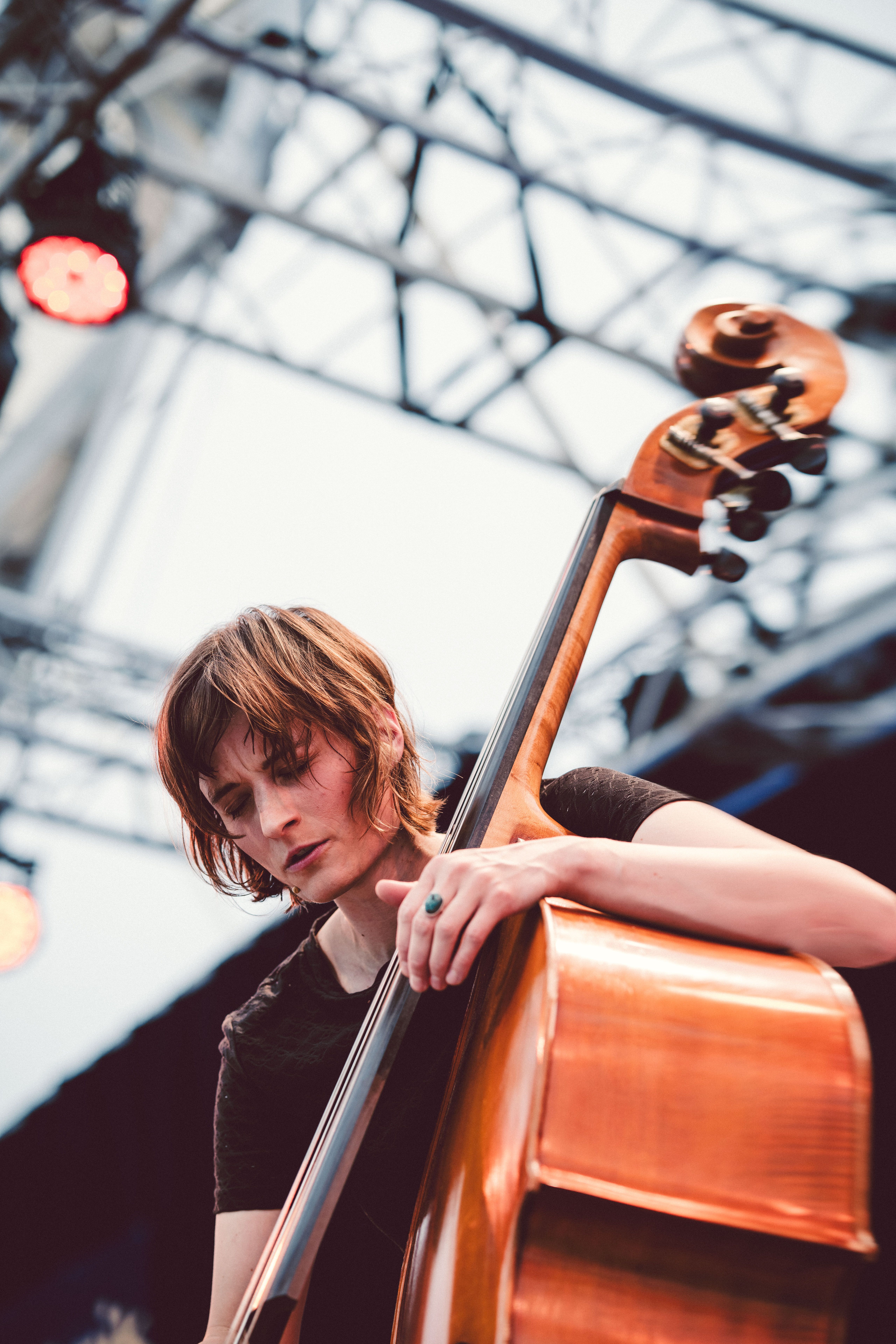
Name: Helene Glüxam
Nationality: Austrian
Occupation: Bassist, composer, improviser, vocalist
Current release: Helene Glüxam 's new album Nachtvogel is out via unit.
Things I am passionate about but rarely get to talk about: A project that has stayed with me for a long time and that's very close to my heart is "Die Schatulle des David Josef Bach" ("The Casket of David Josef Bach"). It's based on the estate of David Josef Bach, a cultural organizer and key figure of Red Vienna, whose rediscovered collection of birthday letters, dedicated to him by major artists of the early 20th century, I turned into an artistic-scholarly lecture performance, which premiered at the Sigmund Freud Museum. For my research I even traveled to Crowborough, England, where the longtime Bach scholar Jared Armstrong had lived, and interviewed him along with Bach's heirs. I have a huge amount of really fascinating interview material, and some day I'd like to use it for a new project.
If you enjoyed this Helene Glüxam interview and would like to stay up to date with her music and upcoming live dates, visit her official homepage. She is also on Instagram.
Where does the impulse to create something come from for you? What role do often-quoted sources of inspiration like dreams, other forms of art, personal relationships, politics etc play?
My inspiration comes mostly from playing itself, from an improvisational process where I simply gather new ideas.
I don't really think much about where the melodies or rhythmic motifs come from, they arise quite intuitively. Some of them become pieces, some don't; some need a lot of time and energy, others come together easily and quickly.
Once a piece is finished, I can no longer hear in it whether the process behind it was difficult or easy. For me it's an activity that never feels pointless: even if I've spent the whole day on it and end up with just one bar, the day still feels well spent.
For you to get started, do there need to be concrete ideas – or what some have called a 'visualisation' of the finished work? What does the balance between planning and chance look like for you?
No, I actually never plan ahead. I didn't plan from the start to develop a whole album either, that only came together gradually.
Chance often plays a big role: "Mondflut" ("Moonflood"), the last track on the album, came out of a moment where I had no inspiration at all. I had no idea for a new piece, so I retuned the strings a bit randomly, just to break my usual playing habits.
Everything suddenly sounded completely different and opened up new possibilities, and the piece came together very quickly after that.
I always play it as the last piece live, since retuning is a bit of a hassle, so right now I'm composing a new piece in the same tuning.
Who knows, maybe a whole program will come out of this tuning eventually.
Is there a preparation phase for your process? Do you require your tools to be laid out in a particular way, for example, do you need to do 'research' or create 'early versions'?
My preparation is really just playing itself. Almost all my compositions come out of the instrument.
I play without thinking much, sometimes just to clear my head, and usually a short idea, a small melody sticks, sometimes even half a piece. I record that, listen back to it the next day, and keep developing the idea from there.
That's my version of an early draft: small sketches that I gradually build on.
Do you have certain rituals to get you into the right mindset for creating? What role do certain foods or stimulants like coffee, lighting, scents, exercise or reading poetry play?
I don't really have any rituals.
I never approach the bass with the goal of "now I want to be creative," I just sit down and start playing. Only gradually does something develop, and I find my way into a creative mood.
What helps me most is not practicing or composing at home, but going to a separate practice room instead.
For Nachtvogel, what did you start with? If there were conceptual considerations, what were they?
I'd wanted to write a solo piece for double bass for a long time, I had lots of ideas, but none of them ever turned into a finished piece.
Then, during the first lockdown, I suddenly had a lot of time and no other way to exchange musically with people, and that's when I composed my first piece, "Wellensturm" ("Wavestorm"), the opening track on my album, very intensively over the course of many weeks, until it was eventually finished.
The voice came in only later. There was no concrete album concept at the start, I never planned to develop a whole album, that only happened gradually.
Tell me a bit about the way the new material developed and gradually took its final form, please.
I originally wrote the first piece, "Wellensturm," purely for double bass. Once it was finished, I made a recording of it at home and sent it to a few friends and my family. My father's feedback was that he liked it, but asked whether I might want to sing along to it.
I really didn't want to at first, but the idea stuck with me, and a few weeks later I started experimenting with a vocal track over the recording and was genuinely amazed by how much it expanded the sound.
After that, more pieces gradually emerged and came together into an album. Some were finished quickly, others took months.
Many writers have claimed that as soon as they enter into the process, certain aspects of the narrative are out of their hands. Do you like to keep strict control or is there a sense of following things where they lead you?
I think my compositional process is really the opposite of always staying in control. I try to get into an open, relaxed state, into playing, and the ideas come out of the playing, not out of my head.
The extended techniques I use also emerged playfully, and they help me keep discovering and exploring my instrument in new ways.
In "Lichtungen" ("Clearings"), for example, I play a lot on the strings below the bridge, which have a very particular character of their own, that was a chance discovery for me.
Unfortunately, I only realized after finishing the composition that the strings below the bridge are tuned quite randomly and differ from instrument to instrument.
After a string change, my piece had suddenly vanished, but I've since found a way to tune those strings, and I'm glad I was able to record it after all.
There are many descriptions of the creative state. How would you describe it for you personally? Is there an element of spirituality to what you do?
During my master's studies I had a gig with a university band, before which I was both nervous and very tired, and we ended up playing late, I honestly just wanted it to be over quickly.
During one piece there was a bass solo, and suddenly the whole band stopped playing, I don't know why, and I was left alone with the solo and started playing. I can't remember anymore what I actually played, but it was the first time I experienced something like a flow state while playing. Minutes later I became aware of where I was and that I'd eventually have to stop playing.
It was a very intense experience, and I know that I felt a strong sense of affirmation back then. I've never had such an intense feeling on stage again since, but there have been moments that go in that direction, and they strengthen and fulfil me a great deal.
Whether that counts as something spiritual, I find hard to say, but it definitely feels bigger than simple concentration.
Once a piece is finished, how important is it for you to let it lie and evaluate it later on? How much improvement and refinement do you personally allow until you're satisfied with a piece? What does this process look like in practise?
For the piece "Vor und Zurück" ("Back and Forth"), I needed a year and a half.
I kept setting it aside and picking it back up again, working on it intensively for a few weeks, then setting it aside once more, it almost tormented me a little that it just wouldn't get finished. But eventually it was done, and even though it takes a huge amount of time, that's simply how it works for me.
That's the advantage of composing only for myself, I can take as much time as I want. In collaboration with others, I'd never dare to rework a piece a hundred times like that.
How do you think the meaning, or effect of an individual piece is enhanced, clarified or possibly contrasted by the EPs, or albums it is part of? Does each piece, for example, need to be consistent with the larger whole?
Thirteen years ago, when I started my music studies, I didn't actually do it to become a professional musician, but to be able to make my own music and figure out what that even was.
I didn't think or plan much further than that back then, and I never needed it to be commercially successful or for other people to like it, I simply wanted to find my musical identity. And I think I've captured the essence of the musical identity I've found so far in this album, which makes me very happy.
So no, I don't think each individual piece needs to be consistent in a strict sense, but together they form a coherent picture for me.
What's your take on the role and importance of production, including mixing and mastering for you personally? In terms of what they contribute to a song, what is the balance between the composition and the arrangement (performance)?
I worked mostly alone on these pieces for years, so it was a really important step for me to start refining the sound together with someone once we got to recording.
Of course my album isn't a heavily produced one, but since it's my first solo album, there were still a lot of fundamental decisions to make, for example, what balance between bass and voice should be in the mix, how much reverb the voice should have, how present or dry the bass should sound.
Arthur Fussy recorded and mixed the album, and beyond being a real professional technically, we shared a similar aesthetic sense on the important things, which was essential for the collaboration. It was a huge relief for me to be able to make certain decisions together with someone else from that point on.
Music and the accompanying artwork are often closely related. Can you talk about this a little bit for your current project and the relationship that images and sounds have for you in general?
The artwork for my album comes from the first music video that Felix Knoche made for my first solo piece, "Wellensturm."
That piece was the starting point of my whole solo project, so it felt very fitting to use that material as the starting point for the cover as well.
After finishing a piece or album and releasing something into the world, there can be a sense of emptiness. Can you relate to this – and how do you return to the state of creativity after experiencing it?
I do know this feeling. With this solo debut in particular, it was especially hard for me to let go of my pieces and suddenly share them with so many people, that took real effort to overcome, but at the same time it was also a strong need of mine. It was definitely very emotional.
But the pieces have been finished for a while now, I recorded them about a year ago, and I'm glad to be able to let them go and have space in my head again for experimenting, the way I did at the start of the project, that's what I enjoy the most.
I would love to know a little about the feedback you've received from listeners or critics about what they thought some of your songs are about or the impact it had on them – have there been "misunderstandings" or did you perhaps even gain new "insights?"
My music is sometimes perceived as dark, which always surprises me a little. Sure, these aren't exactly cheerful songs, but I wouldn't call them dark either.
"Echolot" is fairly dark and heavy, but "Winter" and "Lichtungen," for example, are very peaceful and positive pieces for me.