

Name: Henry James House Wilson
Nationality: American
Occupation: Singer, songwriter, producer
Recent release: Henry James House's new album Last Lights Off The Black West is out August 28th 2026.
If you enjoyed this Henry James House interview and would like to stay up to date with his music, visit his official homepage. He is also on Instagram, Soundcloud, and bandcamp.
When was the first time you noticed you were drawn to darker themes and moods in music, literature or the movies?
As a kid, I loved to perform in plays whenever I got the chance. I was generally quite reserved and shy in person, but on stage I could really ham it up. As soon as I was old enough to participate in plays that depicted characters with a dark or villainous side, I discovered that these characters were the most fun to portray.
Around this same time, which was more or less the beginning of puberty, my personal musical taste first began to coalesce. I quickly discovered here too that there was a certain something, an “edge” that was common to all the music that I connected with, regardless of artist or genre.
When I really got into the blues, in my later teens, I felt like I had discovered the source of that certain something.
“Darkness” is, of course, not strictly speaking a term related to sound. What constitutes darkness to you, especially in instrumental terms?
I don’t fully understand what makes something “sound” dark, but I know it when I hear it. There’s some familiar musicological associations — minor keys, blue notes, etc. I imagine a lot of that has to do with social construction, what our culture teaches us.
I find it interesting, though, that I can find that same darkness in certain Gregorian chant, Indian classical music, and Tuareg music, and from what I can gather from the lyrics, I believe that the intended evocation of longing and soothing of dark thoughts is often actually very similar across these disparate times and places.
Of course, I also find it interesting that songs that are dark lyrically or thematically are not necessarily dark sonically, and conversely songs that instrumentally evoke a lot of darkness are not necessarily the saddest or darkest songs lyrically.
On this album, “Lagan Dream” feels to me like one of the darkest songs sonically, but it is probably one of the “brightest” in its lyrical themes.
How would you describe the physical sensation and possible attraction of being exposed to darkness in music?
When you feel the little hairs on the back of your hand and your neck stand up, you know the muse is present.
And for me personally, for music to have any power to inspire dancing, or for music to have any sexual potency, it has to have a dark edge.
Does your interest in darker musical themes extend into extra-musical fields such as fashion, or politics?
At ten years old I saw Star Wars Episode I in the theater and Darth Maul made a lasting impression on my fashion sensibility.
Within the next couple years I discovered the fashion designer Yohji Yamamoto, and I decided I would overhaul my entire wardrobe to wear black all the time. By the time my parents let me watch The Matrix, I had already committed to that path, but that movie did confirm for me that it was the right path.
Dressing in black or being perceived as “goth” was not cool in those days the way that it is now, at least in the Midwest. I took a lot of criticism and drew a lot of suspicion. When people asked me why I did it I would often say something painfully melodramatic, like “I’m in mourning for the human race.”
The simple truth is, at that age, forming an identity feels overwhelmingly important, and for me wearing black was an aesthetic choice that felt like it reflected something essential about me and helped me establish an identity, even if I didn’t understand why. The habit has stuck with me for the rest of my life.
Who/what are currently artists, labels or even genres which draw you in because of their darker approaches, aesthetics and sound(s)?
Well, there’s a lot of good stuff out there. It’s overwhelming, really. But I think the artist who currently comes closest to embodying what I hope to do artistically, what I’m drawn to, is S.G. Goodman.
Maybe not the artist that first comes to people’s mind when they think of “darkness,” but she’s got it in all the best ways.
I love dark trip-hop and electronica as well. My dad has incredible musical taste that has had a great influence on me. I think there’s only one point where we disagree:
I adore Portishead, but it makes him uncomfortable, he finds it scary.
What were some of the first performances or releases when you became active in exploring truly dark places in your music yourself?
I’ve always been heavily drawn to darkness in my own musical work, but not all of my collaborators have felt the same, or felt that draw to the same degree.
When I first began performing publicly and releasing music, in a group called Pop Empire, the darkness that I brought to the table was tempered by the sensibilities of my collaborators. When I would occasionally play solo, I would lean into a darker aesthetic.
Over the years that I wrote and performed under the name Pop Empire, I feel like it was on our 2016 EP The Violent Bear It Away that we finally fully embraced the darkness in our sound and lyrics, and I’ve felt that that was one of the most fruitful creative decisions we made.
I have had a hard time explaining that listening to death metal calms me down. When you're performing a piece with a darker energy, does it tend to fill you with the same energy or feeling – or are there “paradoxical” effects?
I absolutely relate to being calmed or soothed by heavy or dark music. The blues is what I love more than anything, and it doesn’t make me feel blue to listen to it.
One of my most memorable live music experiences occurred at Levitation in Austin in 2015, on the first day of the festival. My girlfriend at the time and I had driven ten hours that day to get there. We were hassled by security on the way in. We were rushing to set up our tent before the sun went down, and realized that we had brought only tent poles and a rain fly — the actual tent was completely missing.
We said screw it, let’s go get a drink and listen to some music. I was hungry, exhausted, and not good at handling stress in those days. We stood in line way too long to overpay for a beer, listened for a while to a few uncompelling bands, and decided to give up, go back to the campsite and try to get some rest. But security wouldn’t let us out of the nearest exit, they said we had to use the camping gate on the opposite side of the festival grounds.
After almost causing an altercation with the security guard, I backed down and started trudging towards the other gate. My mind was buzzing and my anxiety and frustration had made me essentially nonverbal.
It just so happened that we passed through near the stage where the band Metz was playing. I was transfixed by their sound. If you’re familiar, you know it’s not steretypically “calming” music — it’s jagged, aggressive, loud, and repetitive.
I just stopped and stood there for fifteen or twenty minutes, as the music worked through my brain and brought me a calm that I truly thought was unattainable.
I’ve been a fan of Metz ever since.
Tell me, if applicable, about the concrete lyrical themes that you felt drawn to for Last Lights Off The Black West.
The topic of death is pretty pervasive in the lyrics of this album. Almost all of the songs broach the topic of death in some way. Perhaps the most straightforward in this regard is “Mother Earth,” the album finale.
Three of the songs on the album are murder ballads (“Young Henry Parts I & II”, “Dying Silver Dagger Blues”, and “Tom Dula”). Besides death and violence, these songs are also concerned with sexual infidelity.
Regeneration and the vitality of nature are also important themes on this album. The album title is taken from the words of “God’s Grandeur,” which is in fact a sonnet by the 19th-century poet Gerard Manley Hopkins that I turned into a blues song. One of my all-time favorite poems, it confronts us with a dark and heavy image of the world, but it also says, “Though the last lights off the black West went / Oh, morning, at the brown brink eastward, springs.”
God and the Devil also come up a few times, as on “Preachin’ the Devil” and “Rock Me”.
When it comes to exploring darker themes, what's your approach to writing lyrics? What makes lyrics good in this regard?
For any themes, I think earnestness and honesty are really important to me in lyrics, though I would also stress that lyrics by no means have to express the writer’s own personal point of view. I think that’s one of the most common mistakes people make, both in interpreting lyrics and when they first set out to write lyrics: assuming that it’s always the writer’s own voice that is speaking.
I’ve often felt an unspoken external pressure to provide some ray of hope in any lyrics that I write. It’s a voice that says, you can go somewhere dark, but if you do, you have to try to offer some resolution. But a lot of times, I felt like I would get stuck here. I could write lyrics that I was happy with to express a dark theme, but when I tried to offer some hope at the end, my words just didn’t have the same power.
Eventually I realized that, in the case of music, just the fact that you’re singing these words is itself the ray of hope. If you can go down into the darkest thoughts where the light of the sun is completely extinguished and still survive to sing about it, that is a profound message.
Tell me about the creative process for Last Lights Off The Black West, please.
The songs on this album are amalgamations of old, very old, and new material. There’s no clear line between what is traditional and what is original.
In some cases I’ve taken old texts and set them to new music, and in others I’ve taken old melodies and given them new words. Even on the songs that are, strictly speaking, originals, I’ve tried to enrich them with references and allusions to music that I love, both in the lyrics and in the instrumentation. In this stage of the process, I feel that listening very intently and deeply is the important thing.
Once the song structure and lyrics had come together, I would create a demo that formed a skeleton of each track with the same ingredients: minimal drum machine, synth bass, and either electric piano or guitar to accompany my singing.
At this stage my primary collaborator on the album, Jake Langknecht, a fantastic musician whom I’ve played with for many years in our band Pop Empire, would provide contributions. He played all the live drums on the album, as well as much of the guitar. In some cases, parts of the original skeleton would remain exposed, and in others it would be completely replaced with parts we recorded over it. We let each song speak for itself here.
Finally, mixing the album with Isaac Karns was a distinctly creative process as well. I was in the studio with him for all of the mixing. I would try to leave him to his own devices as much as possible, because I wanted the benefit of his ears and his creativity. But we had a lot of fruitful back-and-forth in these sessions.
How did you realise your goals in terms of the production, including effects for the album?
For this, I have to give credit to my mixing engineer Isaac Karns, who runs a studio called the Marble Garden, and who is also a fantastic musician and a really lovely person.
In the tracking stage, I pretty much kept all the effects to a bare minimum, but I made sure we were getting sounds that I was already happy with, that the mix sounded pretty good already with nothing more than some basic levelling and panning. Adding effects and texturizing in the mixing stage was therefore just adding icing to the cake.
Exploring darker themes in the music often goes hand in hand with the accompanying artwork. Tell me a bit about this relating to your new release.
I’m super lucky in this regard to have collaborated with my father, photographer Michael Wilson. His career, as it happens, has primarily been in the music industry, making portraits and contributing to album artwork for an incredible array of musicians.
“Dark” is not really the first adjective I would use to describe his work — maybe “gritty,” “soulful,” “austere.” But his style is characterized by his use of black and white film, and his work is rich in photographs that complement the dark aesthetic of the music.
How the artwork fits with the music is something I can’t exactly explain, it’s more of an intuitive sense of fitting the mood, and also balancing it in some way. We are putting out a companion book along with this album, also called Last Lights Off the Black West, where we actually got to stretch out in this collaboration more so than in the artwork on the musical album itself. He selected a collection of his photographs, taken over the course of several decades, that stand in conversation with the album.
I’m really excited about sharing that.
Throughout the history of art, there have been artists who did not want to exorcise their demons, afraid they might lose their creative spark. What's your take on that?
I’m somewhat conflicted here. I tend to agree with Oscar Wilde that there is often an inverse relationship between how interesting an artist’s life is and how interesting their art is.
From that point of view, the artistic ideal is to have a boring, perhaps even happy life, and put all the time and mental energy that that affords you into your creative work. I sometimes even suspect that the stereotype of the suffering artist is promulgated in our society in a cynical attempt by the powers-that-be to suppress the desire among artists for organized efforts at improving equitability and living conditions for the average working artist.
On the other hand, dark periods in my life and those of many artists do often seem to yield some of the best fruit. And sometimes you come across an artist who seems like they’ve never really suffered much, and inevitably it feels like their art falls flat.
My early life was relatively sheltered and happy, and while we weren’t especially affluent, I was very loved and never suffered from serious material wants. In my naivete as I became a young adult, I began to court danger and wish for something f-ed up to happen in my life, to give me some creative spark.
My first collaborator in my old band Pop Empire, who is ten years older than me, rightly scolded me for this selfishness and pointed out that you don’t need to go looking for f-ed up things to happen, life will provide them. I soon learned how correct he was.

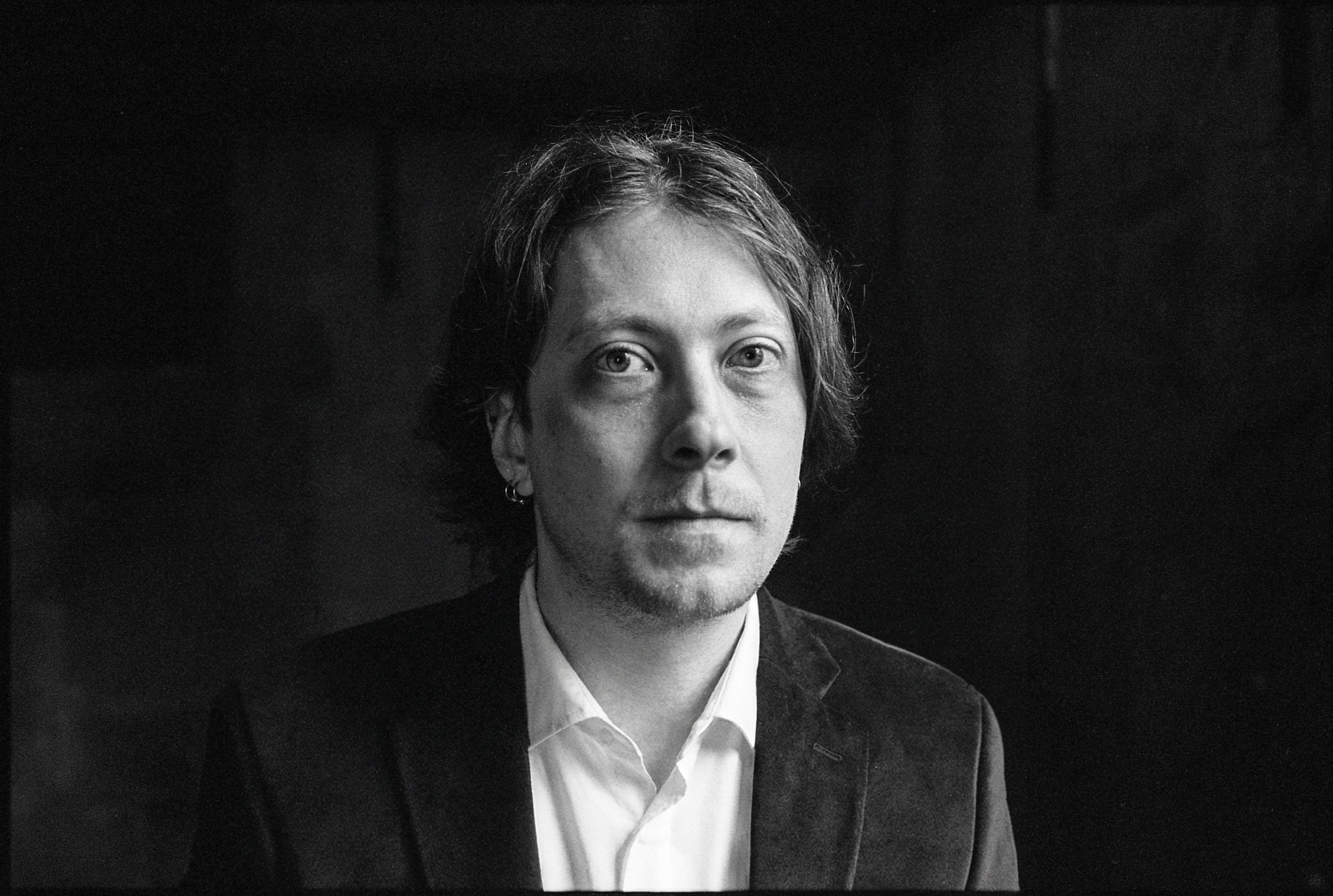 Henry James House Interview Image by Michael Wilson
"You don’t need to go looking for f-ed up things to happen. Life will provide them."
