

Published
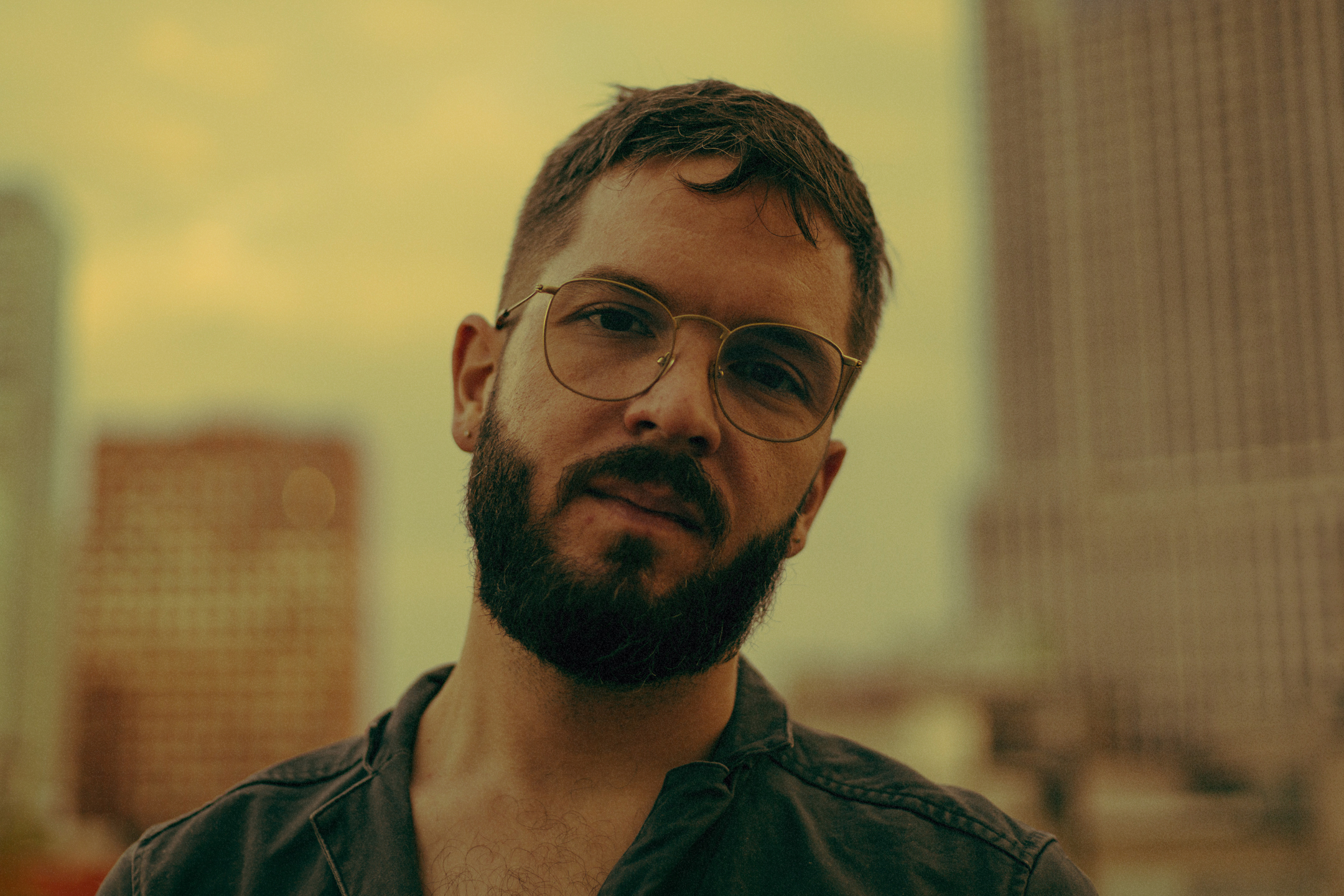
Name: Jacob Wick
Occupation: Trumpet player, improviser
Nationality: American, Mexico-based
Recent release: Jacob Wick's new album I'll make you coffee while you still sleep, featuring Gibrán Andrade (drums), Alonso López Valdés (bass) and Federico Sánchez (guitar) is out via Ropeadope.
If you enjoyed this interview with Jacob Wick and would like to find out more about his work, visit his official website. He is also on Instagram, and bandcamp.
For a deeper dive, read our earlier Jacob Wick interview.
What does the term jazz mean today, would you say?
I think genres - like genders ;) - have always been arbitrary and now more than ever.
For one thing, even "pop" recordings are sounding more and more "experimental," whatever that means. Like, put on "Ugly Season" by Perfume Genius or "Perverts" by Ethel Cain or hell, Rosalía's most recent album and tell me what "genre" you're listening to. Like, who cares?
But really, who cares? For whom is the most important thing about music, or even an important thing about music, what stupid little box it fits in? Especially when you consider that a lot of these decisions come down to marketing & sales and that those kinds of decisions are made by braindead nepo babies whose daddy bought them a Harvard MBA and who don't know their ass from their elbow.
Anyway to answer your question I wish "jazz" still meant "sex" like it did 120-odd years ago. That would make the slogan of the local jazz club ("Let's jazz!") a lot more fun.
Where do most of your inspirations to create come from – rather from internal impulses or external ones? Which current social / political / ecological or other developments make you feel like you need to respond as an artist?
I guess both/and.
Sometimes I hear something completely in my head and I can just write it down and that's that. Sometimes I use tools - like dice, indeterminate processes, etc - to plot out melodies and rhythms and harmonic structures. But even when I write something via a totally arbitrary process, I'll play it out and it will connect with a very specific moment in my memory or my experience.
On the most recent record, "New Jersey turnpike 3am cold coffee stale milk" is one such example. I wrote the harmonic content and the rhythmic content using indeterminate processes, then I wrote out the melody to fit.
Once I played it a couple of times on my keyboard at home, it connected like a magnet with this very specific feeling of driving through a humid night - or early morning - in the early 2010s, in New Jersey, my WaWa hazelnut coffee gone cold, the milk congealed across the surface like a stain, on my home from visiting a lover in Baltimore or Asheville.
As far as social / political / ecological concepts, we are living through the end of a paradigm that may indeed take us down with it. The collapsing climate combined with a global lurch towards fascism may not be survivable. On the other hand, it might be!
In that sense, I've made some moves to dedicate my life completely to providing spaces of intimacy, attention and support, through music, writing and teaching. We all have to consider how we can be useful to each other.
What role do electronic tools and instruments play for your creative process?
I made an Excel formula that automatically maps out a 12-tone row to all possible inversions, retrogrades, etc. Sometimes I use that to set melodies or harmonic progressions.
Other than that nothing.
Thanks to technological advances, collaboration has become a lot easier. What have been some of the most fruitful collaborations for you recently and what approaches to and modes of collaboration currently seem best to you?
I'd push back against that.
Music is very much about bodies in a room, and improvised music even more so. Improvised music is based on attention, intimacy, and horizontal listening, the kind of listening that doesn't necessarily focus on one specific person or thing but instead focuses on an entire situation or scene. Technology does not aid in this, unless of course we're talking about microphones and PAs.
In a very turbulent global moment where people feel alienated and isolated and scared, where the idiotic ideas of the dumbest people on the planet - pathetic losers like Peter Thiel, Elon Musk, etc - are gaining global currency, there is nothing more important than providing space for people to simply be together in physical proximity having a shared experience.
In this way, there is no more important job right now that of the musician, the theater actor, the cook, and so on, professions that are dedicated to shared space and shared experience.
How much potential for something “new” is there still in jazz? What could this “new” look like?
What was it that Miles Davis said? "You can't play anything on a horn that Louis Armstrong hasn't played" or something, right? That still holds true. There never was anything new in jazz and there won't be, either.
Besides that, it's important to remember the fundamental blindness behind the idea of discovery, like when Columbus "discovered" the Caribbean. It was already there! The next time you hear something "new," remember that just because you haven't heard something before doesn't mean that it's never existed. I think it's more than time to drop this goofy search for "the new" and instead be curious about the now.
Like, instead of hearing something you've never heard before and saying, "ah! this has never happened before!" ask yourself instead about the circumstances of this newness. Where are you listening, who are you listening to, how are you listening, what is the situation and what is the scene?
If the artist is new to you, research the artist and find out their influences. That way you can understand what the context of that sound is, where it came from, how it happened. You might even learn something. ;)
For many artists, life-changing musical experiences take place live. How do you see that yourself?
It's still the Cecil Taylor large ensemble at the Iridium in the Hell's Kitchen neighborhood of Manhattan in like 2004. I think a recording of these concerts was recently released.
Anyway I went with friends from college, we took the train down from SUNY Purchase. I don't think I knew who Cecil Taylor was, or if I knew I didn't understand. I will never forget the experience.
I was sitting there, eating a wedge salad - a wedge of iceberg lettuce charred on a hot griddle or grill and topped with crumbled bacon and ranch dressing, classic US cuisine – watching musical ideas move across the stage like clouds across a bay. There was no director, there was barely any conversation amongst the musicians, the music just happened. People had music stands but it was hard to see the music, in my memory's eye - ie don't believe this - in my memory's eye they were looking at napkins. It was profound.
It was profound because I had never seen a concert of somebody - in this case Cecil Taylor - where that one person was a part of the experience and not the focus of it. The entire ensemble, including him, was inside the music, waiting patiently for a theme to arrive, developing it in tandem with the rest of the musicians on that side of the stage, gently pushing it back across the room.
From then on I have been on a quest to write music that pulls everybody, including me, into it, instead of music that pushes me on top of everybody. Does that make sense?
Recently I did a performance in LA with amazing local musicians there. My music is almost entirely written in odd meter and, since I often use arbitrary or indeterminate processes to write out rhythms, can be extremely complex rhythmically. As we ended rehearsal, somebody - I think Miller, the bass player - said, "enjoy the LA driving!"
On my way home, driving on the 5, I thought about how LA driving is a lot like Mexico City driving, where everything is so chaotic that the only way to manage is to simply discard binary concepts of right and wrong and instead work your way through the situation towards an approximation of what you wanted to happen, of course with the understanding that what you wanted to happen may never happen at all. And I thought, that's how to play my music.
I write the way I write because I think difficult music makes people, including me, listen and interact in a different way, a way where we are constantly negotiating what has just happened versus what we hoped or thought would happen and how to arrive together at a mutual understanding.
A couple of reviews of this release have highlighted that the group feels like it is in the music, and I am very, very proud of that, because that's what I've been trying to do since I saw that concert 20-odd years ago.
Improvisation is obviously an essential element of jazz, but I would assume that just like composition, it is transforming. How do you feel has the role of improvisation changed in jazz?
I don't think improvisation has changed in thousands of years. Idea, variation, variation, idea, variation, variation. Sitting silent and reacting.
The book by Derek Bailey, Improvisation: Its Nature and Practice, is a good document of this. Improvisation is always pretty much the same, across cultures and geographies, and always has been. Not everything needs to change and not everything needs to progress.
The only thing that progresses without end is cancer.
What, would you say, are the key ideas behind your approach to improvisation?
The key idea is "nothing comes from nothing." Improvisation comes from lived experience, action, spatial awareness, emotional awareness, rhythmic awareness, harmonic awareness, and melodic awareness, probably in that order. It doesn't come from some kind of magical vacuum.
That's also why I say that there is nothing new in improvisation - it was all always already there. Even when I play a solo set I often feel like I'm stepping into a river of music that was there before I started.
I now have a growing amount of improvisation students. The first thing we study is simply paying attention. In a jazz context, this means listening to records and focusing on one particular instrument, the snare drum for instance, and then slowly expanding attention to the rest of the group. The second thing is to simply improvise, to actually do something. I give them basic tools, like one type of scale, and ask them to start constructing something with that.
Then comes the rest: relating the impulse to create - to speak or sing - with the space, with the emotional context, and so on, later diversifying the tools they have in terms of scales, intervallic patterns, harmonic concepts and rhythmic displacements.