Published
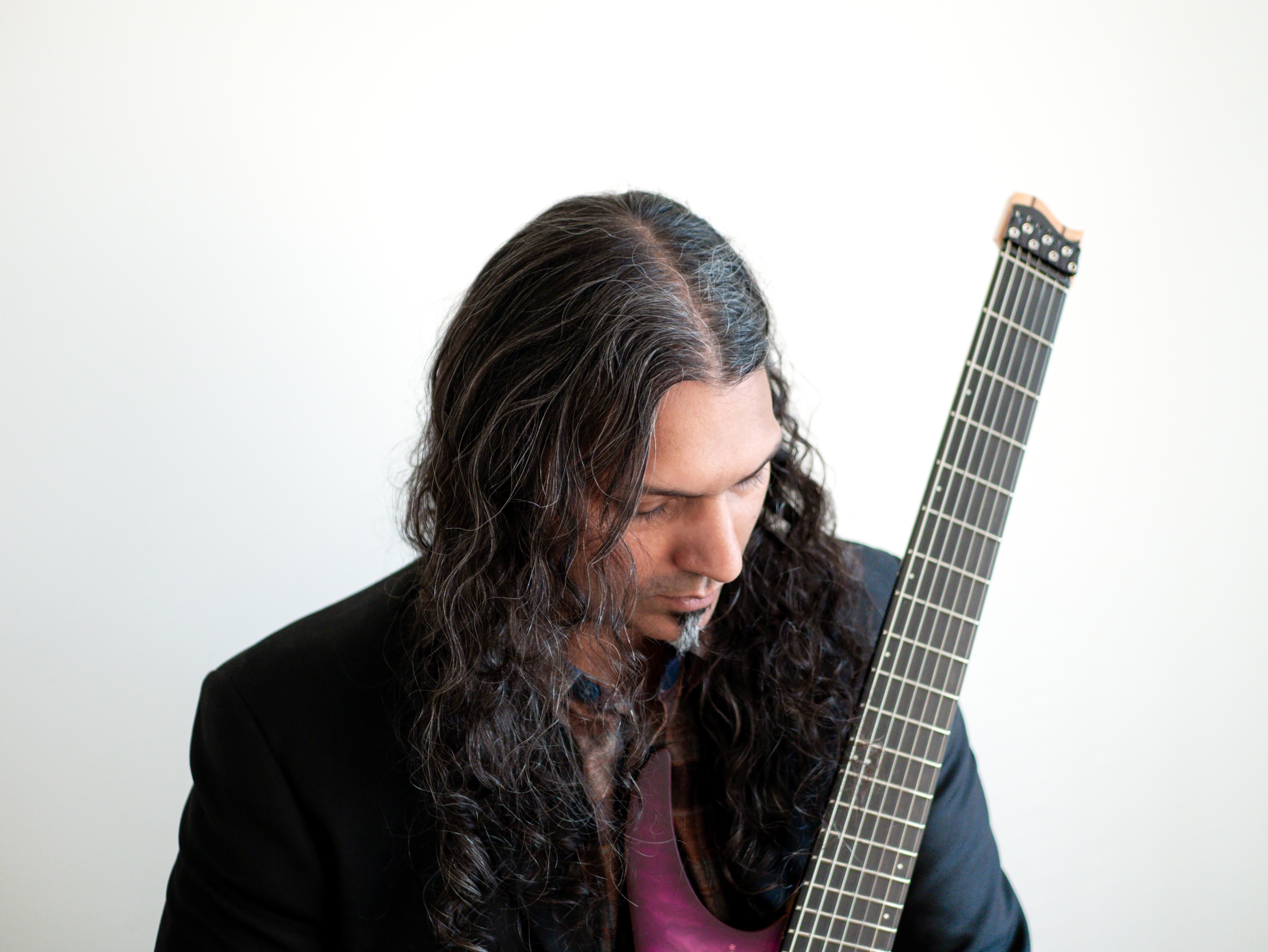
Name: Jay Matharu
Nationality: British, Sweden-based
Occupation: Guitarist, composer, improviser
Current release: Jay Matharu's new album Disillusion is out now.
Hometown Recommendation: If you were to arrive in Uppsala the first place you should visit is the Time Machine in Klosterparken, after that the castle and cathedral. But there are lots of beautiful places to see in and around the outskirts of town.
Things I am passionate about but rarely get to talk about: There are quite a few things, but we would need another interview for that! I do love cooking plant based cuisine and experimenting with recipes from all over the world. I could also talk about my adopted rabbit, Rabinder all day long.
If you enjoyed this Jay Matharu interview and would like to stay up to date with his music, visit his official homepage. He is also on Instagram, Facebook, and bandcamp.
Where does the impulse to create something come from for you?
I’m not 100% sure where the impulse to create comes from really as I come from a relatively unmusical family.
I suppose the main reason at the start of my journey was catharsis and self-expression. Growing up I was a very nervous and introverted person, but where I grew up (Co.Cork, Ireland) being that way was not really socially accepted, I had to put on that friendly charismatic mask, and got so good at it that I managed to eventually change my personality.
But I think creativity is an inherent part of human nature. For me creating music is a way of expressing what is under the facade, whether it’s composing my own songs, improvising or playing live, my soul feels nourished during and after the process which in turn creates a drive to do it more.
What role do often-quoted sources of inspiration like dreams, other forms of art, personal relationships, politics etc play?
I’ve only ever had a few dreams where I heard the most perfect music but of course forgot it upon waking. I think everything we hear, see, watch, smell can influence or inspire us in some way, whether we chose to embrace it or not.
As my medium is instrumental fusion music, it may be difficult to pinpoint specific political views embedded within it. However, on this album the tune “Cog” serves as an expression of self-reflection, inquiry and adaption to the inevitable within the disdain of broken systemic structures.
Outside of music, I am inspired by other art forms, especially painting, illustration, and sculpture, but also dance, film, and poetry.
For you to get started, do there need to be concrete ideas – or what some have called a 'visualisation' of the finished work? What does the balance between planning and chance look like for you?
No not at all! I’m good at making something from nothing, at least that’s what my wife tells me when there is no food left in the fridge ( haha).
However it can be nice to have a specific vision or deadline in some circumstances. I’ve worked with many bands and projects over the years and having that vision and deadline helps you to stay focused or gives an identity to the project. For example for a metal band it might be, “we are so and so, known for this” and this record needs to be slightly heavier or even more commercial sounding then the last.
But on the other side, when I’m composing my own music my approach is more time consuming, as I like to start from a blank page with no preconceptions. The process is not just composing but allocating time to reflect on what I am doing/ have done and letting things breathe.
Being alone is ideal, but living everyday life is also essential, it allows you exit the creative bubble and opens me up to constructively criticise the art produced. I like to allocate a specific timeframe and immerse myself in the process as much as possible, this could be a 3-6 month period where immersion is week or so at time. Lately with my teaching job I usually get 1-3 days in the bubble per week if I’m lucky.
For my solo stuff I never have a specific vision of how the music is going to sound, I just start from the guitar. This could be a chord, a sound, how I’m feeling, I’ll go with the flow and let myself improvise freely and if something I like happens or materialises I’ll record a short clip of audio or video and in some instances notate the idea, so I can pick it up again at a later date to develop or expand further.
At the time of writing and recording my first solo album I gave myself a 100 day deadline, the biggest challenge back then was a full-time job working unsociable and long shifts. I penciled in every hour of free time in a calendar and did my best, as the time slots were short more often then not I found myself compromising creativity instead of fully exploring the potential of some ideas.
Is there a preparation phase for your process? Do you require your tools to be laid out in a particular way, for example, do you need to do 'research' or create 'early versions'?
Not really.
I suppose after many years of having multiple files named “idea 1,” I label things better.
I also like to have a template set up in my DAW so that if I need to record something I can do it instantly without faffing around.
Do you have certain rituals to get you into the right mindset for creating? What role do certain foods or stimulants like coffee, lighting, scents, exercise or reading poetry play?
I use different methods.
Sometimes I just sit and noodle, but when writing my own music I generally try to spend few minutes to connect with what I’m feeling. If I have time I use meditative practice where I close my eyes and follow my breathing or a sound to connect deeper and explore the subtleties and nuances of the moment. I find going for a walk or a run before practicing/ composing can ground me and make it easier to reach a flow state in the session afterward.
I’m definitely a night owl so dim light is where I live. I used to work nightshifts some years ago and found there was a small magical window for creativity, where I would sit after a long night at the point of exhaustion, eyes heavy and wanting to sleep. I would record my improvisations and go to sleep. When I would listen back upon waking, there would be many great ideas.
In this window my inner ego was too tired to chatter, leaving the music to flow purely and pass through without judgement. I don’t recommend it for everyone but I have used alcohol to heighten my sense of emotions and vulnerability, which can also help to revisit past memories, sometimes this can imprint nostalgic elements to the music.
For Disillusion, what did you start with? If there were conceptual considerations, what were they?
Disillusion was born out of my masters research studies. My project was rooted in practice-based artistic research exploring several chord voicing concepts drawn from books by modern jazz guitarist Hristo Vitchev, and investigating the integration of these concepts into my personal harmonic vocabulary as a guitarist and composer.
The study was split into two parts, the first part focused on technical practice, creating etudes and exercises designed to investigate the potential of these concepts and assimilate the material through hands on engagement. The second part aimed to explore the creative application of the material through composition.
It was here that I used exploratory practice as a tool to explore how I could use the concepts in expressing emotions and feelings etc. I composed musical sketches and seeds which would later be the spark for several compositions.
After presenting some of these compositions to one of my guitar professors he encouraged me to release them. So once my studies were finished I re-recorded everything employing my course mate Jacob Johnson on drums, Erik Brandell on tenor sax and an old friend Christine Lanusse on bass guitar.
Even though my final paper was very technical and academic, the tunes themselves were not so, they were based on specific feelings, emotions, themes, and concepts.
Tell me a bit about the way the new material developed and gradually took its final form, please.
The process was quite in depth, but to summarise, it all began with improvisation, where I followed sound, themes, emotions, feelings and my curiosity.
This exploration and discovery eventually took the form of musical sketches which were then further investigated, developed and refined over time into compositions. When an idea manifested I would record it put it on a playlist with other ideas and listen to them as I was walking or on my commute.
After a few weeks I revisited these motifs or sketches with a deliberate intention of developing them into compositions. Once the main ideas where concrete I recorded basic demo versions with midi instruments, which I later sent out to the others before they recorded their parts. There were quite a few ideas that weren’t realised as full compositions due to time constraints.
In the case of “Chalo" the main motif that just flowed out without needing much refinement. It was the anniversary of my close friend and mentor Sanjay Guha’s death, and with instrument in hand I began reflecting on good times together.
The ostinato to “Butterflies” materialised when I was musing on love and anxiety, I tested it within multiple time signatures before settling on 21/16.
Once it felt right the rest of the song built itself gradually on that foundation. Even though I’m a guitarist, piano seemed a perfect fit for the timbre in the ostinato.
The main idea for “Deluge” originally manifested itself when I was staring out the window on a rainy day feeling overwhelmed.
The composition flowed really well, but I felt the original B section was not contributing anything to the overall feeling or story. In the end I made a few tweaks which unfolded into something completely different.
“Shruti” was a one take improvisation, this was the only version, no other takes. At first I felt like it needed more embellishment, denser phrases or more defined melody but in the end I found something charming in the piece.
It was like taking a musical snapshot of how one was feeling in that moment, so I kept it as it was. Kind of like a reminder that moments happen and we move on, whether they are good, bad, life changing etc.
Once all tracks were recorded I sent the files to Marcus Wallberg to mix and master them. I would never trust my ears to do a good mix.
Many writers have claimed that as soon as they enter into the process, certain aspects of the narrative are out of their hands. Do you like to keep strict control or is there a sense of following things where they lead you?
I like to relinquish all control and follow musical ideas. The music tells me where it wants to go and what it needs to be realised as it’s own composition.
I don’t like the idea of writing music starting with a theoretical or technical framework, unless it’s for a specific practical purpose, such as an etude. However, I have listened to a plethora of music across genres and studied music theory to the point where any decision making is subconscious and organic.
I remember when studying my bachelors degree I took several composition electives. We would always get a brief stating what concepts and theoretical devices needed to be included in the piece. I would put that paper in a drawer and just compose. When I felt the piece was nearing completion I would open the drawer and read the brief whilst looking through my work.
In most instances these concepts occurred naturally within the composition, if not, I would adjust to appease the examiners.
There are many descriptions of the creative state. How would you describe it for you personally? Is there an element of spirituality to what you do?
Personally it’s like nothing exists outside of what you are doing. All sense of time dissipates, minutes feel like hours and hours like minutes, thought is non-existent, you lose yourself to the moment. Sometimes it can feel like you are a funnel being used to filter something bigger.
There is no shortage of ideas or variations of those ideas.
How do you think the meaning, or effect of an individual piece is enhanced, clarified or possibly contrasted by the EPs, or albums it is part of? Does each piece, for example, need to be consistent with the larger whole?
Personally I think there is a deeper connection when hearing a piece that is part of a bigger story or narrative.
As a listener I like to be taken on a journey and there is something magical about listening to an album or EP in it’s entirety as whole work of art. There are so many albums I have bought in the past where there was one good song and the flow was disjointed or the other tracks were just filler, without any thought.
I think in the space of fusion, progressive, and jazz music there is much more thought into the album as an entity. Especially if there is an underlying theme or concept, the prog rockers are especially great at the concept album. I think for my music where there are many stylistic influences hearing isolated tracks might seem a bit strange. (To be honest this is the first instrumental album where I have released singles, and it was interesting to see how people experienced the singles in comparison of each other).
However, the overarching theme is that of disillusion and each track explores a distinct emotional landscape leading into the next. From paralysis to movement (Atrophy) into vulnerability (Bare), exploitation and adherence of broken systems (Cog), into overwhelm and depression (Deluge), self-reflection (Shruti), nostalgia and remembrance (Chalo), love and anxiety (Butterflies), and finally acceptance (Bittersweet).
What's your take on the role and importance of production, including mixing and mastering for you personally? In terms of what they contribute to a song, what is the balance between the composition and the arrangement (performance)?
I think production is important nowadays as listeners are used to a certain quality and clarity in sound.
I have a small collection of well known 70s fusion records and it’s amazing how far we’ve come with production, some records have strange pops and clicks where the tape was spliced or extreme level changes in the balance between instruments, clipping and distortion are all pretty normal on these records too. But they were learning and pushing the boat forward in many ways.
In my opinion a good mix enhances the small nuances in the music, and allows more clarity in how the instruments are interacting with each other. The arrangement plays the most important part in my opinion. It’s harder to create a good mix if the arrangement is cluttered or unbalanced across registers.