Published
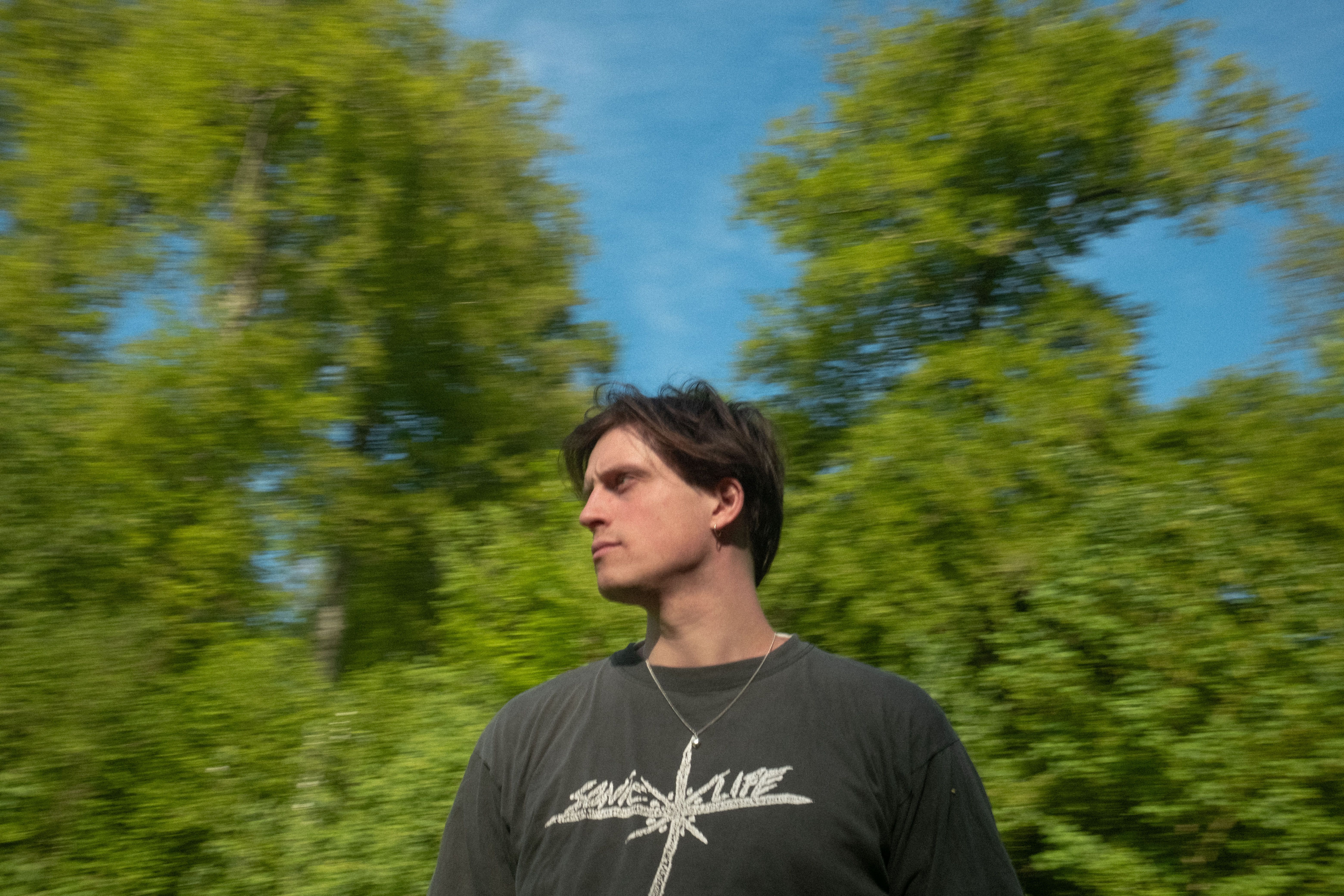
Name: Hector Devriendt aka Jennifur
Nationality: Belgian
Occupation: Producer, DJ, songwriter
Current release: Jennifur's new album Mazda is out via Off Corner.
If you enjoyed this Jennifur interview and would like to know more about his music, visit him on Instagram, Facebook, Soundcloud, and bandcamp.
What were some of the musical experiences which planted a seed for your interest in electronic music?
I wasn't classically trained at all when I started making music in my bedroom, no music school, my mother tried but I was more into skating and sports.
The real seed was planted at home: my older brother and my father had me listen to artists like Sonic Youth, Radio Head, Aphex Twin, Boards of Canada, Crystal Castles, Burial, Four Tet, Mount Kimbie … I was instantly hooked because of the electronic approach the artist have when it comes to making music. For me the idea that any sound, even one that doesn't exist yet, can be created and can trigger emotions felt so unique and exhilarating to me.
Not long after, when I was about fifteen, a friend introduced me to Ableton, and I was sold immediately. I started experimenting at home after school, and that's how I discovered my instrument.
Coming from the music I grew up with as a teenager, Radiohead, Sonic Youth, the more indie darker guitar sounding bands, I’ve always tried to connect that world with an electronic sounding palet.
Most genres of music make use of electronic production means. What does the term “electronic music” mean today, would you say?
To me, "electronic music" today is less a genre than a mentality: it means the sound itself is the starting point, not a predetermined instrument or band line-up.
In that sense almost all music is "produced" electronically now, but electronic music as I understand it is the tradition where you build the instrument and the song at the same time. It’s about sound design. Building sounds from scratch, deconstructing sound, literally manipulating it with the help of electricity and math.
Disco, house, techno, drum n bass, IDM and many other genres were about a lot more than just music. For you personally, is electronic music (still) a way of life – and if so, in which way?
Absolutely. Electronic music is how I navigate my personal experiences and the emotions that come with them, that’s literally been the mission statement of Jennifur from the start.
My albums are diaries: my very first album What Happened Between 2015 and 2018 captured specific moments and feelings from those years; Things Don't Change Until They Do was about growth and memory. And MAZDA is doing the same thing.
I wanted to make a record that feels like a long drive where time briefly falls away. That moment when you’re staring out the window, leaving a city behind, and suddenly looking at everything from a distance: the people you love, where you want to go, what you’ve lost along the way.
When I still lived in Ghent I also co-founded HS71 collective, an audiovisual platform with friends where we run a label, host events, exhibitions and parties. It's was all about creating contexts; nights, spaces, visuals; where people can experience something together. That community side is as much "electronic music as a way of life" as the production itself.
And even now with the new album MAZDA I organized a lot of events to connect the people to the music. We did a private rooftop party, a listening session, an in store live set at MusicMania in Ghent, etc. So for me music is a way of life, especially the social character of it all. I love connecting with people, through the music itself and through the events that are born out of the music.
Debates around electronic music tend to focus on technology. What, though, were some of the things you learned by talking to colleagues or through performing and/or recording with other musicians? What role does community play for your interest in production and getting better as a producer?
Everything, really. I'm not a trained musician, so working with musicians is very enriching.
When I’m not playing a solo set, I play alongside Thibault Goudket on drums, tuur Geldhof on guitar & bass and Manon Gögös on vocal, saxophone, sytnhs and guitar and redesigning my tracks for that band setup taught me so much about arrangement and energy. Also playing along trained musicians is something that motivates you to get better technically as well.
On the last album I recorded and I also collaborated for the first time with vocalists like TEUN and Lindy Versyck.
Community is also how my career started: I once contacted VI.BE, the Flemish support organisation for young musicians, with basic questions about releasing music, and years later that connection led to the Shredders game soundtrack, which was the firestarter of my career.
What are examples for artists, performances, and releases that really inspired you recently and possibly gave you the feeling of having experienced something fresh and new?
Mount Kimble remains a constant; I've listened to Mount Kimble almost daily since secondary school, from Crooks & Lovers to Love What Survives, because they keep reinventing himself.
Growing up, Aphex Twin's “Xtal” taught me about lo-fi sound; Bonobo about sampling. Radiohead's “Lotus Flower” shaped how I use electronic percussion and stretched pad sounds and the voice as an instrument, and Sonic Youth (“Reena” in particular) fed the noise and the melancholy.
For the new album, the direct inspiration was actually a playlist my brother sent me: MAZDA, named after the car our parents drove, full of songs our father played on road trips.
That became the emotional blueprint for the record.
What kind of musical/sonic materials, and ideas are particularly stimulating for your own work right now?
Right now I'm fascinated by the "in-between" space: the feeling of a long car ride, where you've left something behind but haven't arrived yet. That's what my new album MAZDA is built around; moments suspended in time.
Sonically that means blending electronic love songs with indie rock structures, UK bass influences, cinematic electronica and flashes of classical composition. I also keep coming back to acoustic-sounding materials; guitars, basses, real drums, processed electronically, because that hybrid sound triggers me the most emotionally.
Where do most of your inspirations to create come from – rather from internal impulses or external ones? Which current social / political / ecological or other developments make you feel like you need to respond as an artist?
Honestly, they're deeply internal. My process is almost diaristic: a track starts from a specific memory or feeling, and a song is only finished when I can re-experience that emotion through the finished piece.
During the lockdown, locked in my basement studio for eighteen months, that inward focus became extreme; I made the Nowhere, Now Here (soundtrack made for the game shredders) album in a kind of space-time vacuum, asking myself every day: how do I feel, and what can I do with that feeling?
But I do respond directly to the world, too.
The latest single off the upcoming album, “In The Sun,” was inspired by the film About Time and by grief; it’s a love letter to lost loved ones, about racing the setting sun to catch moments before they slip away.
Tell me a bit about the sounds & creative directions, artists & communities, as well as the colleagues & creative hotspots of your current hometown, please. How do they influence your music?
I'm based in Brussels. The Brussels scene is huge and incredibly versatile and super supportive: collectives like Gimic, Kiosk Radio, Volta, Hexagon to new a few and venues like Botanique, AB, Fuse again just a tip of the iceberg give upcoming musicians a stage and voice.
More broadly, Belgium has an incredibly rich electronic heritage and a tight community of young labels. I released my last album on Sweet Sun, the Antwerp label curated by Supreems, and the new one on Off Corner Records (NEWS).
Belgium is small but very very ambitious
Today, electronic music has an interesting relationship between honouring its roots and exploring the unknown. What does the balance between these two poles look like in your music?
It's a constant dialogue. On one hand I carry the history with me and I’m constantly using particular assets of a certain genre especially from post-dubstep, Indietronic, Shoegaze, classical music . But I actively guard against copying.
When I’m in the middle of making an album I deliberately listened to as little electronic music as possible, because I noticed it narrowed my view. Instead I pulled melodies from classical music, ambient and indie rock, and only looked for percussion inspiration in alternative electronica.
On the other hand I love exploring unknown territory by jumping between worlds; making a videogame soundtrack for Shredders, doing foley work and sound design for advertisements, making music for theatre. Switching between these worlds gives me a lot of inspiration and forces me to approach music differently.
But the most important thing for me is honoring the roots and keeping the emotional honesty of that tradition alive, not repeating its formulas; the exploring means using whatever tools, contexts and genres serve the feeling you’re experiencing at a certain moment.
What were some of the recent tools you bought, used, or saw/read about which changed your perspective about production, performing, and making music?
Just bought the novation summit. The mothership of the novation company.
I’m actually exploring the synth while answering this question, so I guess you’ll have to come back for a full review any time soon :).
How do you see the role of sampling in electronic music today?
Sampling, to me, is emotional time travel. A sample can carry a feeling from another era and release it in a new context decades later.
My whole new album is built on that principle in a broader sense: my brother's MAZDA playlist of songs our father played on family road trips became the emotional blueprint for the record; sampling a repertoire of memories rather than just a loop. I do hunt for good vocal samples though.
I’m also always searching for random fx sounds to make the record a bit more visually. Some samples in the new record are: the sound of an elevator when you reached the right floor, the button of a tape recorder, the click from Ableton, …
I like to use samples that give you a spacial hint of where the record was made, so the listener can feel the the room as well.
In as far as it is applicable to your work, how would you describe the interaction between your music and DJing/DJ culture and clubs?
I've always loved standing on a dance floor myself, and dreaming of hearing my own tracks in a club setting was a big motivation when I started making music. Within HS71 we organised nights where we played combined DJ sets of our own music and music that inspires us.
When I started playing my music live, I also started making different music. All of a sudden the guitar, drums and bass were part of my writing process. On my last album I also using my own voice and I guess I’m making more pop focused music. Funny to look back and see how much it changed.
It’s also a natural way of evolving and wanting to challenge yourself. I want to be a good songwriter and I want to be a good producer who’s not afraid of the weird stuff. My ambition was always to combine both I think.
So to come back to your questions. DJ sets and live shows with the band will always be part of the Jennifur project. I’m planning to dj a lot more in the future as well :)
How, would you say are your live performances and your recording projects connected at the moment? How do they mutually influence and feed off each other?
They feed each other constantly now. I deliberately incorporated a lot more acoustic-sounding material; guitars, basses, acoustic drums; so the feel of the album could be translated much more easily into a live constellation.
That gave me bigger freedom in the studio: everything could change faster, build-ups got faster, the rhythm section shifts more. In the other direction, playing live redesigns the tracks: what works on a 50-minute stage show teaches me about arrangement and dynamics I bring back into the studio.
The new album MAZDA will be performed in full band for the first time at at Botanique in Brussels on the 23th of October, that prospect alone influenced how I finished the record haha.
Even if AI will not entirely replace human composition, it looks set to have a significant impact on it. What does the terms composing/producing mean in the era of AI, do you feel?
For me, composing has always been about translating a personal emotion into sound; a track is only finished when I can re-experience that feeling through it. AI can generate sounds, even songs, but it has no actual life to translate; it can only recombine what has already been made or done. And that will always feel a bit off, for now I guess :/
What I fear more than the technology itself is the content-isation of music: while most bend over backwards to satisfy the algorithm's constant need for content, I try to make records that stand the test of time and decreasing attention spans.
In the AI era, I think composing and producing mean exactly that: being the honest, human filter. The tools will keep changing; I taught myself Ableton on the fly as a teenager, and I'm open to new tools; but the meaning of making music stays the same: making something that carries a real moment, a real memory, a real person.