Published
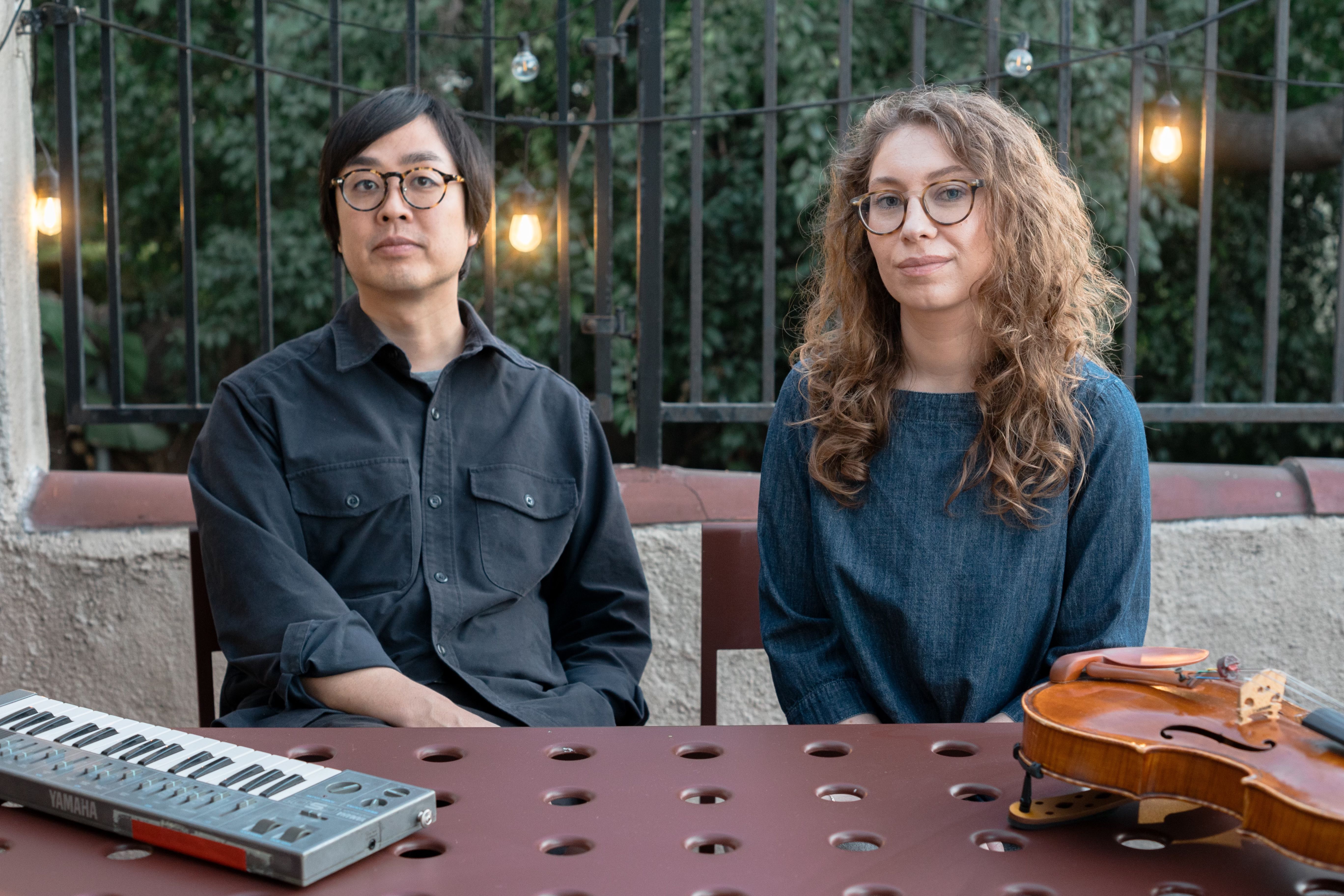
Names: Jeremiah Chiu (JC) , Marta Sofia Honer (MSH)
Nationality: Taiwanese-American (Jeremiah Chiu), American (Marta Sofia Honer)
Occupation: Composer, producer (Jeremiah), violist, violinist (Marta Sofia)
Current release: Jeremiah Chiu & Marta Sofia Honer's new collaborative album Different Rooms is out June 20th 2025 via International Anthem.
Current event: To support the release, Jeremiah and Marta Sofia will perform a few select shows. Catch them live here:
July 14th 2025 - Zebulon - Los Angeles, CA
July 24th 2025 - Lincoln Center - New York, NY
July 27th 2025 - Solar Myth - Philadelphia, PA
Global Recommendations:
JC: If you’re in Northeast Los Angeles and enjoy synthesizers, look no further than the Vintage Synthesizer Museum. It’s an incredible studio and collection of vintage gear, all ready to work with. Call Lance, book your time, enjoy. Nearby, if you’re into a nice Martini, go to Belle’s Delicatessen and Bar.
If you enjoyed this interview with Jeremiah Chiu & Marta Sofia Honer, visit their respective homepages for more information and music: Jeremiah Chiu; Marta Sofia Honer
For a deeper dive, read our earlier Jeremiah Chiu and Marta Sofia Honer interview.
What were some of your earliest collaborations? How do you look back on them with hindsight?
JC: A lot of my practice in both visual art and music has been collaborative. I currently collaborate with Marta in our duo, with Jeff Parker and Ben Lumsdaine in a trio, and in SML with Booker Stardrum, Anna Butterss, Gregory Uhlmann, and Josh Johnson.
Spelling it out here it feels like a lot of great collaboration!
[Read our Booker Stardrum interview]
[Read our Anna Butterss interview]
[Read our Gregory Uhlmann interview]
It may not be the earliest, but I distinctly remember in 2015 (or so), I prompted myself with a “word of the year” that would guide how I wanted to shift my perspective throughout the year. My word was collaboration and it forced me to engage in a number of collaborative projects that I might have otherwise said “no” to.
It really opened me up in a way that I did not expect. My expectation was to have a fruitful year where a lot of new projects emerge. Instead, I really learned how I want to collaborate, what my expectations are, and how to let go of things. Collaboration is an act of trust and if you’re unwilling to trust your collaborator, it makes for a bad collaboration.
That being said, it never gets easier, you just become attuned to how to listen better and how to communicate more clearly.
MSH: The earliest original music collaboration I had was in a post-rock band when I was a teen. Looking back it was delightfully naive, but also successful in its own way as we had common inspirations and were invested in the experience.
As a lifelong classical musician, collaboration means and feels much differently than working on self composed material as the aim is to uphold and execute someone else's work, in which you are listening and communicating really hyper specific goals.
I feel like my collaborative journey in the duo with Jeremiah is not exactly -undoing- this mindset, but more offering an opportunity to collaborate in a way that forces me to be freer and more open.
There are many potential models for collaboration, from live performances and jamming/producing in the same room together up to file sharing. Which of these do you prefer – and why?
JC: Lately, Marta and I have found it productive to multitrack record live performances to use as base material to edit, arrange, and re-compose into new albums.
We record live because a lot of it is improvised. We can hear the difference in our performances in live settings versus in the studio without an audience. From there, the editing process is still collaborative, but we’re often working on different parts of the music, individually, and then bringing it together after we’ve had time to work it out ourselves.
I think it’s important for us to express different modes of collaboration and not feel obligated to be in the same room for all of it. I want to hear someone's vision for a piece, you know?
How did this particular collaboration come about?
JC: Marta and I met performing together with a large ensemble (of 30+) at an annual performance of Terry Riley’s In C at Constellation in Chicago hosted by Bitchin’ Bajas.
[Read our Rob Frye of Bitchin' Bajas interview]
From there, we started to experiment in duo—processing viola through synthesizers without any real intention to form a duo.
It was during the making of Recordings from the Åland Islands that we more formally embarked on a collaboration.
What did you know about each other before working together? Describe your creative partner in a few words, please.
JC: Marta’s practice as a violist in Chicago was quite expansive.
Beyond what you might expect from a classically trained musician—orchestral performances—I had seen her perform in experimental music settings, in small ensembles playing the music of J. Dilla, and with Bitchin’ Bajas. I think we got along quite easily because we both have eclectic tastes in music, visual art, etc …
MSH: Meeting Jeremiah years ago in Chicago, where he was performing solo and in a few bands, I quickly learned he was a polymath of design and synthesizers, but beyond that had a huge internal encyclopedia of music knowledge and recall.
It has been fun over the years to see him really deepen and develop his musical composition style, subtly drawing from all the music he has catalogued inside him.
What do you generally look for in a collaborator and what made you want to collaborate with each other specifically?
JC: I guess it’s really helpful to have a commonality of interests, one where each person can bring new reference points into the conversation.
I love learning about things I haven’t seen, heard, or read before, but that are connected to the larger network of subcultures that I’m already familiar with and invested in.
The other thing that I look for—which I mentioned earlier—is someone that I feel I can trust. There’s always a hope that what forms is something more wonderful than you could pull off individually.
MSH: Someone you have commonalities with, you can trust, can learn from, and can have fun with!
Tell me a bit about your current instruments and tools, please. In which way do they support creative exchange and collaborations with others?
JC: We’re still working with the modular synthesizer and viola. In the modular setup, there’s a few different ways to manipulate live-sampled instrumentation—either from the viola or from microphones or synthesizers in the rig. Things are live-captured into a Make Noise Morphagene, an Instruo Lubadh, or a Chase Bliss Mood.
Using those instruments to manipulate the sound forces us to be in collaboration with the recorded performance, as no two captures are identical.
We’re processing the sound through traditional reel-to-reel style, granular synthesis, or a mix of the two. It allows for moments of chance and magic that we respond to.
Before you started making music together, did you in any form exchange concrete ideas, goals, or strategies? Generally speaking, what are your preferences when it comes to planning vs spontaneity in a collaboration?
MSH: I don’t recall sharing anything concrete other than common interests and overlap in music that we liked. From there, things happened organically and through improvisation, which is how most of our music is made today.
Sometimes there may be some slight planning of things that we think could enhance material we have already been working on and sit well with it, but everything always starts off in an exploration with unknown destination.
Describe the process of working on your latest release, please. What was different from your expectations and what did the other add to the music?
Pulling from our liner notes: In our typical process, much of our material is collaged and combines moments of live improvisation, field recordings, and in-studio experimentation. This record, however, marks an evolution in our approach to studio production.
Our studios are side-by-side. When we were writing this album, you might have found us tracking viola stacks in one studio while, in the other, we were writing through-composed themes and rearranging the material. Granular synthesis and tape manipulation are key tools we use to create variation and movement in a composition. This process often yields surprising results, capturing the emotion but expressing it in unexpected ways. It feels essential that we embrace a bit of chance.
In contrast to our first album, Recordings from the Åland Islands, we wanted this music to feel very present. Where Recordings was intended to transport you to another place, Different Rooms is meant to meet you where you are. It’s a decidedly urban album. The field recordings were captured on train platforms, in city streets, in rooms at home, and intentionally paint a quotidian sonic image, blurring the line between what you hear in your own environment and what is on the record.
Was/Is this collaboration fun – does it need to be?
JC: Yes. And I think, yes.
Similar to hearing the recordings from a live performance, I think you can hear tension and ease in the creative process. If people aren’t working well together, I think that energy is transferred into the output and can be felt by the listener.
Maybe some people are better at hiding it than others. But maybe this is a good reminder to myself to rewatch Metallica’s Some Kind of Monster, and then relisten to the subsequent album that was made during the filming.
Collaborating with one's heroes can be a thrill or a cause for panic. Do you have any practical experience with this and what was it like?
JC: Marta and I had a dream opportunity to make a record with Ariel Kalma—rest in peace—and it was one of the most memorable experiences of my life.
Ariel was such a special energy, a true light, and a joy to work with. He taught us a lot about listening, improvisation, and when to push/pull. As an example, I fondly remember that he was quite open to a lot of the musical direction and editing approach that Marta and I applied to our improvisations. He always responded enthusiastically except for the one or two moments when he felt strongly that a song was veering too far from itself. In that moment, he said, “no, it should not change and needs to be what it is”.
I started to understand that he had a great ability to zoom out and view the work from both a macro and micro vantage point. Allowing space for us to activate, and only chiming in when things felt critical to the work. It’s a balance of intuition and observation.