Part 1
Name: Jérémie Ternoy
Nationality: French
Occupation: Composer, improviser, pianist
Current Release: Jérémie Ternoy's new album Ça commence par la marche is out via Circum Disc.
Local Recommendations: I was born in Béthune, in the Pas-de-Calais region, in the north of France. I grew up in Lillers, a small town on the edge of a former mining region and at the beginning of the more agricultural Flanders area. Northern France is often seen as a deindustrialized and rather poor region. Far-right ideas grow there amid the remnants of the different cataclysms the region has gone through … But the longer I live there, the more I learn to appreciate the singularity of this territory.
There is a park called Olhain, with a belvedere perched twenty meters above the ground on top of a hill. From there, you can see the chain of mining slag heaps stretching across the landscape like a strange mountain range; farther away are the hills of Flanders, and behind us those of Artois.
It’s not a grand or spectacular kind of beauty, but something simpler and more human. And once again, if you take the time to truly look, I find there a kind of beauty that feels paradoxically almost wild.
If you enjoyed this Jérémie Ternoy interview and would like to know more about his music and upcoming live dates, visit him on Instagram, and Facebook.
Are there examples of minimalism in music – and outside of music - that impressed you early on?
I was lucky to grow up very early in a musical environment. My older brother is a pianist and composer, and when I was in middle school he introduced me to an enormous amount of music, including jazz, which I immediately connected with.
He would often come home with records for us to listen to. I especially remember hearing Music for 18 Musicians during a car trip, as well as Ligeti’s Poème Symphonique for 100 Metronomes.
So not exclusively minimalist music, necessarily, but I think that encountering these works very early on opened me up to the possibility of inventing, and also to a certain absence of boundaries, because all these different kinds of music arrived without any order or hierarchy, almost without me realizing it.
But I very clearly remember a musical game my brother, my sister and my cousin had created when they were together: a sentence whose syllables they would distribute between themselves and, through a kind of “mathematical” shifting process, they would create phase patterns and eventually the sentence would reappear.
I still don’t know exactly why I became so fascinated by that moment, but I think it gave me a key to what composing actually is … I understood much later that these are writing processes that are very present in minimalist music.
Were you ever interested in minimalism as a style – from the Philip-Glass-variety to solo instrumental work to minimal techno? If so, tell me a bit about your interest in this.
I tend to connect my interest in a musical movement or an artist to an actual human encounter. In general, it’s through people that I discover musical styles. I never really approached minimalism as an aesthetic to claim or as a movement I wanted to belong to.
On the other hand, certain musical experiences deeply affected me: Steve Reich of course, but also African music, some forms of electronic music, Moondog … all of which share this ability to create a trance-like state or an extended listening experience from very simple material.
I think what interests me most is not minimalism as a style, but the way an extremely reduced motif can open up an immense listening space.
Do you tend to find that, as many claim, “less is more?” Are the notes you don't play really as important as the ones you do play?
With my colleagues in the group TOC (Peter Orins and Ivann Cruz), we’ve been playing completely improvised music for twenty-five years, mainly in two forms: one electric and very dense, sometimes almost excessive in terms of sound, and the other entirely acoustic.
Curiously, it is through the acoustic version that I learned the weight of silence, and how silence can sometimes become the strongest equivalent to very loud sound. How silence itself can carry the intention to play, and how that allows you to say a great deal with very little.
That dimension is not necessarily very present in CCPLM, because there is actually very little silence in the piece. There, it is more about the treatment and evolution of the elements themselves.
Do you feel as though making music is a process of adding elements until it is done – or one where you chisel away pieces from something that is already there?
This is precisely something that has evolved in my work over time.
I once discussed this with a musician I admire very much, Mathias Delplanque, who makes electronic music. He spoke to me about this relationship between material and writing. His compositional process was close to that of a painter throwing matter onto a canvas and then gradually removing it in order to reveal what was already there.
More generally, my relationship to composition has evolved toward greater simplicity, as if every time I write, I am trying to reach the core of each piece. Very often, I start from something complex in order to arrive at a more stripped-down material that still retains traces of that complexity.
Many artists are becoming more minimalist in their music as the years go on, focusing on the “essence.” How is that for yourself and how would you describe your development in this regard?
I think CCPLM is the musical project in which I allowed myself to be guided only by the essence of the piece itself. For me, it is a work about accepting the passing of time. Whenever I had doubts about the direction to take, I kept telling myself that I had to trust the initial idea and let myself be carried by it.
I realized this while working on the RITUAL repertoire with the Organik Orkeztra. Together with the orchestra’s co-artistic director, Kristof Hiriart, we had already structured the music very precisely before even writing a single note — through themes, narration and overall form. In that context, writing simply meant making those narrative choices concrete.
It is also part of a broader evolution in which I try to assume my artistic choices as simply and honestly as possible. When I begin a project, I hold onto the image or intuition it evokes in me, and I let myself be carried by it.
In a way, I try to place myself in the service of the idea itself, while putting my ego aside as much as possible. At least, I try.
What were some of the starting points for your most recent release?
“Ça commence par la marche” (“It Begins with Walking”) is a very particular project for me.
In 2016, I had just come out of four years with MAGMA. It was an intense and enriching experience in which I found myself repeating rhythmic sequences over long stretches of time, where the challenge was not to move, but to embrace — with the same material — everything happening around me, constantly re-evaluating what was going on while remaining unchanged myself.
I realized that I loved that, and that repetition was absolutely not synonymous with sameness. Sameness is impossible: even when you try to recreate the exact same thing, the sensation is never truly identical. It taught me a form of release, a way of listening that is both active and simply “open” to others and to my own sensations.
I think that’s the feeling I wanted to experience again. I had already written the source phrase for “Ça commence par la marche,” a small 13-note motif somewhat reminiscent of Steve Reich’s Piano Phase. I originally wrote it for two piano students as part of a project within my class. I asked them to play the motif in unison and occasionally remove a note in order to create a phase shift.
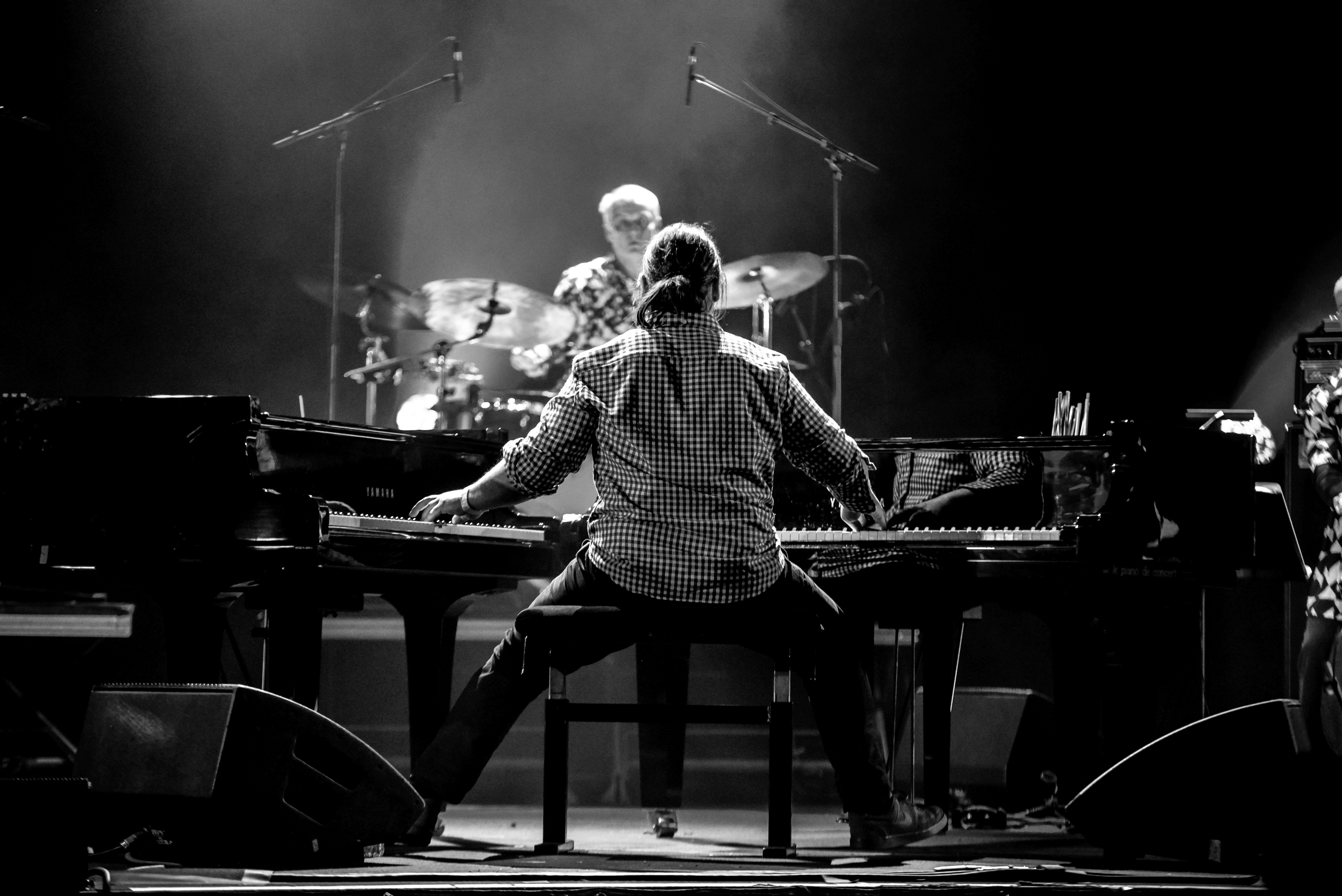
Eventually, I started experimenting with the idea on my own, playing on two pianos. After an initial trio work session (with Nicolas Mahieux and Charles Duytschaever), I had the idea of preparing the piano and then progressively unpreparing it (see the YouTube video), and I suddenly realized the almost infinite possibilities this opened up. I decided to push as far as possible everything that could emerge from this 13-note motif.
As a reflection of my two hands, I created a doubled orchestra: two drum sets, with bass on one side and guitar on the other, as well as three wind players and three voices. Each musician worked with a deliberately minimal amount of material.
All these very “practical” considerations gradually resonated with deeper questions. Little by little, the record became an almost allegorical proposition for me. I brought together musicians with whom I’ve worked for a long time, people who accompany me and embody the different artistic dimensions that inspire me: Nicolas Mahieux and Charles Duytschaever (Jérémie Ternoy Trio), Peter Orins and Ivann Cruz (TOC), Kristof Hiriart and Vianney Desplantes (Organik Orkeztra), Maryline and Christian Pruvost, Sakina Abdou — with whom I’ve shared musical experiences for more than twenty years (Vazytouille, Zoone Libre) — as well as Sarah Butruille (Conservatoire de Tourcoing). It felt almost like gathering my family together.
That is the version I ultimately recorded.
[Read our Sakina Abdou interview]
How did a minimalist mindset possibly inform the creative process?
I love silence and stillness. I find a kind of inner peace in simply observing. To me, looking at a space — even an empty one — reveals precisely that true stillness is impossible. You may feel as though nothing is happening, but in reality something is always happening: time is passing.
So the challenge simply becomes making that temporality exist.
I don’t know if that is truly minimalism, but I’ve always found it fascinating to observe almost anything: given enough time, you begin to perceive an infinity of things within it … That is what I personally associate with the idea of minimalism.