Part 2
Do you like to set yourself limitations? If so, which were some of those limitations for the new pieces?
I don’t really think in terms of limitations, but rather in terms of constraints.
When I was younger, I was a huge fan of comic books, especially Schuiten and Peeters … One day, I realized that their comic Nogegon was a palindrome. I had read it ten times without noticing that every image mirrored another one …
CCPLM has nothing directly to do with that, but it does use very simple processes that listeners do not necessarily need to perceive consciously in order to experience the piece, even though those processes deeply structure its narrative. I don’t really think in terms of formal restrictions; rather, constraints allow me to dig deeper and find the core of a piece.
I divided the work into three sections. The first uses only a motif of thirteen sixteenth-notes, the second is built around a riff in 13/4, and the third functions as a superimposition of the first two. Some musicians end up playing only two notes, and as for me, I use only two formulas throughout the fifty-minute duration of the piece.
Thanks to sampling and digital synthesis, there are endless possibilities for sculpting the sounds and overall sound design of a piece or album. What are your considerations in this regard?
I have a very acoustic approach to all of this. I’m more interested in the possibilities offered by sound capture and studio time as a space for invention, but still within the framework of a live recording process. I use very few machines …
But for the live version of CCPLM, I wanted to propose a form that differed from the traditional concert format. Together with one of my longtime collaborators, Alexandre Noclain, we worked on developing a computer program that would allow me to perform the orchestra virtually. I hesitated for a long time before diving into it, but the prospect of creating something meaningful pushed me to go through with it.
In CCPLM, the compositional system is actually very simple. Each instrument has one, two, or three motifs that evolve throughout the piece while always following the same protocol. Each musician is assigned one to three notes from my original source motif and shifts them by a sixteenth-note value according to a given cycle.
The orchestra is conceived as an extension — or an augmentation — of the piano, since it first merges with the piano before gradually taking on a life of its own. Because of that, it became possible to imagine a simple system that I could control while playing.
So on stage, I control the ten musicians with my feet, triggering and shifting them in real time. We first sampled all the musicians, and then Alexandre created this instrument that allows me to interact freely with all these materials while continuing to play my own motifs with both hands … It’s a small challenge in terms of concentration, but it’s incredibly stimulating to perform.
Would you say that you approach your creative tools with a minimalist mindset? Or do you need a wide choice of instruments and tools to make music?
I’m not obsessed with minimalism as a style. I think I have a certain sensitivity to that idea, but without being exclusively attached to it.
My background is that of a jazz musician who gradually evolved toward different forms of writing … I think that’s where my attachment to a certain kind of simplicity comes from. I love acoustic sound, and I’m fortunate to work with musicians who explore the full sonic palette of their instruments. I love the idea of starting from the acoustic nature of an instrument and extracting the widest possible range of sounds from it.
So in reality, I use relatively few tools, but I try to explore them as deeply as possible.
What were some of the most important pieces of gear or instruments for this release?
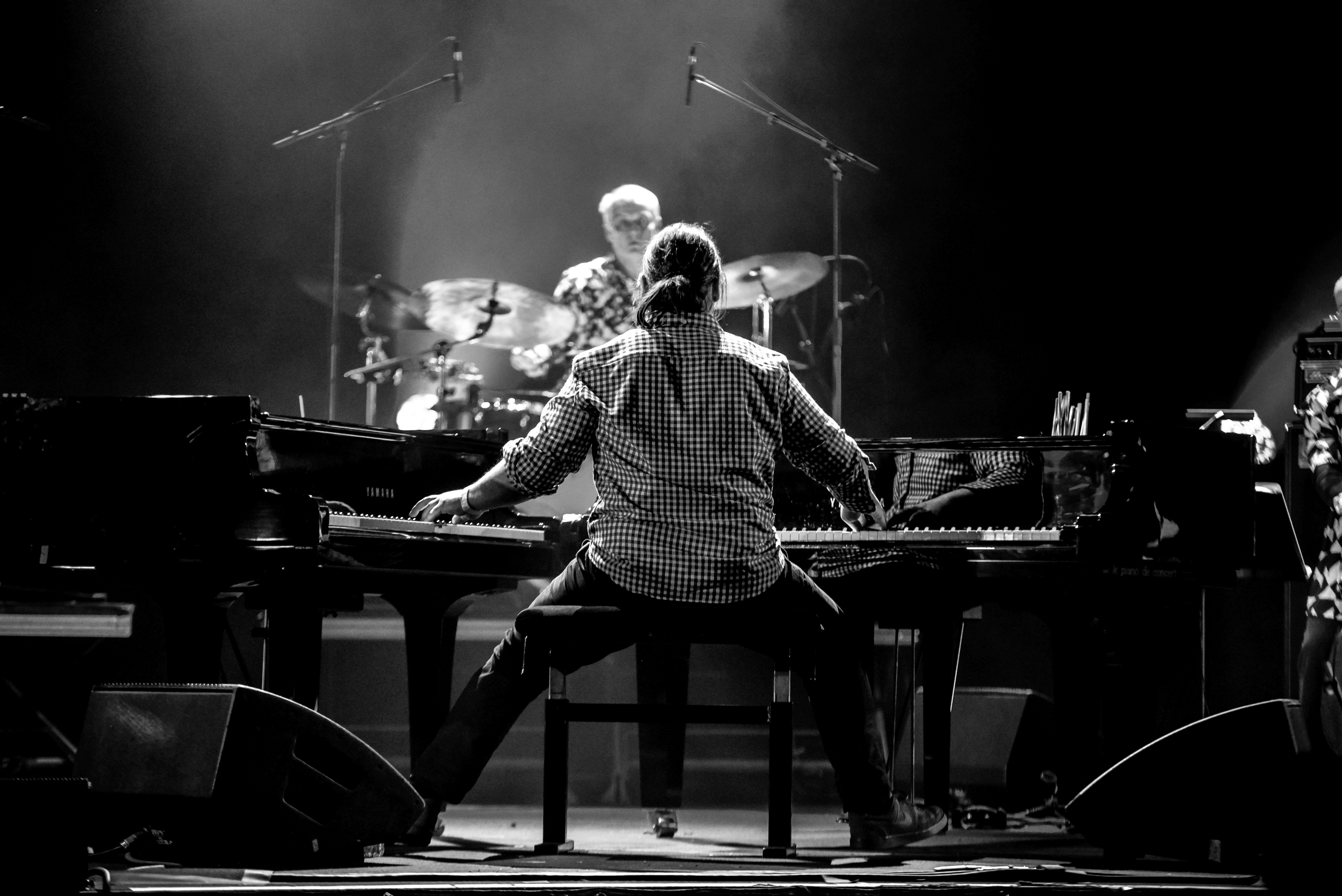
Nothing particularly complex was used, apart from two pianos. Everything else came out of a very traditional recording process.
After the recording sessions, which were carried out by Alexandre Noclain, we handed the tapes over to Philippe Teissier du Cros for mixing. He’s someone with a very strong artistic point of view, and that is precisely what I was looking for.
Of course, I already had a fairly clear idea of what I wanted, but at the same time I wanted things to escape me a little during that phase. He mixed the album through his own ears, with certain choices that surprised me, but that’s exactly why I entrusted him with it.
I knew he would take the music somewhere slightly different from where I would have taken it myself, and I find it important to know when to let go.
Reducing one's options and techniques often implies a different way of working with the materials. Tell me about yours, please.
While working on CCPLM, I was confronted with a very practical question: how do you continuously play the same thing while the piano is progressively being unprepared?
I tried several ideas, and eventually, while working with Sakina Abdou — who, besides being an extraordinarily talented saxophonist, is also a visual artist — we developed an almost sculptural way of approaching this question.
During her years at the Beaux-Arts school in Tourcoing, Sakina created two singular works that deeply affected me. The first was a sculpture in which two saxophones, connected through a system of strings and wooden rods, allowed each performer to activate the other person’s instrument. It was beautiful, but it also already raised questions about musical gesture and constraint.
Another work, in which I was personally involved, used two pianos and two pianists, while Sakina acted through a system of strings as a constraining force on our musical gestures. By working together on the question of piano de-preparation, we designed a system of weights and counterbalances that gradually and mechanically removes the piano preparation over time.
The version I perform on stage today is quite particular because I’m alone with this rather spectacular installation, which acts autonomously on the piano. Thanks to Alexandre Noclain’s work, I also perform every instrument through a MIDI controller. Each instrument was sampled, allowing me to diffuse and spatialize them through an octophonic sound system. The audience is free to move around the space, almost as if they were inside an art exhibition.
So in this case, a rather paradoxical reversal occurred: in the pursuit of musical “minimalism,” and in order to fully push this idea to its limits, I ultimately created a system that “augments” the piano and transforms the live experience into something that belongs as much to performance art as to musical concert.
French producer Guillaume Duchastel told me: “Minimalism is about more than owning fewer things. It’s about focusing on what truly matters.” What are some of your strategies for separating what matters from that which doesn't?
I think it’s the test of time. With patience, what truly matters eventually imposes itself naturally. Of course, it’s not magical, but I realized that every decision I made while shaping this project ultimately came from asking myself what was capable of remaining in memory.
I was both very dogmatic in my approach and, at the same time, simply attentive to my own sensations, trusting that time itself would do its work. And that by accepting temporality — by accepting to live within this tension that constantly longs for change — a space can begin to appear.
With so much incredible music instantly available, are you finding that you want to take it all in – or that you need to be more selective? How do you pick the music you really want to invest in?
In general, it’s human encounters that guide my listening choices …
When I was in high school, I was sixteen, and together with some friends we created a radio show. Every Saturday evening, we would gather at “Radio Banquise” in Isbergues, in northern France, and spend the night broadcasting music — for the listeners, but also for ourselves. Everyone would arrive with records they had discovered during the week, and I think it was during those years that I built a large part of my musical culture … from Arvo Pärt to Nana Vasconcelos, from Corsican polyphonies to Bernard Lubat.
I’ve kept that same way of functioning ever since: when I work with someone, it’s often through that person that I discover their artistic world and the music orbiting around it.
As a result, it’s actually quite rare for me to use the internet as a field of research. I need music to come through something alive. Either I discover an artist in concert, or someone talks to me about them, or even better: I get to play their music.
That’s how I discovered Moondog, for example, through a choir in which we were performing one of his canons …
Would you say that minimalism extends into other parts of your life as well?
I would like it to, but the truth is that unfortunately it doesn’t really.
In my relationship to time, perhaps yes — but materially speaking, although I aspire to a greater sense of simplicity and clarity, it’s not so easy in the modern world …