

Name: Jesus Is The Path To Heaven
Members: Jordan Hoban, Zach Jordan, Thommy Underhill
Interviewee: Jordan Hoban
Nationality: American
Current release: Jesus Is The Path To Heaven's new album Power ! is out now.
Recommendation for Boston, USA: If you’re in Boston, I’d recommend leaving.
Things I am passionate about but rarely get to talk about: Ask me about the Brontë children sometime.
If you enjoyed this Jesus Is The Path To Heaven interview and would like to stay up to date on the band and theiir work, visit their official homepage. The group are also on Facebook, and bandcamp.
When the first time you noticed you were drawn to darker themes and moods in music, literature or the movies?
As a kid, I was drawn to songs in a minor key. Of course, back then I wouldn’t have recognized it as a minor scale, but the mood of it, whatever weather it created, was a refreshing contrast to the overwhelming positivity of the contemporary Christian music that filled my childhood.
However, the lyrics of that Christian music leaned dark, with open references to death and the torture. In a very concrete way, my first introduction to the dark, earthy themes of mortality and violence came from the Bible.
“Darkness” is, of course, not strictly speaking a term related to sound. What constitutes darkness to you, especially in instrumental terms?
It’s easy to reduce sonic weather-patterns to a question of scales. I write in C for my voice and transpose up or down to new keys to keep each track feeling refreshed, which means I tend to fall into A Minor for a descending motion, the sense of falling, the sense of darkness.
But, as many of my favorite artists have taught me, true darkness is about a contrast between themes both sonic and lyrical. If my band, Jesus is the Path to Heaven, released an instrumental record, our name would act as a striking contrast to whatever sounds we created and lend an interpretation to the material for the listener that is all their own.
There’s a holistic approach to working thematically that illuminates themes through contrasting tones, lyrics or imagery.
How would you describe the physical sensation and possible attraction of being exposed to darkness in music?
It’s validating.
Does your interest in darker musical themes extend into extra-musical fields such as fashion, or politics?
I’d imagine it does, although I’m not sure what a darker politics would look like. So let’s nix that, as the darkest political threat in the world is currently spreading itself across the oceans from the central point of Washington, DC, US.
I’m fascinated by the connection between religion and the political Right in America (and, I’d argue, in most of the West; UK, your street preachers and Falun Gong practitioners are clotting the highstreet), but I’m not drawn to participate.
Who/what are currently artists, labels or even genres which draw you in because of their darker approaches, aesthetics and sound(s)?
Current 93, Laibach, and Swans will always be my go-to artists. They do exactly what I explained above, by allowing the sonic-weather of their albums to be dependent on a holistic approach to the music.
You could have a perfectly serviceable song in a major key turn, through packaging and lyrics and alternative instrumentation (usually folk instruments; not too alternative to people who have listened to a few folk records, but a staggering obstacle for many listeners), into one of the most subversive compositions.
Artists like David Tibet and Laibach have challenged me to find the root causes of regressive political and social movements within a culture and to expose them. In America, our folk tradition is consistently usurped by political forces, either for the Left or the Right, and doesn’t exist as an uncanny example of a “pagan” past, but instead as a means of dictating the characteristics of what a unified American identity looks like.
I named the band Jesus is the Path to Heaven because the phrase is ubiquitous in the States, something most people from the South East take for granted. But it has authoritarian overtones. It’s scary and, after the Trump elections, it should be properly terrifying.
And, to talk about darkness wrapped in a cozy glow, the new record by Laibach is all positive aphorisms and reassurance, yet nothing feels more sinister than a disembodied voice demanding that “you do you.”
What were some of the first performances or releases when you became active in exploring truly dark places in your music yourself?
Every one of them. My approach to music has always been about emotional release first, conceptualization second.
Jesus is the Path to Heaven is a more pointed way to communicate those emotions to others.
I have had a hard time explaining that listening to death metal calms me down. When you're performing a piece with a darker energy, does it tend to fill you with the same energy or feeling – or are there “paradoxical” effects?
My approach to music differs a little. I grew up during the emo and hardcore movement of the early 2000s and had a lot of disdain for what I recognized as pure performance.
My hope is that when my band goes to those places, when my performance pushes into the “metal” or “hardcore” genres by screaming and barking and whatever else I do, that it hurts people to hear it. Not in terms of decibels or high tones, but in terms of the performance.
I want people to hear another person in pain, like a mouse in a glue trap clawing into itself for freedom, and to recognize that it isn’t a performance.
Tell me, if applicable, about the concrete lyrical themes that you felt drawn to for Power !
The lyrics on our new record, Power !, were designed to follow a specific pattern from concrete descriptions of place on the first track, “The Lord Has Bled a Line”, (1000 miles across the beltway of 40) and into more conceptual, embodied territory by the final track, “Little Lamb”, where an apparent mantra becomes a mode of self-exegesis.
Throughout the entire record, the lyrics explore the violent language of the evangelical church in the States, and reflect that language back to the culture in its favorite packaging of semi-folk americana, a package that can’t contain the emergent destruction within the religious and cultural identity as described.
When it comes to exploring darker themes, what's your approach to writing lyrics? What makes lyrics good in this regard?
I locked myself in a room and wrote the album in a week.
I brought the songs to the band and the band made the songs better.
Exploring darker themes in the music often goes hand in hand with the accompanying artwork. Tell me a bit about this relating to Power !
We were fortunate to work with one of my favorite artists. Emily Warner, out of Virginia had an idea to help the listener understand the themes on the record, especially the use of americana tropes, by commissioning a Grandma Moses style cover, hand painted, where the blood of the lyrics would invade a southern town of an idealized American past.
Emily took to the idea, drafted sketches, patiently listened to me ramble about the album’s themes and its imagery, and she created something better. It’s a proper painting, acrylic on canvas.
I love it so much that I have it hanging up in my bedroom as a reminder that no matter which way the political wind is blowing, there is always an undercurrent of conservative Christianity waiting to bubble up from the ground like oil and drag us socially back to the 1850s. It’s our American heritage.
I would love to know a little about the feedback you've received from listeners or critics about what they thought some of your darker songs are about or the impact it had on them – have there been “misunderstandings” or did you perhaps even gain new “insights?”
The songs are usually not the issue for us, but our name causes a stir. It’s eye-catching to some and repellent to others, and not without consideration. We make music that is meant to challenge the listener, and the first challenge is to come to terms with our name.
We have a lot of people ask if we are ironic or sincere. We’re sincere.
Sharing music on stage can change the way it is experienced, both for musicians and the listeners. Can you talk about this a bit, especially in the light of darker themes?
Jesus is the Path to Heaven has two iterations: the version in the studio is pulling from a variety of musical and literary influences to craft a coherent experience that is adventurous and thoughtful.
Our live shows, however, are pure emotion. Playing live is our chance to drop the pretense of the larger concept of the songs and to lean into their menace and vulnerability.
“Little Lamb”, for example, is our closing track (as it is on the record), and it’s the track that makes fans or it makes enemies. We ask a lot of our audience with that song, but if they sit it out they will experience something that I’m not seeing other AMAB fronted bands present to its listeners: an experience of vulnerable emotions.
Throughout the history of art, there have been artists who did not want to exorcise their demons, afraid they might lose their creative spark. What's your take on that?
An interviewer asked actor Gary Oldman about catharsis in regards to a performance where he was particularly angry. He referred to the process of catharsis as a snowglobe: you can shake it up and the snow flies everywhere, creating momentary chaos, but it always settles back to the ground, never escaping the confines of the globe.
People have attempted to label our performances as cathartic, but, to quote the late David Berman, “this kind of hurtin’ won't heal.”

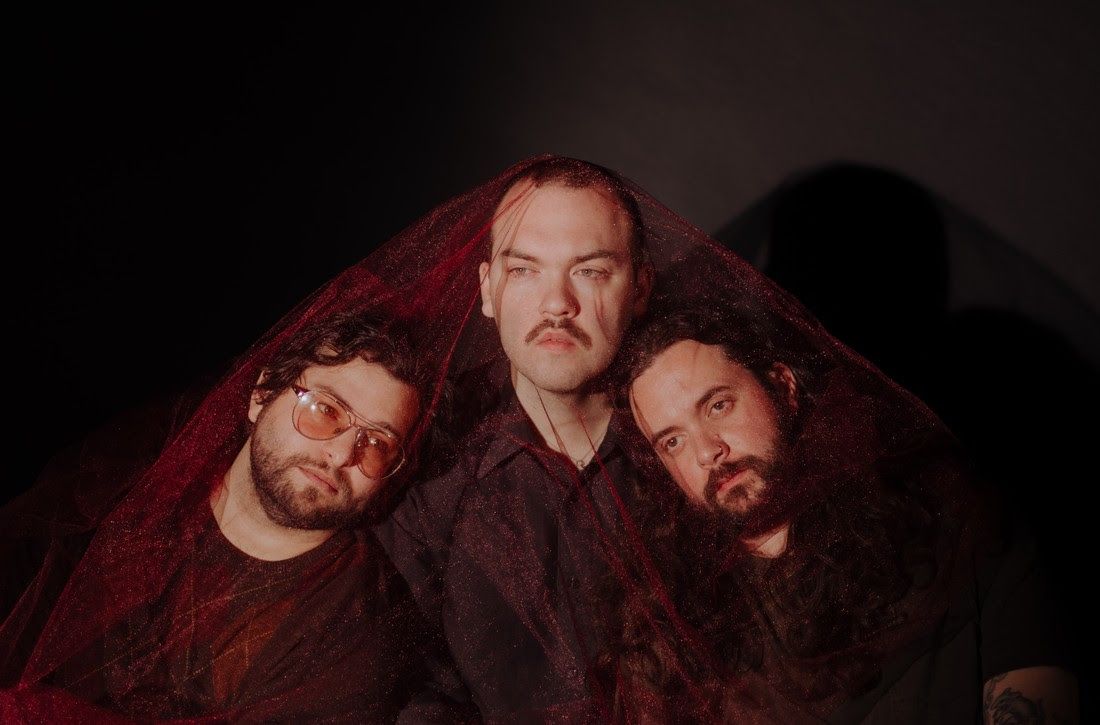 Jesus Is The Path To Heaven Interview Image by Victoria Byers
“We have a lot of people ask if we are ironic or sincere. We’re sincere.”
Video
