Published
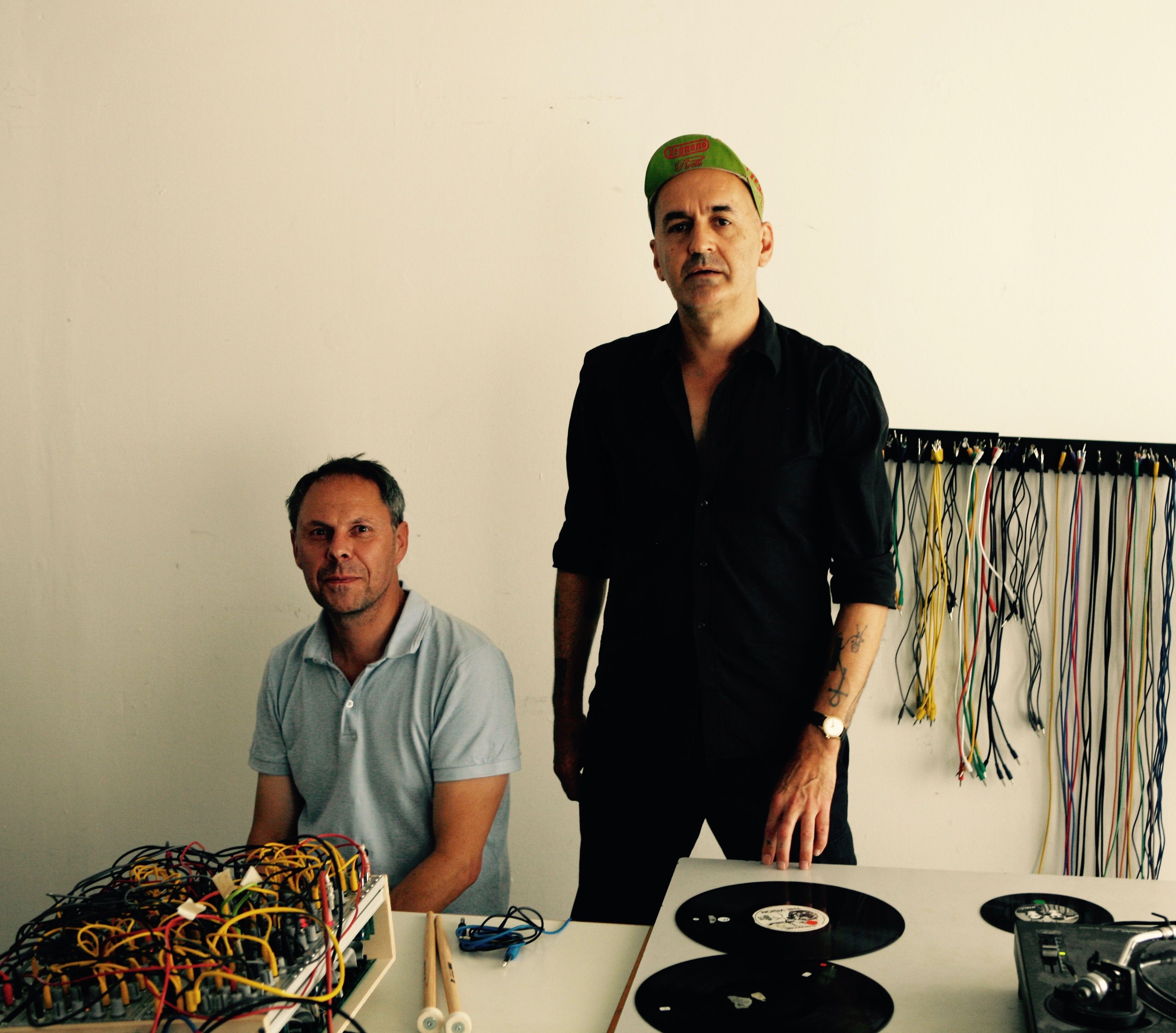
Name: Joke Lanz, Thomas Rehnert
Nationality: German (Thomas Rehnert), Swiss (Joke Lanz)
Recent release: Joke and Thomas team up for Combination Without Repetition, out via Dumpf Edition.
Recommendations on the topic of sound:
TR: Helmholtz: On the Sensations of Tone, Iannis Xenakis: Formalized Music, Derek Bailey: Improvisation: Its Nature and Practice in Music
JL: R. Murray Schafer (The Tuning of The World), William S. Burroughs (The Electronic Revolution), Robert Schneider (Schlafes Bruder), New York Times (article about "Cairo: A City Where You Can’t Hear Yourself Scream”)
If you enjoyed this interview with Joke Lanz and Thomas Rehnert and would like to know more about their music, visit Joke on Instagram, and bandcamp; Thomas has an official homepage.
For a deeper dive, read our earlier Joke Lanz interview. For the views of some of his collaborators, read our Dave Phillips interview, Jason Kahn interview, Ute Wassermann interview, Lasse Marhaug interview, and Sakina Abdou interview.
When I listen to music, I see shapes, objects and colours. What happens in your body when you're listening? Do you listen with your eyes open or closed?
JL: I listen to music in an intuitive way. The sound arrives directly in my inner psyche and evokes all sorts of emotional states. If the music is intense it automatically touches my abstract thinking, my memories, my inner monologue and my immediate existence. I literally suck the music into my whole body through my pores.
My eyes are open and my mind is hungry.
TR: When I listen to music and especially when I play it, I always manage to lower my stress level and release happiness hormones.
How do listening with headphones and listening through a stereo system change your experience of sound and music?
JL: Listening to music with good headphones is almost a claustrophobic experience for me, a complete confrontation with the sound. It can be a huge adventure in terms of sound quality and clarity. Something like an ecstatic cleansing of your sound perception.
But for some reason I prefer to listen to music through a decent stereo system in which I feel more open and more grounded with the earth.
TR: Stereophony is the desire for realistic, three-dimensional spatial representation. Just as all machines are an extension and projection of our body, our electro-acoustic instruments are part of an extension of our senses.
In my own live work, I prefer mono or two-tone transmission.
Tell me about some of the albums or artists that you love specifically for their sound, please.
JL: I really love Trevor Wishart’s album Red Bird from 1977, a 45-minutes piece of musique concrete. It’s mainly made of bird sounds, body sounds and selected mouthed words. It has a strong cinematic approach to audio and sound morphing.
Another great album regarding sound and production is Out Of The Blue by Electric Light Orchestra, funnily also recorded in 1977.
Productions by Roli Mosimann (Wiseblood, The Young Gods) and Steve Albini (Big Black, Shellack, Nirvana, Whitehouse) are definitely at the top of my list.
[Read our Young Gods interview]
TR: "Produced by Conny Plank" Kraftwerk, Neu!, La Düsseldorf, Kluster, Ash Ra Tempel, Brian Eno, Can, Ultravox, DAF, Devo.
Brian Wilson: Pet Sounds, Iannis Xenakis “Electroacoustic Works”
[Read our Michael Rother of Neu! Interview]
[Read our Michael Rother interview about improvisation]
[Read our Hans-Joachim Roedelius of Kluster interview]
[Read our Roedelius interview about Ego as an Energy]
[Read our Roedelius interview about Collaboration]
[Read our Manuel Göttsching of Ash Ra Tempel interview]
[Read our Brian Eno interview]
Do you experience strong emotional responses towards certain sounds? If so, what kind of sounds are these and do you have an explanation about the reasons for these responses?
JL: I think it totally depends how you put the sounds together into a composition or a line of sounds and noises.
But generally I experience emotional responses when I listen to body sounds, low frequency sounds and some minimal music patterns.
There can be sounds which feel highly irritating to us and then there are others we could gladly listen to for hours. Do you have examples for either one or both of these?
JL: Well, the majority of mainstream pop music feels highly irritating to me. There are exceptions but in most cases these tunes are simply designed for mass stultification. In contrast, I can listen to birdsong or the sound of raindrops for hours and hours.
TR: I can listen to the sound of the sea for hours. I also like the sound at large train stations. I like to hear the sound of bells on cow pastures in the mountains.
Are there everyday places, spaces, or devices which intrigue you by the way they sound? Which are these?
JL: Train stations, churches, mountains, La Monte Young's dream house
TR: For example, when listening to my percussion instruments, there are moments of resonance with the environment. These moments of resonance can have a transformative character - if you can get involved with hem.
Have you ever been in spaces with extreme sonic characteristics, such as anechoic chambers or caves? What was the experience like?
JL: I’ve only been once inside an anechoic chamber. It is very fascinating, but personally I felt a bit claustrophobic in there.
TR: The sounds in caves that I love most are the resulting cacophony of splashing, gurgling, popping water ...
What are among your favourite spaces to record and play your music?
JL: There are many cool studios and venues to record music and play live. Some of my favourites are Martin Siewert’s studio in Vienna, studio Wong Berlin, Cave12 Geneva, Instants Chavirés Montreuil, Soup Tokyo, Exchange Bristol, A4 Bratislava, Punctum Prague, Echoraum Vienna, KM28 Berlin.
[Read our klingt.collective interview, a project featuring Martin Siewert]
Do music and sound feel “material” to you? Does working with sound feel like you're sculpting or shaping something?
JL: No. I see music more as a living being that should be stroked and hugged. Sounds are like small organisms which can be melted together in order to create something new.
TR: I'm interested in contrasts in music: objectives and auditory experience, our perception of time and a felt pulsation, our inner self and the outer world.
How important is sound for our overall well-being and in how far do you feel the "acoustic health" of a society or environment is reflective of its overall health?
JL: It’s very important!
But acoustic health is very subjective. Every human being reacts differently to sounds and music. Many people find certain sounds and certain music as disturbing. To other it can be a healing and therapeutical experience.
Sound, song, and rhythm are all around us, from animal noises to the waves of the ocean. What, if any, are some of the most moving experiences you've had with these non-human-made sounds?
JL: As a child I once spent a holiday in the Swiss mountains with my mum. It was sometime in the late 70s. We were in Zermatt at the foot of the famous Matterhorn. One night, an avalanche came right down to the edge of the village. I will never forget the deep rumble and the intensity of the sound.
Another extreme experience was a typhoon of the highest category in Hong Kong during my stay in 2008. The entire city and the airport were closed. Rubbish bins flew through the air and the wind whistled through the city’s skyscrapers at tremendous speed creating some stunning tone sequences.
TR: The croaking of frogs. The blackbird is an excellent singer. The voices of cicadas, grasshoppers, and crickets.
Many animals communicate through sound. Based either on experience or intuition, do you feel as though interspecies communication is possible and important? Is there a creative element to it, would you say?
JL: Since almost 10 years I share a dog with my partner. I can definitely say that interspecies communication is possible.
Dogs are listening, observing and studying every word and sound humans make and they are capable to read our moods. It is a mutual exchange and process.
Our last dog Mika expressed himself very often with sounds, e.g. whining, grumbling, howling and even some sort of singing. Especially in the morning Mika performed regular chants with certain harmonies and structures. There is definitely a creative element in this communication.
TR: Yes, for example, bird brains synchronize when singing duets. And there are many forms of deception and manipulation in the animal kingdom, from insects to primates.
Tinnitus and developing hyperacusis are very real risks for anyone working with sound. Do you take precautions in this regard and if you're suffering from these or similar issues – how do you cope with them?
JL: Unfortunately I never took precautions in my earlier years. This was a mistake. I regret it.
I have been suffering from a mild tinnitus for a few years now. There are days when it is worse and days when I can hardly hear it. As I mentioned before, I don’t like wearing headphones because then I’m directly exposed to the sound. But ear protection became mandatory for me during loud concerts and projects.
We can surround us with sound every second of the day. The great pianist Glenn Gould even considered this the ultimate delight. How do you see that yourself and what importance does silence hold?
JL: Silence is bliss! Glenn Gould probably meant to surround himself with the music of Johann Sebastian Bach every minute of the day.
Honestly I think in our modern and hectic times silence has become a precious thing. Most people are afraid of silence. For them, silence means death. People surround themselves with all kinds of acoustic and visual stimuli and distractions, e.g. gaming, social media, radio, music, television etc. Silence is just as powerful as noise.
A musical composition is a beautiful thing but it can only really unfold when silence is included and becomes a part of it.
By the way: I like plants a lot. They don’t make any noise!
TR: For me, silence is the absence of the background noise of the modern world.
Being in extreme silence has an interesting effect. Without distracting sound, your body becomes a sound field.
Seth S. Horowitz called hearing the “universal sense” and emphasised that it was more precise and faster than any of our other senses, including vision. How would our world be different if we paid less attention to looks and listened more instead?
JL: That’s an interesting question. Hard to say if the world would be different or even a better place if we’d pay more attention to listening and hearing. But certain acoustic embellishments would certainly contribute to a better atmosphere.
In Taipei (Taiwan) for example, garbage trucks announce their arrival with the melody “Für Elise” by Ludwig van Beethoven. I think that’s great!
TR: Humans also see with their ears and probably hear with their eyes, and the sense of language influences both.