Published
Name: Jordan Sand
Nationality: American, Norway-based
Occupation: Double bass player, composer, improviser, vocalist
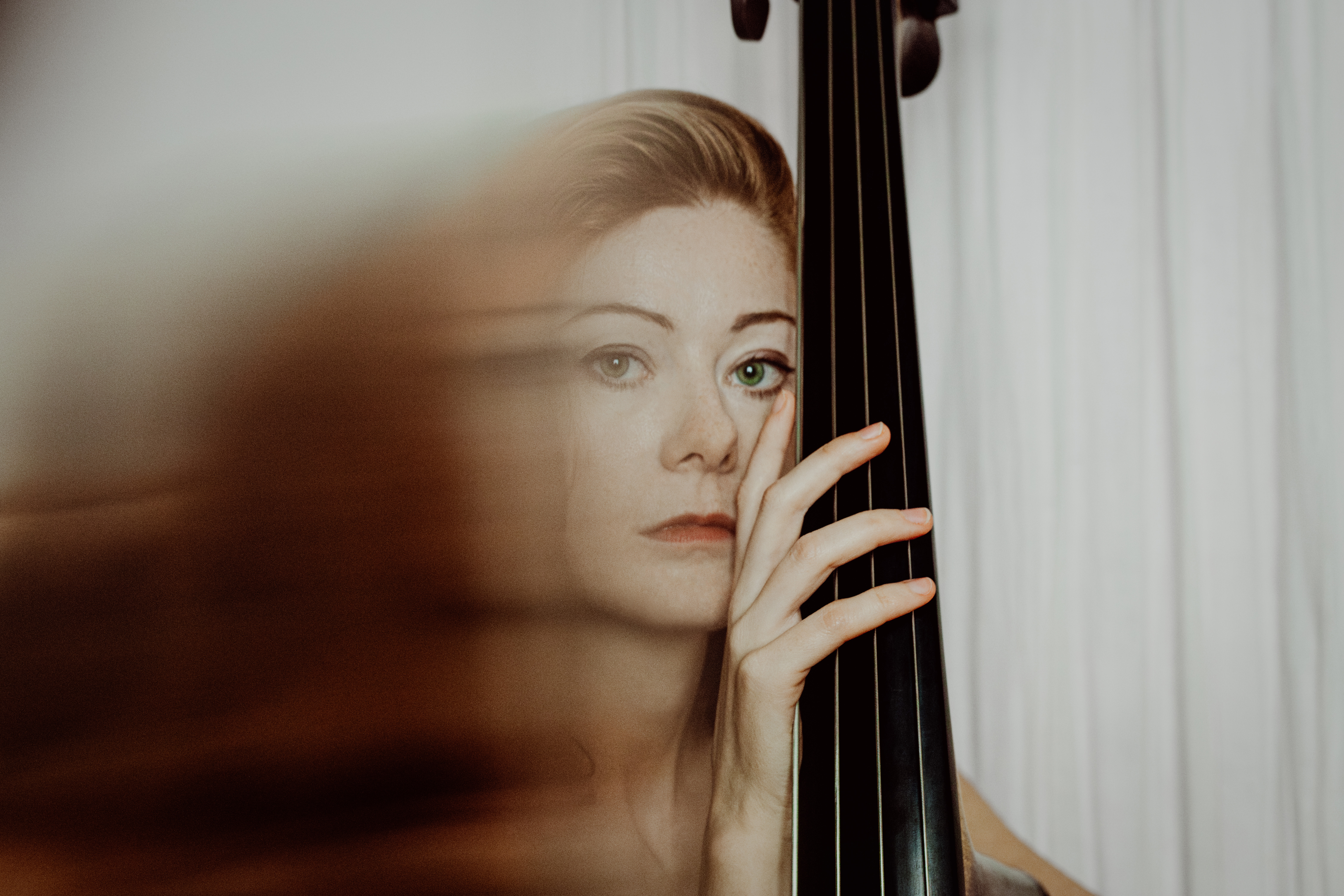
Current release: Jordan Sand's new album Baby Ghost is out via Hallow Ground.
Current event: As part of her European tour, Jordan Sand will perform at Eternal Series in London on 6th November 2026. For more information and tickets, go here.
If you enjoyed this Jordan Sand interview and would like to know more about her music and upcoming live dates, visit her official homepage. She is also on Instagram, Facebook, and Soundcloud.
There was a long phase where you couldn't listen to music. I actually had the same, still, I never considered stopping which seems paradoxical looking back. What was this like for you: Did those feelings fundamentally question your involvement in music?
Absolutely. Actually there hasn’t been a day since where I don’t fundamentally question my involvement in music.
Doubt can be fruitful in some doses, for that reason I allow it place. For context, the time period in question was 2020. I’d just uprooted my life and moved alone to Norway in January.
It was a great bid of faith of course, no one could have seen what was coming.
The press release mentions that listening to or playing music could even be "enraging" – how did this manifest itself?
Music void of its social and connective context at that time was simply put, overstimulating. Overstimulation can provoke such feelings in a neurodivergent brain. This was the case for me during that unprecedented year.
My threshold for processing emotional and sensory stimuli dropped sharply and suddenly. I needed to listen instead to the water gurgling in the roof gutters of my apartment. Sparrows. Watch the sun moving and talk to strangers at grocery stores.
What were some of the things you possibly did about this disinterest and rage? Was there anything that proved to be helpful?
I did nothing really. I let music go.
It was a tenable loss at the time, and it helped.
I would imagine that an unused double bass standing in your room is a looming and almost accusing presence if you don't want to use it. Did the thought of switching instruments ever enter your mind?
On the contrary. My particular double bass is a calming presence in the room. It lives its own life somehow. Does not pressure me. There’s been so much movement and change in life, but this instrument has been a beloved constant, whether sounding or still.
When I need a change, I turn to violin, piano, field recording, old drum machines, broken mandolins, etc. But I always come back to this bass. What a being.
How did moving to an isolated space change the situation?
The isolated space caused the situation.
It was the isolation of lock downs in a new country that catalyzed these changes in my listening and my work.
How and when did your interest in – and potentially love for - music come back?
A slippery moment to pinpoint. Perhaps it waxes and wanes still.
Some days I can’t stand to hear anything, others I have a joyful appetite for all sounds and shapes one could possibly propose. Maybe that’s normal for a musician, journalist, sound artist, anyone working critically and creatively with their ears.
Our muscle expands and contracts, needs rest. Needs emptiness.
There is a story of a great chess master who, after being exposed to the horrors of WWII, forgot how to play. He had to relearn everything, but became an excellent player again. I was wondering, especially seeing the album also deals with life and death, if your new creativity feels less like a return but a new beginning?
You’re speaking of trauma, and the slow healing process of reclaiming oneself, re-inhabiting the markers of oneself afterwards.
My faculties did break down so significantly that the evocation of new beginning, or rebirth, might be accurate. But it was so slow … the rebirth was harder to perceive than the collapse.
Musically speaking, what happened over time was more of an intense distillation of the song forms, concepts, characters that had defined my solo work up until that point.
How, would you say, have you changed as a listener and a performer of other people's work?
As a listener now, fewer sounds really catch me, but the ones that do tend to catch me completely, obsessively.
As a performer, I’m unsure. It remains to be seen. I never really returned to my former life as a freelancer and session musician. That version of me is so tied to New York.
But I do think I’ve become a more honest collaborator. I know aesthetically what I can and can’t offer, can better intuit where I belong as a player. I’ve also pivoted toward translating sound and music into the visual world, in film, installation, VR, etc.
Looking back, do you have explanations for this episode?
Not conclusive ones.
To pick up on something mentioned in the press release: What do the bass and the voice have to say to each other?
In ensemble, a bass provides the lowest melody which moves in counterpoint with the highest, which is often voice. The defining characteristic of a great bass line is this point and counterpoint it forms with the voice. Maintaining that hierarchy requires them to differentiate against each other, starkly, in timbre, register, density. Bass usually remains accompanimental.
But what if they circle each other in the same register, similar timbres, fusing and multiplying, without a mind for these typical hierarchies? In other words, without the chordal lunchmeat of an ensemble, each can be the counterpart and extension of the other, the boundaries separating their sounds can blur and there’s something of a composite instrument taking form.
How did an album emerge from that time of exploration?
Many years later, subconsciously, in one fell swoop at a recording studio in Takoma Park, Maryland.
Where did you record the album and how do you see the importance of space and environment on the music that's created in it?
In the case of this record, space and environment boil down to the skill and good graces of a single person: my friend and recording engineer Don Godwin.
We knew each other from the Balkan scene in Brooklyn. He came to a solo show of mine last year in D.C. then all but dragged me into Tonal Park Studio the next day to test out mics. It was a blast, so we scheduled time to come together again and make a record.
Don’s invitation, warmth and enthusiasm, curiosity, micing and re-amping ideas, and excitement about the music spearheaded this record and set the tone for my playing, allowed me total freedom and safety to explore. He was often chasing my downbeat, I was in and out of the zone and rather unpredictable, but he never missed a take. He’s that kind of attuned.
Don is now the audio engineer at Smithsonian Folkways in Washington D.C.
It seems like words like "improvisation" don't really do justice to the way these pieces came about. Can you give a rough indication of what it felt like?
That’s interesting. Why not? My right hand rests on a holy book and I’ll type with my left.
I went into a studio and improvised about 30 distinct, unscripted and complete musical thoughts. No two were alike, no do-overs of an idea, no plan, no clue, nothing I could articulate as we went along. Nor I could never play any of it again word for word. Listening back, there’s a sense of structure or song form lurking in the free improvisations of Baby Ghost. Did that spark the question?
My live sets also have this pacing, they hint on song cycle. Each idea progresses and concludes, has its own internal organization. But the organization is happening off the cuff, and the feeling is what I imagine a high wire act might feel … harrowing, arresting, total focus. Sometimes it works, sometimes it doesn’t.
Either way the crucial thing is not to lose contact, to relax and have a smidge of faith.
The album deals with themes which some may regard as dark but which are inevitably part of our existence. If it's not too private, can you share some of your conclusions from pondering death?
The only conclusion I might be able to offer here, would be to keep death phrased as a question mark, not a finality. Like standing looking at an open field.