Published
Name: Juan J. Ochoa
Nationality: Spanish
Occupation: Pianist, composer
Current release: Juan J. Ochoa's new album Something to Remember is out via Protomaterial.
If you enjoyed this Juan J. Ochoa interview and would like to know more about his music, visit his official homepage. He is also on Instagram, Facebook, and bandcamp.
When I listen to music, I see shapes, objects and colours. What happens in your body when you're listening?
I usually say that my music is quite physical, in a way that you have to feel it in your body. I guess, that is why they say it is very suitable for dance.
Hence, when I listen to music, I need to have the same sensation. It has to move me, not only emotionally, but also physically.
Do you listen with your eyes open or closed?
Open.
How do listening with headphones and listening through a stereo system change your experience of sound and music?
I guess, it changes in relation to myself.
With headphones is a more introspective and lonely experience. Listening through a stereo system, I am more aware of the space, the acoustics and all the things happening around me.
Tell me about some of the albums or artists that you love specifically for their sound, please.
That's quite an stimulating question:
The use of nuances in the voice of Sandrine Piau or Veronique Gens, the pianism of Daniil Trifonov or the electronic soundscapes of Moderat, Alva Noto or William Orbit.
[Read our Alva Noto interview]
Do you experience strong emotional responses towards certain sounds? If so, what kind of sounds are these and do you have an explanation about the reasons for these responses?
I am very keen of the kind of effects when there is a subtle and long crescendo on the same note, and it changess timbre throughout. It always touches my soul somehow, I can't explain why.
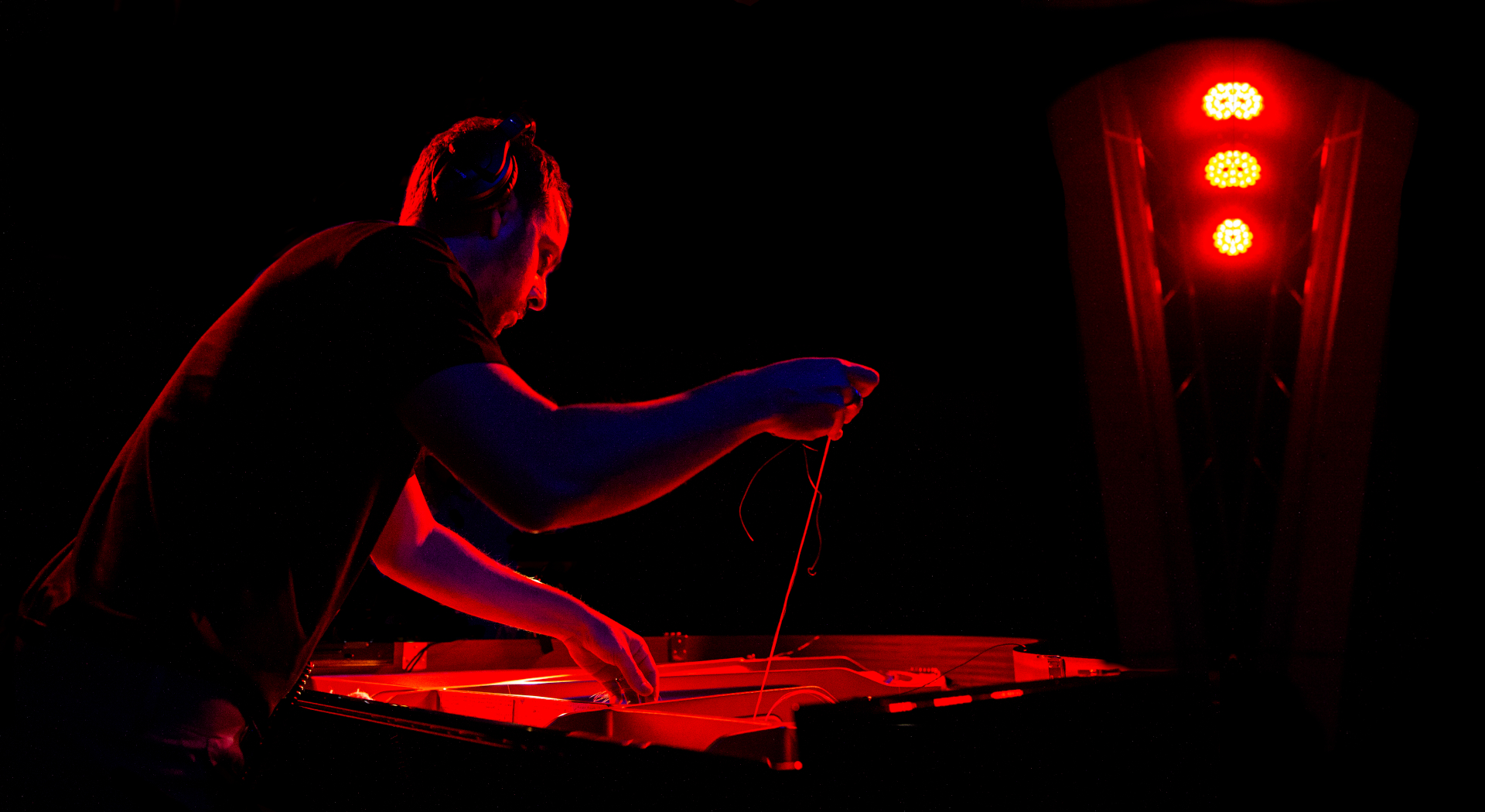
Also, the sounds that I produce with my prepared piano. There is always some mystical and profound experience in discovering new sounds coming from the inside of the instrument.
There can be sounds which feel highly irritating to us and then there are others we could gladly listen to for hours. Do you have examples for either one or both of these?
As John Cage said … everything is music.
Are there everyday places, spaces, or devices which intrigue you by the way they sound? Which are these?
Under a bridge.
I love the unespected ways of how the sounds are reflected though the bow.
Have you ever been in spaces with extreme sonic characteristics, such as anechoic chambers or caves? What was the experience like?
Yes, indeed. I went to an anechoic chamber once as I wanted to experience what John Cage felt, before he composed his piece 4.33.
I didn't really hear my nervous system as he apparently did, but somehow I felt his presence and legacy.
What are among your favourite spaces to record and play your music?
My studio, in the privacy of my place.
Do music and sound feel “material” to you? Does working with sound feel like you're sculpting or shaping something?
Abolutely!
ince some of my practice is very related to the piano and its physical sound possibilities, the way I play and discover new sounds has a lot in common with modeling with clay or sculpting marble to bring out the shape underneath.
How important is sound for our overall well-being and in how far do you feel the "acoustic health" of a society or environment is reflective of its overall health?
I guess, it depends on our background and culture.
I am a Spaniard, and here, we tend to be quite noisy and there is not much space for silence. In general, we live in a moment where silence seems to be a luxury.
Sound, song, and rhythm are all around us, from animal noises to the waves of the ocean. What, if any, are some of the most moving experiences you've had with these non-human-made sounds?
I don't know if I would call it 'moving', but definitely relevant: The sound of a fox.
I don't know if you ever heard one, but the first time I did, a had never heard something like that in my life. It was at night, in my back garden in London, and I was terrified as I didn't know what it was. The day after, all my flatmates were very normal about it, as it is a very common thing in London.
From that experience, I realised how powerful a sound can be when you are not able to identify it. It's just rare that these things happen in our everyday life when living in big cities.
Many animals communicate through sound. Based either on experience or intuition, do you feel as though interspecies communication is possible and important? Is there a creative element to it, would you say?
If animals and plants could comunicate with us, they would probably tell us off for all what we are doing to them ...
Tinnitus and developing hyperacusis are very real risks for anyone working with sound. Do you take precautions in this regard and if you're suffering from these or similar issues – how do you cope with them?
I try to be cautions with that, not to listen very much with headphones, and being careful with volumes, etc ...
We can surround us with sound every second of the day. The great pianist Glenn Gould even considered this the ultimate delight. How do you see that yourself and what importance does silence hold?
As a composer, I need to listen to silence to create music.
You have to be sure that whatever you are going to play or compose is really worth breaking it.
Seth S. Horowitz called hearing the “universal sense” and emphasised that it was more precise and faster than any of our other senses, including vision. How would our world be different if we paid less attention to looks and listened more instead?
I don't know how different if would be, but perhaps more peaceful.