Published
Name: Julius Schwing
Nationality: Australian
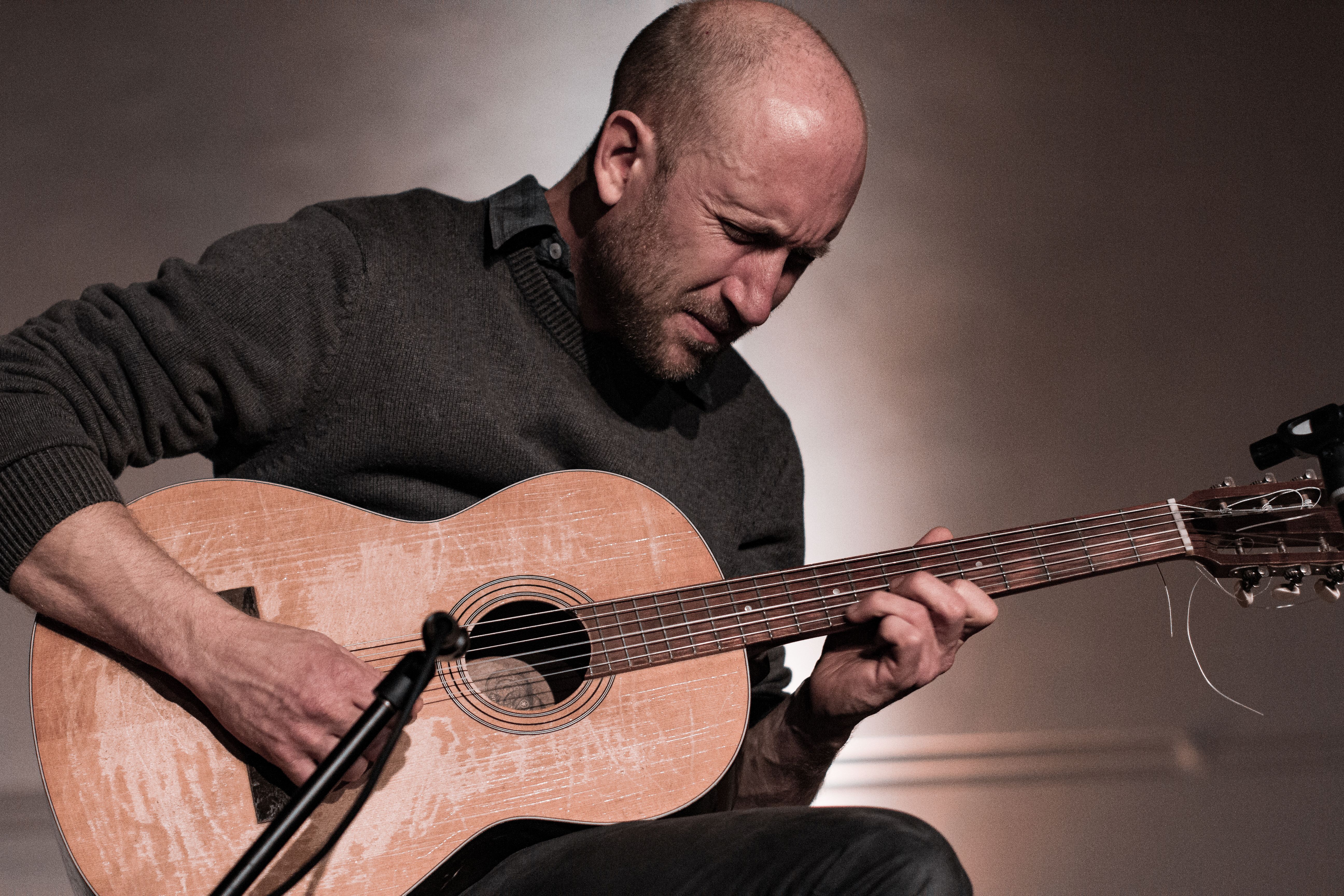
Occupation: Guitarist, composer, improviser
Current release: Julius Schwing's new album Forest is out via Isthmus.
Hometown Recommendations: Fluted Cape on Bruny Island.
Things that I am passionate about but rarely get to talk about: This thing called nature …! I believe spending time outside and amongst the natural world is incredibly healthy for all aspects of life. Immersion in the natural world is where it’s at!
I have no major hobbies but I do enjoy most things to do with the ocean.. bodyboarding, skin diving, fishing. I enjoy working with my hands, driving my tractor and splitting wood. If I had another lifetime I’d probably build guitars, and I think I might become a bird watcher when I’m older.
If you enjoyed this Julius Schwing interview and would like to stay up to date with his music, visit his official homepage. He is also on Instagram, Facebook, and bandcamp.
When did you first consciously start getting interested in musical improvisation? What was your first improvisation on stage or in the studio and what was the experience like?
I started improvising at home as a young teenager. I think it is a pretty intrinsic aspect of learning guitar, the constant noodling and exploring. This can be sharpened into a more focussed way though.
My dad who is an actor and theatre maker would come to my room and give me little scenes to play. “Play me an elephant walking down the main road” or something like that, and off I’d go. He made his theatre shows by improvising for weeks with his director, filming it, and then chiselling out the final flow from the collected footage.
I think that process rubbed off on me very early and improvising has been at the centre of my playing ever since.
Tell me about your instrument and/or tools, please. What made you seek it out, what makes it “your” instrument, and what are some of the most important aspects of playing it?
My instrument is the guitar. At the age of 9 my parents suggested I give it a go and it came to me very naturally. My first teacher was a local here on Bruny island, he taught me the blues and for a couple of years that is all we would do in our lessons, jam on the blues.
What makes it “my” instrument is probably the sheer amount of time I have spent playing it and thinking about it. I love the physicality and tactile nature of playing the guitar and the infinite ways of playing any given note.
The expressive qualities of the guitar are very deep, it has so many colours and sound qualities and so many ways of approaching it as a player. It is a world that just keeps opening up more and more.
How would you describe your own relationship with your instrument – is it an extension of your self/body, a partner and companion, a creative catalyst, a challenge to be overcome, something else entirely?
All of the above plus roller coaster. Playing the guitar is certainly something I cannot live happily without and it’s part of my everyday fabric now.
It is my access point into music and the most direct link I have to expressing myself through sound.
Derek Bailey defined improvising as the search for material which is endlessly transformable. What kind of materials have turned to be particularly transformable and stimulating for you?
The basics.
I feel like all materials are transformable but I am most attracted to the fundamental aspects of music and the guitar, such as coordination, pulse, melodic shape, harmony, timbre etc. Every time I spend time practicing something at a fundamental level my awareness and ability to hear and execute new sounds increases.
I believe that if I have a firm grasp of the fundamentals I can then aquaplane across the top of them, pushing and pulling and twisting and turning while still feeling an underlying ground. I love to sometimes pull away completely from these fundamentals and explore another layer, but I feel like I can only pull away from things if I know them well. Basically, the deeper I know something the further away from it I can get.
All the pieces on my new album “Forest” dig into this idea, especially tracks such as “Pillars”, “Walking, thinking, listening” or “Rush hour.”
They all have very basic elements of pulse or harmony that are veiled in layers of exploratory and spontaneous textures.
Do you feel as though there are at least elements of composition and improvisation which are entirely unique to each? Based on your own work or maybe performances or recordings by other artists, do you feel that there are results which could only have happened through one of them?
Tricky. For me they are completely different, yet both have their own freedoms and opportunities.
The two can cross over of course, but I think it takes a very good soloist or connected ensemble to make it work well.
When you’re improvising, does it actually feel like you’re inventing something on the spot – or are you inventively re-arranging patterns from preparations, practise or previous performances? What balance is there between forgetting and remembering in your work?
Sometimes, sometimes and about 50/50.
There have been times during improvising where I have felt like I’ve discovered something that is new to me. This mostly happens when playing live, something about the adrenalin of performance seems to push me into new areas much more effectively than when practicing at home or recording.
This is super exciting when it happens and is one of my favourite aspects of improv, that feeling of pushing through into something new because you have no choice but to continue playing. Having said that I’m not sure it is possible to play something totally totally new.. I guess it must always be rooted in some sort of previous experience or intention.
Forgetting equals letting go for me. It can lead to moments of real flight in the music. But remembering can do the same thing, as sometimes having just a tiny academic thought can trigger a whole other trajectory in the music.
There are so many ways. Sometimes I end up in places with no idea how I got there or how I am physically playing the thing I am playing. This to me is a sign that the music was in charge for a while and my hands just had to follow.
Sometimes I don’t fully know what or how I’m doing what I’m doing, and that is my favourite. Toeing that line between knowledge and discovery is a place I like to be.
Artists from all corner of the musical spectrum, not just “free jazz” have emphasised the importance of freedom in their creativity. What defines freedom for your improvisations?
I have no idea if what I am feeling is actual freedom but freedom for me is linked to relaxation.
With the kind of music I want to make, that freedom comes from having an intimate and deep knowledge of my instrument. If my mind and body are warmed up, I feel relaxed and free. This opens me up to directions I wouldn’t normally be able to find, there is less clutter in my mind and I am able to put more energy into listening and feeling, letting my impulses shape the music rather than my mind.
It can take me days to feel “free” on the instrument and often it comes after doing a string of shows. Blowing out the cobwebs!
Taking your recent projects, releases, and performances as examples, what, would you say, are the key ideas behind your approach to improvisation? In your best improvisations, do you feel a strong sense of personal presence or do you (or your ego) “disappear”?
It really just feels like the most direct and true way to express myself and experience the moment and is one of the most vivid ways of living. Improv also allows me to create a world that feels a whole lot more genuine to me.
It depends on the setting/project but some ideas that drive my urge to play and seem to be reliably present would be: zooming in (macro), zooming out from the world, standing on a mountain top shouting, manifesting and projecting light, release, odd shaped objects rolling down hills, trying to get inside the timber of my guitar, love and connection.
What are some of your favourite collaborators and how do they enrich your improvisations?
There are so many but my most steady and long term collaborators would have to be trumpet player Scott Tinkler, drummer Alf Jackson, DJ Jon Smeathers, singer Matilda Martin, bassist Hamish Houston, drummer Konrad Park and increasingly the Brisbane based drummer Ben Shannon.
Whenever I get the chance I also love playing with sax/wind g.o.a.t. Jim Denley, saxophonist Scott McConnachie and pianist Erik Griswold, who all have a knack of making the music feel instantly easy, new and exciting. All of these players have had a serious impact on my life and music and continue to inspire me daily.
Through our duo GROUND, Scott Tinkler has given me a deeper work ethic and appreciation of the life long process of being an improvising musician, as well as maintaining a healthy distance from the outcomes of playing. Alf and Jon have helped me to find and embrace the ridiculous and wild parts of myself and experience moments of true catharsis through our trio Reptrillion Culture Club and in duo form as Dogs of Pleasure with Alf. I feel like I can move mountains with those two.
With Matilda I have learned so much about finding essence in the music, digging deeper into an initial idea and crystallising my intent.
In a live situation, decisions between creatives often work without words. From your experience and current projects, what does this process feel like and how does it work?
Absolutely, I very rarely discuss anything before playing. More important for me is to have a good catch up before-hand over dinner or a cuppa and chat about life etc and just get in the groove of hanging out.
I try and avoid having an agenda but different projects definitely have different sounds and I am totally cool with letting that sound/language stay strong and find the spice within that sound world. With some collaborations we don’t talk about the music at all, be it before or after playing.
From my experience some of the best times I’ve had playing are with either people I’ve known with for years or people I have never played with. First meetings can be super fun. It comes back to the idea of freedom and letting go, If I am relaxed around the people I play with then generally the music feels better.
Stewart Copeland said: “Listening is where the cool stuff comes from. And that listening thing, magically, turns all of your chops into gold.” What do you listen for?
That’s a golden quote. Listening is one of those fundamentals I mentioned earlier. Listening, or hearing, especially while playing is really hard to do. I think really tapping in and listening intently while playing solo is one of the most rewarding things and can really help give the music more intent and strength.
I like to think about how listening deeply while playing quickly can effect the flow of the improvisation as the brain cannot quite keep up with the fingers and there is a kind of a broken feedback loop or dance between the two polarities of mental and physical, each informing the other in the moment but with this awesome latency. Sometimes it might take me a few seconds to realise or react to something I did, but there is an automatic subconscious physicality going on while that recognition takes place, a kind of auto pilot. These peaks of awareness are something I am really into.
Some things I listen for are space, shape, pulse and feelings of distant memory/familiarity.
There can be surprising moments during improvisations – from one of the performers not playing a single note to another shaking up a quiet section with an outburst of noise. Can you tell me about such situations from your own performances and how they impacted the performance?
Yes, to play or not to play …
I think feeling comfortable with starting and stopping while improvising is something that takes a long time. Ultimately there is no right or wrong with this and sometimes it can be great to shake up a sleepy moment with some rapid fire.
I like to talk to students about exploring the extremes and outer edges of these ideas ie. playing and not playing, having that choice to go with someone or against them, together/apart (and everything in-between) as I think it can stretch your palette really nicely, and makes the playground feel bigger and less serious.
It is easy to think that making an entrance is a precious thing but I say just go for it. These surprising moments happen every time I play with people and I love dipping in and out of the “togetherness” sound. That dance makes the music feel alive.
I made an album with Scott Tinkler in 2019 called At the Lighthouse, recorded in the Cape Bruny lighthouse where this kind of interplay was captured really nicely.
As a listener, do you also have a preference for improvised music? If so, what is it about this music that you appreciate as part of the audience?
I don’t have a preference for improvised music.
When it comes to listening it just comes down to whether the music makes me feel anything. I really don’t mind if its Justin Bieber, Allan Holdsworth or Penderecki.
In a way, we improvise all the time. In which way is your creative work feeding back and possibly supporting other areas of your life?
Probably not as much as I’d like to think. Sometimes in conversation I guess, most vividly in humour and wit, that’s where it feels closest to playing.
Every now and again I’ll have a day that is more stream of consciousness than others but I find those quite exhausting.