Published
Part 2
Jazz has always had an interesting relationship between honouring its roots and exploring the unknown. What does the balance between these two poles look like in your music?
My approach to the improvisation and interpretation of melodies and harmonic movement is informed by my study of the jazz tradition. You could say, my brain is doing the same thing over a jazz standard as on my own compositions, more or less.
But my music doesn’t sound so much like older jazz. I guess I am not conforming to stilistic norms and take my freedom with it. The other thing is that I try to extend the harmony and rhythm in ways that are new and personal.
But “umrissen” is a piece on the album where the jazz roots come out prominently.
How much potential for something “new” is there still in jazz? What could this “new” look like?
To be fair, at this point there is already so much discovered and the music developed so far from its origins.
But the beautiful thing is that this doesn’t mean, that there is now less potential for “new” than it was decades ago. I would argue it is actually the opposite. Through so many people pushing the boundaries and pointing at directions the music could go to, the possibilities become more abundant.
“New” could look like a lot of different things depending on the context. For example, what pianists like Sullivan Fortner or Micah Thomas are doing right now is very new, especially regarding the texture of their playing.
[Read our Micah Thomas interview]
Also there are musicians that create their very own sonic aesthetic. It always fascinates me listening to the Duo STEMESEDER/LILLINGER.
What they created – and they are also coming from jazz – it is so distinctly their own sound, with carefully chosen electronic sounds, acoustic instruments and electronic live processing. Also, they compose very new forms and structures.
[Read our conversation with one of Elias Stemeseder's bands in our Sarter Kit interview]
For my own music, there is definitely a lot to discover, sonically, only using the piano. I want to discover new textures, that define my sound on the instrument.
Harmonically and form-wise I think there have already been so many interesting developments and possibilities, just combining them in unique ways can already create something very new.
For many artists, life-changing musical experiences take place live. How do you see that yourself?
I feel like improvised music has a special magic when you see it live. You can feel where ideas are coming from, how the band interacts and how they are connected with the audience.
But there is also so much ambiguity in the process of a live concert so you never really know, how it will be. A lot of factors need to work together, especially the acoustics of the room, the instruments and the attention of the audience.
Venues, audiences, artists and organizers can all contribute to create a great musical experience.
How, would you say are your live performances and your recording projects connected at the moment? How do they mutually influence and feed off each other?
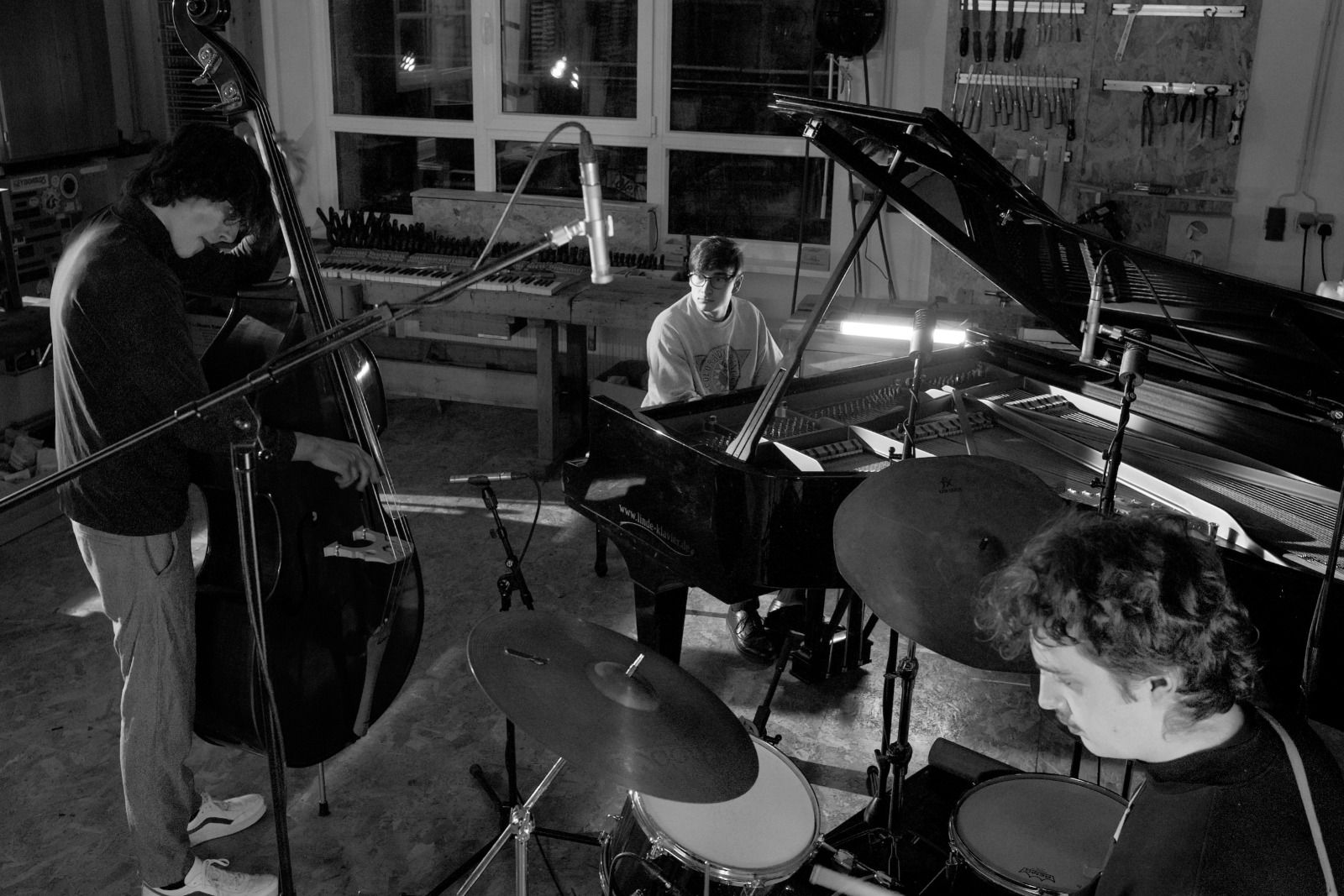
I am still very young and I am influenced by certain biases of what I think something should sound like on a record. Recording my album, I was actually a little bit inside a box – “a grand piano should sound like this” - and also I took the written material very seriously. So that’s now part of the album, the music is very accurately executed.
That’s great, especially for a first album, I think, but when playing live we can take way more freedom when interpreting those pieces. Also we know the material so well now. So we can focus more on the improvisational side and try to play more “through” the composition – to use the composition as a common ground but from which we can go in all sorts of ways. That would be a goal.
Actually we just recorded a concert of our tour featuring Sebastian Gille, where this more bold way of playing could potentially become a recording. So this is an example of how this is very much connected and influenced by each other.
I also enjoy albums a lot that feature a certain “live-aesthetic”, for example The Betrayal by ENEMY.
Improvisation is obviously an essential element of jazz, but I would assume that just like composition, it is transforming. How do you feel has the role of improvisation changed in jazz?
This is impossible to generalize. But I guess in a lot of avantgarde music improvisation and composition are maybe more intertwined. Improvisation becomes an essential part of the composition and aesthetically the both sides (improvisation / composition) are shaping each other.
So maybe in earlier jazz, improvisation was mainly about playing 8th note lines, whereas nowadays it can be any sound, and playing 8th note lines – which I love – becomes just one of many textures that one can choose.
On “Fontainebleau” I try to implement a more textural approach to improvisation.
What, would you say, are the key ideas behind your approach to improvisation?
One part of it is, I would like to be coherent, especially melodically, and use this establishment of narrative to create expectation that I can play with. To me this feels very exciting. I would like my improvisation to surprise. The other part of it is, that I want my improvisation to create an energetic flow, driven by my natural impulsiveness. It just needs to feel good.
And then I also want to create interesting structures and textures that I find compelling. Of course I don’t really think so much about all of these things while playing, that’s more part of the practicing process.
The piano solo on “Regen im Feuerwald” is one that really goes into that direction of creating an energetic drive.
The Montreux Festival intends to preserve its archive of recordings for future generations. Do you personally feel it's important that everything should remain available forever - or is there something to be said for letting beautiful moments pass and linger in the memories of those that experienced them?
I think it is great that they preserve their archives. Imagine how great it would be if we would have more live performance recordings from 80 years ago.
Of course that’s not fair to compare, but what I am saying is that this could be a part of connecting generations. It could help especially musicians in the future to understand the heritage and development of the music better.
From an audience perspective I advocate for the live performance and its memory. This is a beautiful thing.