

Published
Name: Kåre Nordstoga
Nationality: Norwegian
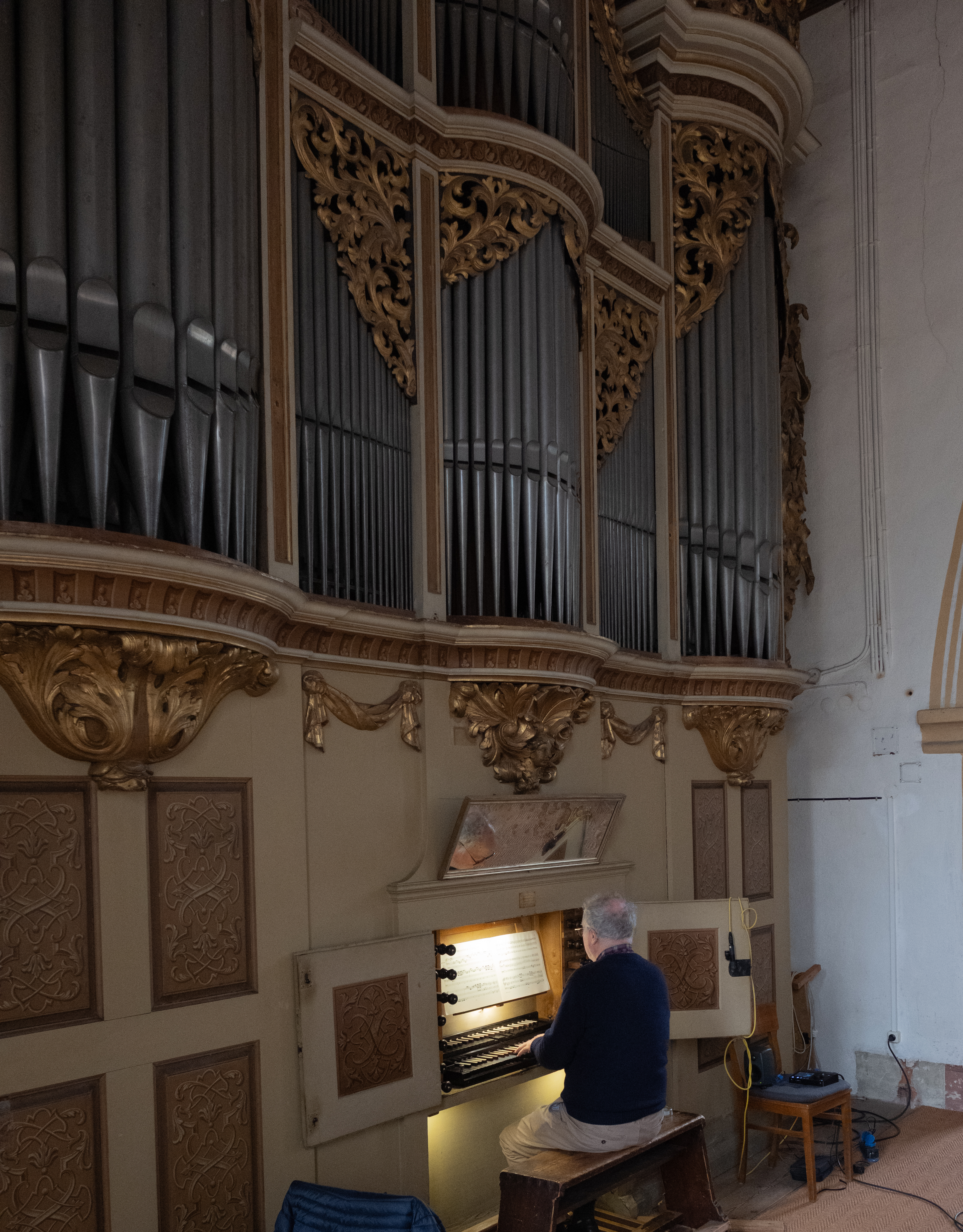
Occupation: Organist
Current release: Kåre Nordstoga's final instalment of J.S. Bach's Organ Works is out October 30th 2026 via LAWO.
Hometown Recommendation: I grew up right near Heddal Stave Church, which is located in the municipality of Notodden. This old church, dating back to the 13th century, is truly worth a visit.
Things that I am passionate about but rarely get to talk about: It is very close to my heart that acoustic music, performed live, remains a genre that survives!
If you enjoyed this Kåre Nordstoga interview and would like to know more about his music and projects, visit him on Facebook.
When did you first start getting interested in musical interpretation?
It was when I got my first stereo system around the age of 12—and started buying LPs—that I realized that one and the same piece, indeed one and the same passage, could be played in vastly different ways.
And, in fact, I became increasingly interested in these differences the smaller they were.
Which artists, approaches, albums or performances captured your imagination in the beginning when it comes to the art of interpretation?
I grew up during Karajan’s heyday, and for a time, his recordings of Beethoven’s Fifth and Ninth symphonies were on my turntable daily.
Then there were the Bach interpretations by Karl Richter, Helmut Walcha, and Jiří Reinberger. I liked the last one best.
Are there examples for interpretations that were entirely surprising to you personally and yet completely convincing?
Like many others, I was, I suppose, enormously fascinated by people like Glenn Gould and Vladimir Horowitz (who wouldn’t be, the first time they hear them?).
My enthusiasm for Gould has waned, but Horowitz has stood the test of time!
What do you personally enjoy about the act of interpretation? Are you finding that this sense of enjoyment is changing over time?
I view the work of interpretation almost as a social endeavor. It is about constantly putting oneself in the listener’s shoes and finding the approaches that resonate in the most meaningful way.
Classical music is a highly structured form, which makes every single detail—details not found in the score, but which the performer has the privilege of contributing—vitally important.
This is the aspect of the musical profession that brings me the greatest joy.
How much creativity is there in the act of interpretation? How much of your own personality enters the process?
I’d say it plays a significant role. One shouldn’t place one’s own personality ahead of the music. Respect for the composition—and, not least, a sense of style—is of the utmost importance.
That said, any good performance relies on both creativity and spontaneity. The latter is perhaps what is most often missing in classical music, but—my goodness—how wonderful it can be when such moments occur.
Could you describe your approach to interpretation on the basis of a piece, live performance or album that's particularly dear to you, please?
Since I play the organ, I am perhaps particularly focused on timing. Timing is, after all, the single most important tool for an organist (and surely for everyone else, too).
There are countless examples of excellent role models. Let me mention my favorite recording of Sibelius’s Second Symphony, featuring Okku Kamu and the Berlin Philharmonic.
The way he times the climaxes surrounding the grand pauses in the second movement is absolutely magical—and unsurpassed.
What was your own learning curve/creative development like when it comes to interpretation - what were challenges and breakthroughs?
Hard to say. I’m not sure if I’ve experienced any real breakthrough, but one thing is certain: I felt somewhat constrained during my student years—perhaps a bit too focused on playing the "right" way for my teacher.
Everything became much more enjoyable once I finished my studies and could take full responsibility for my own interpretations.
In many cases, the score will be the first and foremost resource for an interpretation. Can you explain about how “reading” a score works for you?
For me, reading a score is synonymous with practicing.
An organ piece is often complex, in the sense that it takes a long time just to get the notes in place and flowing correctly. Consequently, the work of addressing questions of interpretation happens intuitively in parallel with practicing technique and coordination. (This can actually be an advantage, compared to a singer or instrumentalist who only has to deal with a single musical line.)
One of the key phrases often used with regards to interpretation are the “composer's intentions”. What is your own perspective on this topic and its relevance for your own interpretations?
I would say that the "composer’s intentions" are certainly important, in the sense that one should not do anything that the composer demonstrably could not have intended. In practical terms, this might apply, for instance, to manual changes, registrations, and the like.
That said, I believe there is a certain degree of leeway, provided one remains within the bounds of appropriate style and taste—though these are, of course, rather vague concepts.
Ultimately, a musician must follow their own intuition; for my part, I am the type of performer who prefers to follow my own convictions rather than trying to determine what might be "correct" through research.
I am infinitely fascinated by radically different or even “wrong” interpretations – the tempi of Toscanini, Kempff's Goldberg Variations. Are there extreme interpretations that you enjoy as well? Do you personally draw a line – and if so, what happens when we cross it?
I completely agree here. Such departures from tradition can produce truly magical moments—think of Richter’s extreme tempos in Schubert’s G major sonata.
In general, I’m in favor of interpretations that step outside the "comfort zone." After all, a problem in classical music is that people play everything far too similarly! That said, I find it difficult to make "breaking the mold" an explicit agenda. But one shouldn't let the opportunity pass by when it arises.
I’ve had many discussions with my students about this. Unfortunately, there are many ways to play "strangely" that simply amount to "bad taste."
When you have the score in front of you, what's your take on taking things literally, correcting possible mistakes, taking into account historical aspects etc?
I try to keep up to date with the best musical editions, but I’m probably not among the most diligent when it comes to examining primary sources.
With regards to the live situation, what role do the audience and the performance space play for your interpretation?
It is of great significance. And this presents a dilemma when it comes to CD recordings made without an audience: one must keep the audience in mind, even though they are not actually present.
I am reminded of my former principal at the Norwegian Academy of Music, Robert Levin, who once put it quite simply in a speech: "If you are going to play music for people, you must know something about the people you are playing for."
Some works seem to attract more artists to add their interpretation to it than others; some seem to even encourage wildly different interpretations. From your experience, what is it about these works that gives them this magnetic pull?
I believe such works possess a special quality—a durability that allows them to remain compelling in various versions.
The material is simply so good that it can be bent in any direction.
Artists can return to a work several times throughout the course of their career, with different results. Tell me about a work where this has been the case for you, please.
When I listen to old recordings of myself, I find many examples of ideas I have abandoned or altered; mostly, though, it’s a matter of having become freer—perhaps a little less hurried …
Part of the intrigue of interpretations is that the process is usually endless. Are there, vice versa, interpretations that feel definitive to you?
Yes, there are several pieces for which I feel I have found a definitive solution—though, of course, this is an illusion.
The pianist Olli Mustonen put it quite bluntly in an interview: "It’s all a paradox; you always play it exactly the way it absolutely *must* be, yet it turns out differently every single time!"