Published
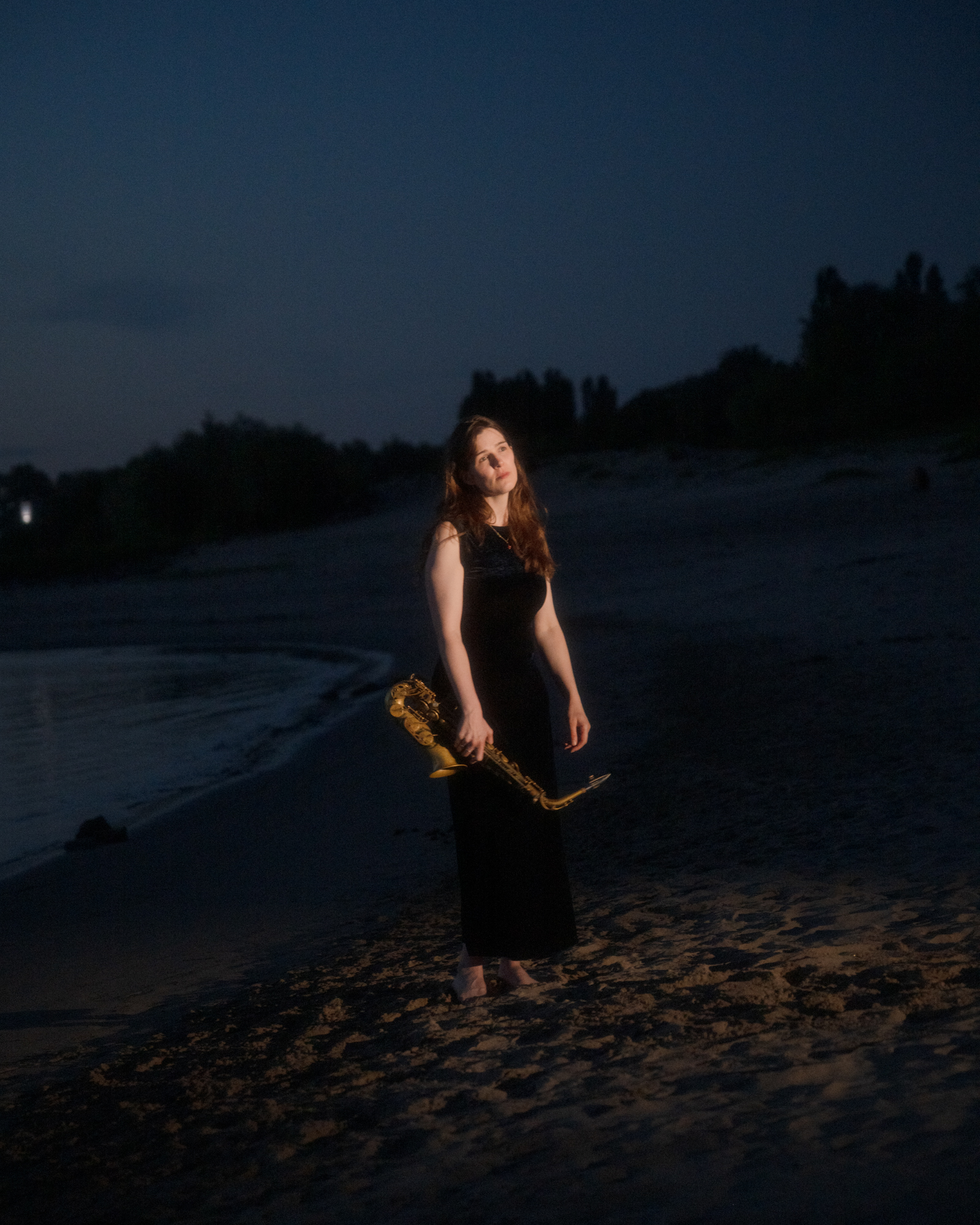
Name: Kika Sprangers
Occupation: Composer, improviser, saxophonist
Nationality: Dutch
Recent release: Kika Sprangers's new album river, river is out November 13th 2026 via Dox.
Hometown Recommendations for Nijmegen, the Netherlands: Go to the riverside of de Waal. Not the one close to the bridge, but a bit further up. It’s beautiful. And Nijmegen is a great city.
If you enjoyed this Kika Sprangers interview and would like to find out more about her work, visit her official homepage. She is also on Instagram, bandcamp, and Facebook.
When the first time you noticed you were drawn to darker themes and moods in music, literature or the movies?
I guess this started already in my childhood. My favorite book series were the Inkheart novels by Cornelia Funke. A story in which a colorful world is described but with a lot of melancholy.
I was drawn to melancholy from a young age. Sad songs, moving movies, touching books. Rather than the happy go lucky stories. I guess a darker theme or mood can be deep and let you feel something.
I am a light hearted person. Not dark in termes of moods of way of thinking I guess. But in music, or in art in general I think the amount of melancholy is limitless. It should be because it doesn’t have to be light or down to earth. In music we can fly and find the magic.
“Darkness” is, of course, not strictly speaking a term related to sound. What constitutes darkness to you, especially in instrumental terms?
Somehow I hear richness when I think about a dark sound. Also in terms of production I like it when a record has an edge and is not sounding perfectly bright. Closeness so that you can here the breaths and air makes it more personal but maybe also darker in a way.
I would say I searched for a dark sound in my saxophone playing. On soprano as well as on the alto. With soprano I think it is not so common to play with a dark sound, since some people think the instrument ask for something different. But I disagree.
How would you describe the physical sensation and possible attraction of being exposed to darkness in music?
It can be deep. And overwhelmingly beautiful. I watch a funny movie to be entertained but I watch a sad film to feel something. To let emotions flow and go there own way.
In music it might be the same for me. I am more attracted to the darkness in music because there is more to feel. You can also experience happiness.
Melancholy can be beautiful and darkness can be uplifting because of the feeling of being alive.
Does your interest in darker musical themes extend into extra-musical fields such as fashion, or politics?
Other than other art forms I don’t think so. Besides music and art I consider myself a down to earth human being that believes nuances can be helpful. Although it is not always easy to find the nuance.
I can be straightforward and outspoken on topics I find important in life but I always fancy the conversation and want to be curious. I wouldn’t consider that as a darker theme. Although we live in a intense and sometimes hard and horrible world, I am still positive and believe in the good side of people.
Fashion wise I am a dark colors lover, yes.
Who/what are currently artists, labels or even genres which draw you in because of their darker approaches, aesthetics and sound(s)?
Artists such as Marina Herlop, Björk, Rosalía, Alabaster Leplume, Blake Mills and Pino Palladino, Elena Pinderhughes, Wayne Shorter, John Coltrane, Ambrose Akinmusire, Erykah Badu draws my attention.
I also like flamenco music and dance. It has a certain urgency of expression. And yes, dark as well.
Other artists that I like listening to and playing with are the musicians of the Norwegian jazz scene. Such as Mette Henrette. I play in a band called Beiggja which I think has a sound on the darker side of the spectrum.
[Read our Marina Herlop interview]
[Read our Alabaster Leplume interview]
What were some of the first performances or releases when you became active in exploring truly dark places in your music yourself?
I guess I was drawn to this way of playing already from an early age with my first band, besides the bright and uplifting jazz tunes we played. I could already feel an audience being drawn into the melancholic sound but as an artist I did not set the tone yet and was exploring the interplay and jazz and pop music in general.
I think you start to hear this darker sound from albums such as Lumen (the title song), No Man’s Land (the song "Terra" for example) and Mind’s Eye ("Mind’s Eye" or "A Picture Paints a Thousand Words").
With Morning by Beiggja and with river, river I have the feeling I deepened this darker sound.
River, river might have a wider range of sound colors but we really made a choice as a band how we want to sound and I followed that way of thinking while constructing the album. Because it is my most personal work to date it has this darkness, melancholy as well as some of the openness and hopeful sound I guess.
I have had a hard time explaining that listening to death metal calms me down. When you're performing a piece with a darker energy, does it tend to fill you with the same energy or feeling – or are there “paradoxical” effects?
Totally, I get that. I think it is because it draws your attention. Or even better, I gets to you on and emotional level. Therefore you are totally into that for some time and not distracted by anything else. Full surrender. That can be extremely calming. It can even overwhelm me.
Sometimes I feel that in music I can really go to that dark place. While in life itself, you can sometimes snap out of it. At least we are all trying to do so. And that is maybe the best thing. To cheer up, be able to feel but think further and live on the bright side of life.
But in music, or art in general, you can go deep, into the unknown, into dark places, wherever it leads you. There it is uncommitted and you can be even shamelessly dramatic. As long as it’s real music, played by people that believe that, honestly, I can have that experience without thinking about it.
The composing process is lonely. In the most positive sense. I can already feel that darkness there already. Like I felt when writing the song ‘dearest’. I remember that moment very well. It was really calming. I forgot about time and place. There was just a song.
Tell me, if applicable, about the concrete lyrical themes that you felt drawn to for river, river.
River, river tells the story of my personal way of life. I was born and raised along the riverside in a Dutch town called Nijmegen. Very comfortable, very warm and with lots of space to create, to think, or to just be.
I was on my own from an early age since I was not really drawn to the way people gather in groups in school, though I have always wanted to be surrounded by people I love. My family walked the forest every week or went to the riverside. I watched the water, attended the build of the bridge, and had my first outside night parties at the river’s beach. Like a river shapes itself from mountain to the sea, my life was shaped along that river.
I have the feeling I learned a lot in life. Sometimes life is a meandering flow, sometimes it heavily swirls, sometimes it adapts, or sometimes not at all. The river keeps on taking shape. I hope I can do the same in life. That I am never done learning, shaping who I am.
When it comes to exploring darker themes, what's your approach to writing lyrics? What makes lyrics good in this regard?
I don't considering myself as a lyricist. Not yet. I have the feeling this might come at some point.
I am drawn to poetry and literature (with a darker mood, such as the books of Griet op den Beeck or the poetry of Vasalis and Rilke) and I write for myself from time to time. But I always have loved the abstraction instrumental music can have. As soon as you put lyrics to it, the listener’s attention goes there.
But for this record, I wanted to have some lyrics. Not a lot, but the music just needed it. Together with producer Mete Erker (saxophonist as well) I decided to put lyrics to "If You Dare." We found the lyrics on a website (all poetry.com). It was a fit.
Good lyrics to me are lyrics that are not too literal, a bit abstract but not too pretentious. What you hear is what you get is something I also really love. It doesn’t have to be difficult. I love the lyrics writing of artists such as Thomas Azier.
It also matters who sings it of course. Nina Simone could sing any lyric to me and I would still feel it.
Tell me about the creative process for river, river, please.
I started writing the songs in 2025. Originally I wanted to explore a more electronic sound field for the band and this album, but when I was writing the music that did not feel right anymore. It evolved into music about me.
Other than my previous albums, where I was inspired by other art forms or phenomenons outside of myself, I felt that this was the time to tell my own story. The river as metaphor for life helped me shape the sound and the music. Having said that, while writing I just try to not think so much about the overall theme. It should come from a right feeling and honest place.
I just followed my own composition process steps guide. I created that one a couple of years ago when I experienced a writer’s block for the first time. After that, my arranging teacher taught me how to avoid a writer’s block by not judging your ideas too soon. The process also includes a day off to be able to walk a bit, feel space and create a clean slate. This creative process was a bit spread out over the year.
My band members and producer Mete Erker helped me to shape the music in a final state. We even shaped a lot in the studio. Lots of it is open for interpretation in the moment.
Exploring darker themes in the music often goes hand in hand with the accompanying artwork. Tell me a bit about this relating to your new release.
The artwork is a photo of my brother and me along the riverside. On the backside of the album I stand in the water as a kid, ambling along with my brother. The picture was taken by my parents (either one of them, we didn’t find out). It was a momentum in the shaping of my life. And a very precious memory.
I was working on the artwork with my mother. (In another life she will be an artist in fine arts.) We had so many other ideas but we stumbled upon this old picture and it just felt right. We found the cover. The design was made with my dear friend Pim. This record became kind of a DIY record. Pim really helped me with putting the artwork together and finalize it.
I would love to know a little about the feedback you've received from listeners or critics about what they thought some of your darker songs are about or the impact it had on them – have there been “misunderstandings” or did you perhaps even gain new “insights?”
I strongly believe anyone should receive music the way they want. Some want to fully understand it, some want to feel it the fullest, some want to just dream away to it.
That last reaction was one of the audience feedbacks I got from playing my music on an outside festival in the dunes. She said ‘hope you don’t mind I was wondering off a bit while listening to your music”. I found it funny and totally okay of course. With instrumental music or abstract music it really depends on the listener’s imagination how it is received. I think that’s beautiful.
I even dedicated the album Mind’s Eye to the human skill to imagine. For my debut album I wrote and played music based on different human characters. After playing it live with visuals of those characters (photo exhibition and video) I had some conflicting reactions of the audiences that said they thought person A fit song B better than song A. Great! I love those reactions. It makes the music come to life.
Besides that I strongly believe that the way I expose the music will always be through my colored class of my emotional world. The listener is free to feel or receive the music in their own way.
Sharing music on stage can change the way it is experienced, both for musicians the listeners. Can you talk about this a bit, especially in the light of darker themes?
For me it is all about live music. It’s a such a beautiful thing to be able to create something in the moment. All elements in that exact moment might be equally important: the atmosphere, the sound, the fellow musicians, the audience, etcetera. If all those elements are working together, music can create something spiritual.
It think this is the most beautiful thing there is. It is not something that happens regularly. Since there are many elements you can’t control, and even if you can, it isn’t easy to control them without thinking.
But the phenomenon itself it so strong that I could even live with only thriving to come close to that experience.
Throughout the history of art, there have been artists who did not want to exorcise their demons, afraid they might lose their creative spark. What's your take on that?
Wow, well, that’s a huge question. I guess I cannot deal or be something else than I am now as an artist. In music, it just is, and for me the most beautiful feeling and experience is to be free.
Therefore I have to deal with any hiccups, or things that are bothering me. This can be my saxophone technique, my mental saneness, my composing skills. I try to improve all of them to be able to let go more.
Demons might pass by, but that’s fine. It can be rough, but it is not bad at all. As long as I can be free in music and my listeners could experience the same.