Published
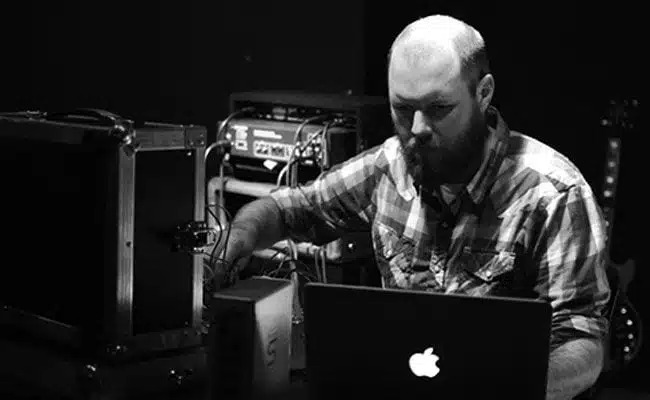
Name: Koen Holtkamp
Nationality: Dutch, NYC-based
Occupation: Sound artist, composer, producer, visual artist
Current release: Koen Holtkamp's new album Nightlife, featuring contributions by Matt Bauder, Greg Fox and Ben Vida is out via Western Vinyl.
[Read our Ben Vida interview]
[Read our Greg Fox interview]
If you enjoyed this Koen Holtkamp interview and would like to know more about his music and upcoming gigs, visit him on Instagram, and bandcamp.
For a deeper dive, read our earlier Koen Holtkamp interview.
If I understood correctly, you were more active in film and video before turning towards sound. What was this phase of transition like and how did you and Brandan get together and found the label?
Brendon and I became friends in middle school mostly via skateboarding and music and then ended up going to the School of the Art Institute of Chicago at the same time. I was initially studying film and he was focused on painting but we both quickly gravitated to the sound dept.
While I did most of the day to day work, apestaartje was conceived as a collective with the two of us and a few other folks the year before we graduated. We spent a lot of time hanging out, listening and critiquing each other’s work.
At a certain point I was really taken with a piece he’d composed largely out of processed acoustic guitar so I suggested we release a 3” compilation featuring all of our work because I liked the format but also because they were short in length and relatively cheap to press. So we pooled our resources and went for it.
All the covers were handmade with archival graph paper I found in a junk shop and stamps. I sent one to Forced Exposure and I was pleasantly surprised when they responded with an order.
As a Dutch native speaker myself, I was always curious about the name of the label. Was the term Apestaartje (@) a response to technology that felt more optimistic and inviting than dark and dystopian?
Without going deep into the world we are currently living in, yes times felt quite different then.
It was pretty simple, @ being a location for something a label being a space for artists. I wanted to give a nod to my background and I also appreciated that it would seem somewhat abstract to the rest of the mostly non Dutch speaking world.
But it was actually a quite simple, playful and even cute name for a label putting out somewhat experimental music.
From over here in Europe, the wealth of great music coming from Chicago from the 80s onwards, from house via post rock to experimental sounds was impressive. How did you experience the scene at the time yourself? What other local artists were you in touch with?
I'm eternally grateful to have experienced the Chicago music scene in the late 90s.
It was such a vibrant and accessible scene with so much cross pollination style wise. On top of a wealth of the amazing local folks there was always a steady stream of artists particularly from Europe and Japan coming through at the time and the jazz and improv scene was having a really special moment thanks to the artists but also key organizers like John Corbett.
I was at art school then and most of my work was more studio based rather than performative. So while I would go see music several nights a week at that point I was taking it in and learning more as a spectator rather than a participant.
You could see Kevin Drumm play prepared guitar with Taku Sugimoto in the basement of Myopic bookstore one evening then catch Milford Graves at the Empty Bottle the next, then an evening of Kagel pieces at the Renaissance Society or Jim O’Rourke jamming with the Mego crew or Fred Anderson playing with Hamid Drake at the Velvet Lounge.
[Read our Jim O’Rourke interview]
There were several great shows on a weekly basis and generally I was either in the studio working inspired by everything I was taking in or going out to see music.
There were a lot of references to the visual arts in early apestaartje releases, from working with film samples on Re: Martin Arnold 'Alone, Life Wastes Andy Hardy' to the title of Kleur en motief. How closely were these art forms related in those releases and your own work?
My early background was in experimental film and stop motion animation and this is what I initially went to school for. At a certain point I started making soundtracks for the films and then gradually sound sort of took over.
I still work with video and projections regularly as well as some sculptural projects and visual art is a great inspiration to me but music has mostly been at the forefront in terms of my output. There are times when I don’t work with sound for months and just focus on visual work.
I enjoy the back and forth and find that taking a break from one discipline helps me come back fresh later on.
The Mountains s/t came out in 2005, quite a while after you had founded apestaartje. What do you still remember about recording that debut album?
I remember the time more than the actual recording as it was done gradually over a year or so.
We recorded it in Brendon’s apartment which at the time was just a big open space in Brooklyn with some minor acoustic treatment but very much not a studio. We were young with few resources and lots of ideas and we could basically work whenever we wanted so it was an ideal way to experiment.
From a production standpoint it was limited but this also forced us to experiment and come up with different ways to work like putting a mic on a spinning fan to create a Doppler effect.
We had done a European tour with Sebastien Roux as three separate solo acts a bit before starting to work on a recording together and our solo sets quickly turned into longer duo sets which was essentially the informal beginning of Mountains.
It's quite fascinating to think that this soft music often made with personal sounds suddenly become so exciting on a global scale. What drew you to it back then and do you have an explanation for its impact?
A lot of it came from what we were listening to.
The Mego and Touch labels felt really unique to me in the late 90s and early 2000s but I was also going to see a lot of improvised music, discovering British folk and private press guitar soli records as well as things like the Lovely Music and Table Of The Elements catalog.
Folks like Berhard Guenter, Francisco Lopez, Folke Rabe and Eliane Radigue really tuned me into hyper detailed listening.
[Read our Francisco Lopez interview]
There were great, unexpected pieces on Sewn (“Hundred Acre”!) but it seems like you really found your voice on Choral. What was your approach like around that release?
In between those releases Brendon went to study audio engineering in Arizona for a few months and I started to get back into working solo mainly out of necessity which kind of made me hone my acoustic guitar chops a bit.
Thrill Jockey had reached out after Sewn just sort of inquiring what our future plans were which was exciting as we were very much inspired by Oval and particularly Microstoria early on. Brendon set up a makeshift studio in his apt when he got back and we spent a year slowly working on what became Choral.
Previously the set up was predominantly acoustic guitars, objects, laptops and pedals but by the time we were working on Choral more synths started to get involved as well.
Having gotten to know each other musically over a number of years we had a greater understanding of what we wanted to do as a duo and also a better handle on production.
At the time it felt like I was half running the label and half doing the band which was becoming more active performance wise on top of day jobs so I decided to fully commit myself to one of these endeavors. I chose the band so that was effectively around when apestaartje ended.
I just did an interview with Lusine and he singled out Mountains as a major influence on his work. He told me that after being exposed to your music, his approach became all about “trying to incorporate acoustic instruments, really spreading out my progressions, allowing all of the dirt and nastiness to affect the sound. But, also making sure that there is an overall warmth to the sound.” Is that a response you can recognise your creative goals in?
That’s very cool to hear. I should spend some more time with their work.
The warmth and handmade quality was and is always important to us. I started playing acoustic guitar because at a certain point I realized I had more acoustic guitar records then anything else and that warm naturally resonant sound of a string ringing in the wooden body of the guitar really drew me in.
I’ve never been interested in being a guitar player. For me it was more about that sound.
The early Mountains albums made a lot of use of field recordings, gradually patterns and loops became more important. Do you see this as a change in direction or are there overlaps, creatively?
It all overlaps. There were a lot of field recordings on Sewn, mostly binaural recordings I made of water that kind of flow through the album. After that we used them more sparingly as we didn’t want to repeat ourselves but there's field recordings on the records after that as well.
In contrast to the previous albums, Choral and all the Mountains albums that followed were made from pieces that were developed live first so some of the emphasis on looping gradual patterns comes out of the process of how we worked with loopers to create a continuous evolving sound.
For your work, does it matter “when and where one enters it” in the sense of a narrative that needs to be followed from beginning to end?
Not to me. When I make an album I want it to be able to exist as a stand alone listening experience .
But there's a lot of connections within the works so if someone takes the time to dig a little deeper and explore the discography I would hope it illustrates a bigger picture .
John Luther Adams once said: “The density of tones and the tempo relationships between the different layers of the music give shape to the colors.” Is that something you can relate to?
I appreciate the sentiment but it’s not necessarily how I would frame it.
I tend to see sound in more three dimensional sculptural terms.